
Pulp Fiction, 1920 · page 101 of 164
Argosy, Vol. 122, No. 1 — page 101: what you’re looking at
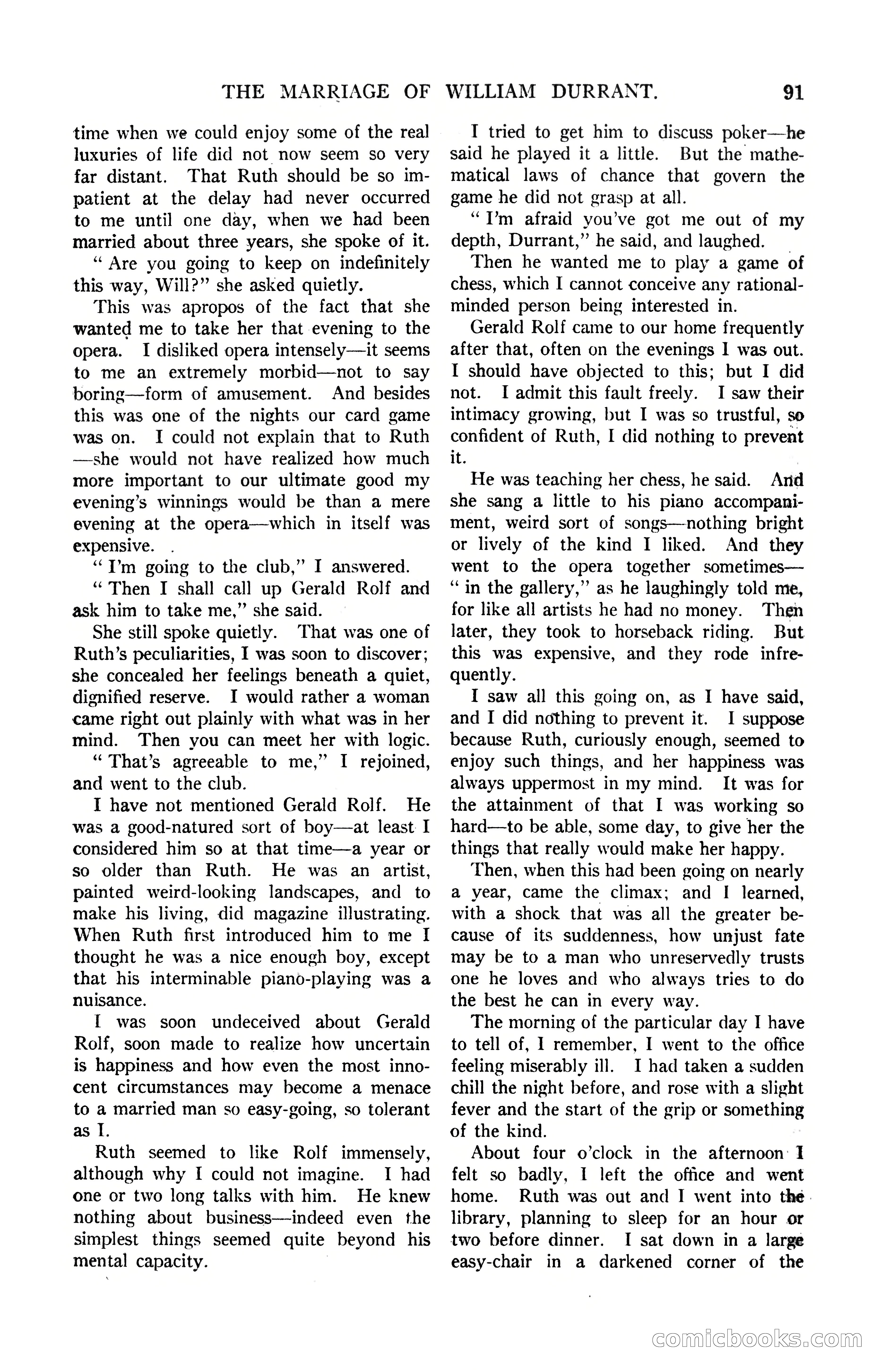
A restored page from Pulp Fiction, 1920. Page through the whole issue in the reader above.
📄 Transcribed text from this page (OCR, searchable)
Machine-transcribed from the original scan — historical spelling and the odd misread are preserved.
THE MARRIAGE OF time when we could enjoy some of the real luxuries of life did not now seem so very far distant. That Ruth should be so im- patient at the delay had never occurred to me until one day, when we had been married about three years, she spoke of it. “Are you going to keep on indefinitely this way, Will?” she asked quietly. This was apropos of the fact that she wanted me to take her that evening to the opera. I disliked opera intensely—it seems to me an extremely morbid—not to say boring—form of amusement. And besides this was one of the nights our card game was on. I could not explain that to Ruth —she would not have realized how much more important to our ultimate good my evening’s winnings would be than a mere evening at the opera—which in itself was expensive. “I’m going to the club,” I answered. ‘“‘Then I shall call up Gerald Rolf and ask him to take me,” she said. She still spoke quietly. That was one of Ruth’s peculiarities, I was soon to discover; she concealed her feelings beneath a quiet, dignified reserve. I would rather a woman came right out plainly with what was in her mind. Then you can meet her with logic. ‘“‘ That’s agreeable to me,” I rejoined, and went to the club. I have not mentioned Gerald Rolf. He was a good-natured sort of boy—at least: I considered him so at that time—a year or so older than Ruth. He was an artist, painted weird-looking landscapes, and to make his living, did magazine illustrating. When Ruth first introduced him to me I thought he was a nice enough boy, except that his interminable piano-playing was a nuisance. [I was soon undeceived about Gerald Rolf, soon made to realize how uncertain is happiness and how even the most inno- cent circumstances may become a menace to a married man so easy-going, so tolerant as I. Ruth seemed to like Rolf immensely, although why I could not imagine. I had one or two long talks with him. He knew nothing about business—-indeed even the simplest things seemed quite beyond his mental capacity. | WILLIAM DURRANT. 91 IT tried to get him to discuss poker—he said he played it a little. But the mathe- matical laws of chance that govern the game he did not grasp at all. ‘Tm afraid you’ve got me out of my depth, Durrant,” he said, and laughed. | Then he wanted me to play a game of chess, which I cannot conceive any rational- minded person being interested in. Gerald Rolf came to our home frequently after that, often on the evenings I was out. I should have objected to this; but I did not. I admit this fault freely. I saw their intimacy growing, but I was so trustful, so confident of Ruth, I did nothing to prevent it. He was teaching her chess, he said. And She sang a little to his piano accompani- ment, weird sort of songs—nothing bright or lively of the kind I liked. And they went to the opera together sometimes— ‘in the gallery,” as he laughingly told me, for like all artists he had no money. Then later, they took to horseback riding. But this was expensive, and they rode infre- quently. I saw all this going on, as I have said, and I did nothing to prevent it. I suppose because Ruth, curiously enough, seemed to enjoy such things, and her happiness was always uppermost in my mind. It was for the attainment of that I was working so hard—to be able, some day, to give her the things that really would make her happy. Then, when this had been going on nearly a year, came the climax; and I learned, with a shock that was all the greater be- cause of its suddenness, how unjust fate may be to a man who unreservedly trusts one he loves and who always tries to do the best he can in every way. The morning of the particular day I have to tell of, 1 remember, I went to the office feeling miserably ill. I had taken a sudden chill the night before, and rose with a slight fever and the start of the grip or something of the kind. About four o’clock in the afternoon: I felt so badly, I left the office and went home. Ruth was out and I went into the. library, planning to sleep for an hour or two before dinner. I sat down in a large easy-chair in a darkened corner of the cComiclbooks.com