
Pulp Fiction, 1920 · page 100 of 164
Argosy, Vol. 122, No. 1 — page 100: what you’re looking at
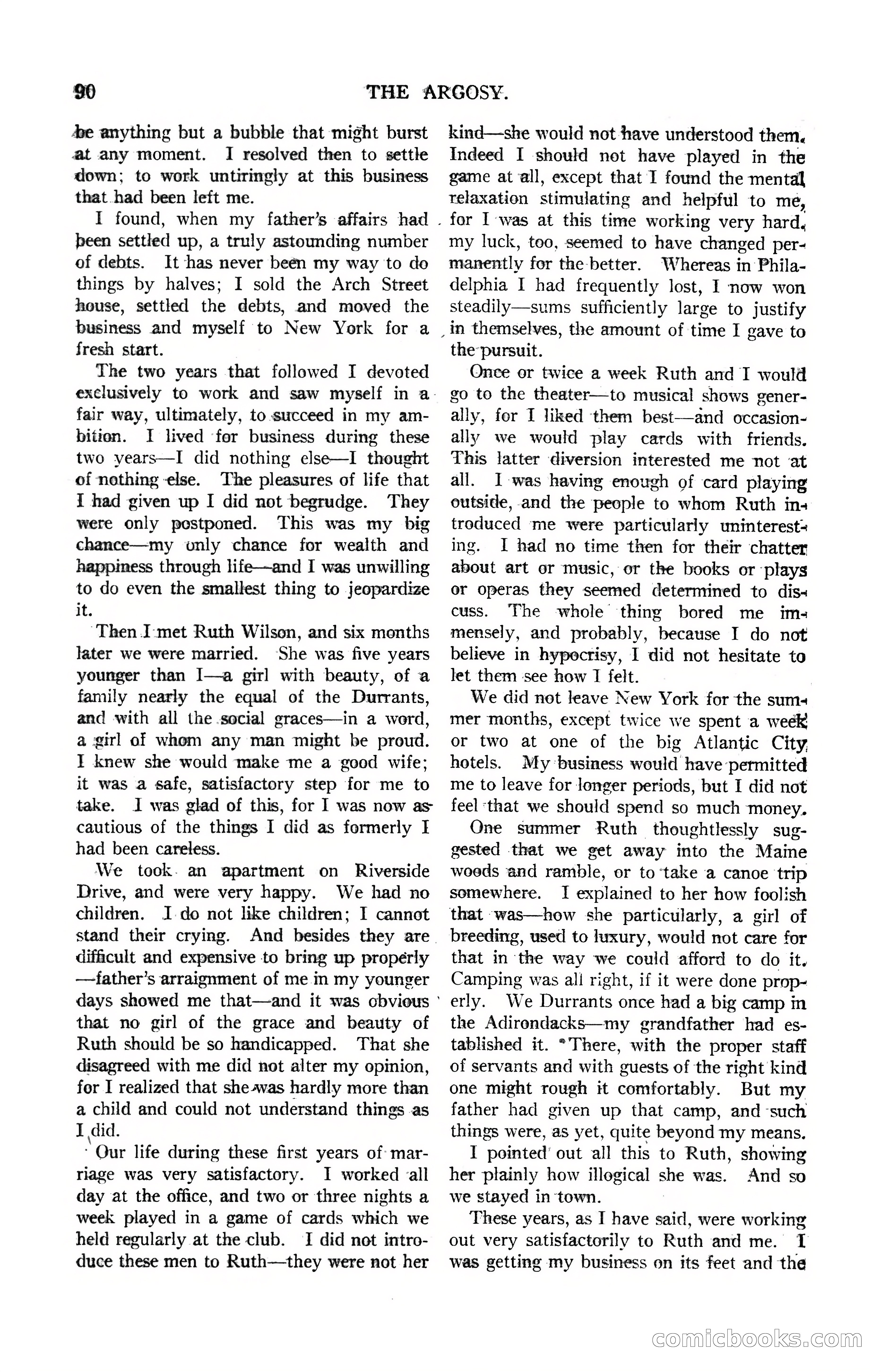
A restored page from Pulp Fiction, 1920. Page through the whole issue in the reader above.
📄 Transcribed text from this page (OCR, searchable)
Machine-transcribed from the original scan — historical spelling and the odd misread are preserved.
‘$0 4se anything but a bubble that might burst at any moment. I resolved then to settle down; to work untiringly at this business that .had been left me. I found, when my father’s affairs had been settled up, a truly astounding number of debts. It has never been my way to do things by halves; I sold the Arch Street house, settled the debts, and moved the business and myself to New York for a fresh start. The two years that followed I devoted exclusively to work and saw myself in a- fair way, ultimately, to succeed in my am- bition. I lived for business during these two years—I did nothing else—I thought of nothing else. The pleasures of life that I had given up I did not begrudge. They were only postponed. This was my big chance—my only chance for wealth and happiness through life—and I was unwilling to do even the smallest thing to jeopardize it. Then .I-met Ruth Wilson, and six months later we were married. She was five years younger than I—a girl with beauty, of a family nearly the equal of the Durrants, and with all the social graces—in a word, a girl of whom any man might be proud. I knew she would make me a good wife; it was a safe, satisfactory step for me to take. IJ was glad of this, for I was now as cautious of the things I did as formerly I had been careless. We took. an apartment on Riverside Drive, and were very happy. We had no children. I-do not like children; I cannot stand their crying. And besides they are. difficult and expensive to bring up properly —father’s arraignment of me m my younger days showed me that—and it was obvious ' that no girl of the grace and beauty of Ruth should be so handicapped. That she disagreed with me did not alter my opinion, for I realized that she~vas hardly more than a child and could not understand things as I did. ‘ Our life during these first years of: mar- riage was very satisfactory. I worked all day at the office, and two or three nights a week played in a game of cards which we held regularly at the club. I did not intro- duce these men to Ruth—they were not her THE ARGOSY. kind—she would not have understood them. Indeed I should not have played in the game at all, except that I found the mental relaxation stimulating and helpful to me, . for Iwas at this time working very hard, my luck, too, seemed to have changed per- manently for the better. Whereas in Phila- delphia I had frequently lost, I now won steadily—sums sufficiently large to justify _in themselves, the amount of time I gave to the-pursuit. Once or twice a week Ruth and I would go to the theater—to musical shows gener- ally, for I liked them best—and occasion- ally we would play cards with friends. This latter diversion interested me not ‘at all. I-was having enough of card playing outside, and the people to whom Ruth in- troduced me were particularly uminterest= ing. I had no time then for their chatter about art or music, or the books or plays or operas they seemed determined to dis- cuss. The whole thing bored me ims mensely, and probably, because I do not believe in hypocrisy, I did not hesitate to let them see how I felt. | We did not leave New York for the sum- mer months, except twice we spent a week or two at one of the big Atlantic City, hotels. My business would have permitted me to leave for longer periods, but I did not feel that we should spend so much money. One summer Ruth thoughtlessly sug- gested that we get away into the Maine woeds and ramble, or to ‘take a canoe trip somewhere. I explained to her how foolish that -was—how she particularly, a girl of breeding, used to luxury, would not care for that in the way we could afford to do it. Camping was all right, if it were done prop~ erly. We Durrants once had a big camp in the Adirondacks—my grandfather had es- tablished it. ° There, with the proper staff of servants and with guests of the right kind one might rough it comfortably. But my father had given up that camp, and -such things were, as yet, quite beyond my means. I pointed’ out all this to Ruth, showing her plainly how illogical she was. And so we stayed in ‘town. These years, as I have said, were working out very satisfactorily to Ruth and me. I was getting my business on its feet and the cComiclbooks.com