
Pulp Fiction, 1920 · page 72 of 180
Argosy, Vol. 118, No. 4 — page 72: what you’re looking at
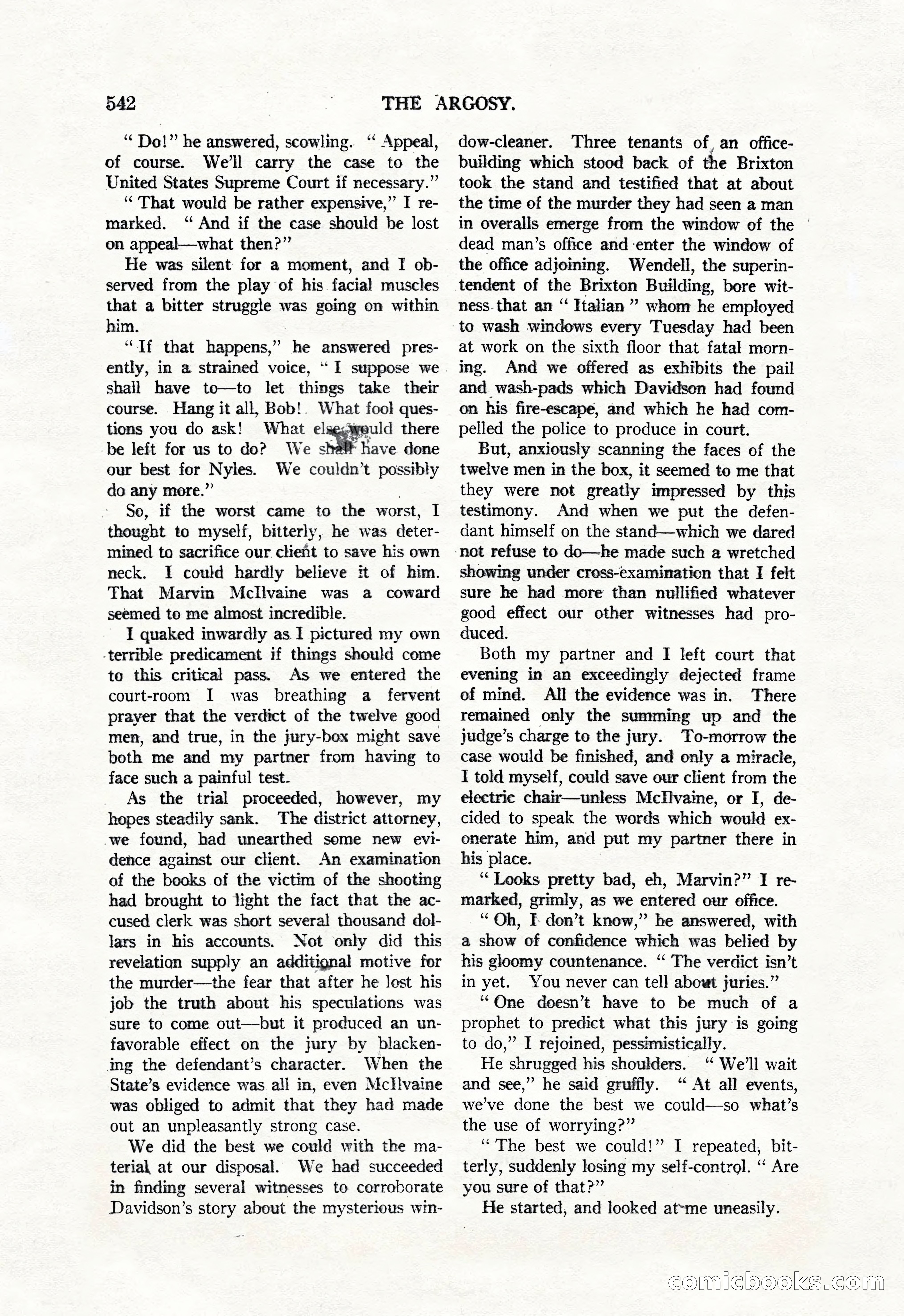
A restored page from Pulp Fiction, 1920. Page through the whole issue in the reader above.
📄 Transcribed text from this page (OCR, searchable)
Machine-transcribed from the original scan — historical spelling and the odd misread are preserved.
542 “Do!” he answered, scowling. “ Appeal, of course. We'll carry the case to the United States Supreme Court if necessary.”’ ‘That would be rather expensive,”’ I re- marked. “ And if the case should be lost on appeal—what then?” He was silent for a moment, and I ob- served from the play of his facial muscles that a bitter struggle was going on within him. ‘““If that happens,” he answered pres- ently, in a strained voice, “ I suppose we . shall have to—to let things take their course. Hang it all, Bob!. What foot ques- tions you do ask! What elsegweuld there be left for us to do? We shalt have done our best for Nyles. We couldn’t possibly do any more.”’ oe So, if the worst came to the worst, I thought to myself, bitterly, he was deter- mined to sacrifice our cent to save his own neck. I could hardly believe it of him. That Marvm Mclivaine was a coward seemed to me almost incredible. I quaked inwardly as. 1 pictured my own -terrible predicament if things should come to this critical pass. As we entered the court-room I was breathing a_ fervent prayer that the verdict of the twelve good men, and true, in the jury-box might save both me and my partner from having to face such a painful test- As the trial proceeded, however, my hopes steadily sank. The district attorney, we found, had unearthed some new evi- dence against our client. An examination of the books of the victim of the shooting had brought to light the fact that the ac- cused clerk was short several thousand dol- lars in his accounts. Not only did this revelation supply an additignal motive for the murder—the fear that after he lost his job the truth about his speculations was sure to come out—but it produced an un- favorable effect on the jury by blacken- ing the defendant’s character. When the State’s evidence was all in, even Mclivaine was obliged to admit that they had made out an unpleasantly strong case. We did the best we could with the ma- terial at our disposal. We had succeeded in finding several witnesses to corroborate Davidson’s story about the mysterious win- THE ARGOSY. dow-cleaner. Three tenants of, an office- building which stood back of the Brixton took the stand and testified that at about the time of the murder they had seen a man in overalls emerge from the window of the | dead man’s office and enter the window of the office adjoining. Wendell, the superin- tendent of the Brixton Building, bore wit- ness. that an “‘ Italian” whom he employed to wash windows every Tuesday had been at work on the sixth floor that fatal morn- ing. And we offered as exhibits the pail and wash-pads which Davidson had found on his fire-escape, and which he had com- pelled the police to produce in court. But, anxiously scanning the faces of the twelve men in the box, it seemed to me that they were not greatly impressed by this testimony. And when we put the defen- dant himself on the stand—which we dared ‘not refuse to do—he made such a wretched showing under cross-examination that I felt sure he had more than nullified whatever good effect our other witnesses had pro- duced. Both my partner and I left court that evening in an exceedingly dejected frame of mind. All the evidence was in. There remained only the summing up and the judge’s charge to the jury. To-morrow the case would be finished, and only a miracle, I told myself, could save our client from the electric chair—unless McIlvaine, or I, de- cided to speak the words which would ex- onerate him, and put my partner there in his place. ‘“Looks pretty bad, eh, Marvin?” I re- marked, grimly, as we entered our office. ‘Oh, I. don’t know,” he answered, with a show of confidence which was belied by his gloomy countenance. ‘“ The verdict isn’t in yet. You never can tell abowt juries.” “One doesn’t have to be much of a prophet to predict what this jury is going to do,” I rejoined, pessimistically. He shrugged his shoulders. “ We'll wait and see,” he said gruffly. ‘“ At all events, we’ve done the best we could—so what’s the use of worrying?” ‘The best we could!” I repeated, bit- terly, suddenly losing my self-control. “‘ Are you sure of that?” He started, and looked at-me uneasily. CO DOO SJ (C(O)