
Pulp Fiction, 1920 · page 71 of 180
Argosy, Vol. 118, No. 4 — page 71: what you’re looking at
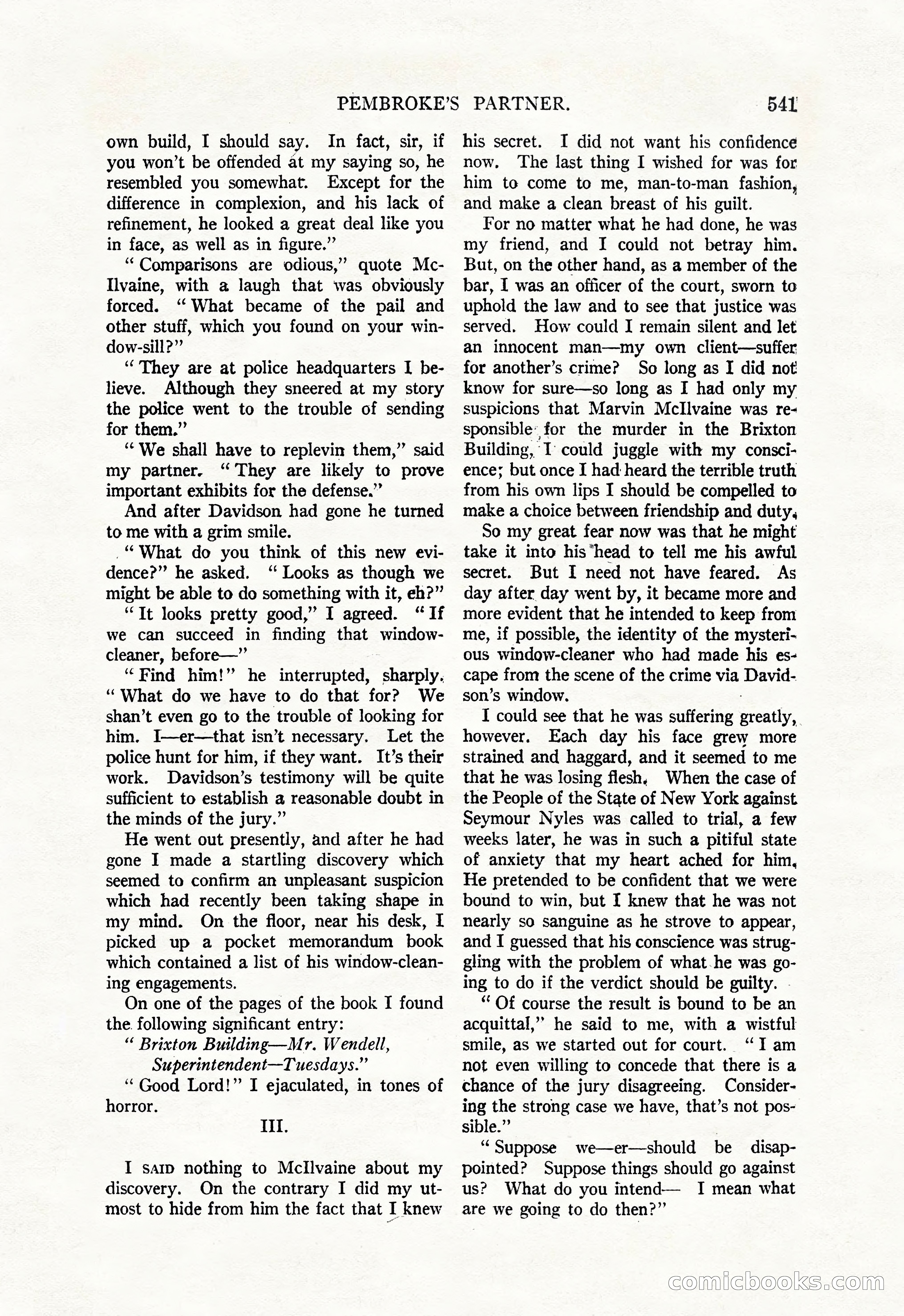
A restored page from Pulp Fiction, 1920. Page through the whole issue in the reader above.
📄 Transcribed text from this page (OCR, searchable)
Machine-transcribed from the original scan — historical spelling and the odd misread are preserved.
PEMBROKE’S PARTNER. own build, I should say. In fact, sir, if you won’t be offended at my saying so, he resembled you somewhat. Except for the difference in complexion, and his lack of refinement, he looked a great deal like you in face, as well as in figure.” ‘“‘ Comparisons are odious,” quote Mc- Ilvaine, with a laugh that was obviously forced. ‘‘ What became of the pail and other stuff, which you found on your win- dow-sill?”’ ‘They are at police headquarters I be- lieve. Although they sneered at my story the police went to the trouble of sending for them.” “We shall have to replevin them,” said my partner. ‘“‘ They are likely to prove important exhibits for the defense.” And after Davidson had gone he turned to me with a grim smile. .“ What do you think of this new evi- dence?” he asked. ‘“ Looks as though we might be able to do something with it, eh?” “It looks pretty good,” I agreed. “If we can succeed in finding that window- cleaner, before—”’ ‘Find him!” he interrupted, sharply. ‘What do we have to do that for? We shan’t even go to the trouble of looking for him. I—er—that isn’t necessary. Let the police hunt for him, if they want. It’s their work. Davidson’s testimony will be quite sufficient to establish a reasonable doubt in the minds of the jury.” He went out presently, and after he had gone I made a startling discovery which seemed to confirm an unpleasant suspicion which had recently been taking shape in my mind. On the floor, near his desk, I picked up a pocket memorandum book which contained a list of his window-clean- ing engagements. On one of the pages of the book I found the. following significant entry: “ Brixton Building—Mr. Wendell, Superintendent—T uesdays.” “Good Lord!” I ejaculated, in tones of horror. Til. I sarp nothing to Mcllvaine about my discovery. On the contrary I did my ut- most to hide from him the fact that i knew 541 his secret. I did not want his confidence now. The last thing I wished for was for him to come to me, man-to-man fashion, and make a clean breast of his guilt. For no matter what he had done, he was my friend, and I could not betray him. But, on the other hand, as a member of the bar, I was an officer of the court, sworn to uphold the law and to see that justice was served. How could I remain silent and let an innocent man—my own client—suffer for another’s crime? So long as I did not know for sure—so long as I had only my suspicions that Marvin Mcllvaine was re- sponsible’ for the murder in the Brixton Building, I could juggle with my consci- ence; but once I had heard the terrible truth from his own lips I should be compelled to make a choice between friendship and duty, So my great fear now was that he might take it into his “head to tell me his awful secret. But I need not have feared. As day after day went by, it became more and more evident that he intended to keep from me, if possible, the identity of the mysteri- ous window-cleaner who had made his es- cape from the scene of the crime via David- son’s window. ; I could see that he was suffering greatly, however. Each day his face grew more strained and haggard, and it seemed to me that he was losing flesh, When the case of the People of the State of New York against Seymour Nyles was called to trial, a few weeks later, he was in such a pitiful state of anxiety that my heart ached for him, He pretended to be confident that we were bound to win, but I knew that he was not nearly so sanguine as he strove to appear, and I guessed that his conscience was strug- gling with the problem of what.he was go- ing to do if the verdict should be guilty. - “ Of course the result is bound to be an acquittal,” he said to me, with a wistful smile, as we started out for court. “I am not even willing to concede that there is a chance of the jury disagreeing. Consider- ing the strong case we have, that’s not pos- sible.” : “‘ Suppose we—er—should be disap- pointed? Suppose things should go against us? What do you intend— I mean what are we going to do then?” nn (S| QO) DOOK