
Pulp Fiction, 1920 · page 59 of 180
Argosy, Vol. 118, No. 4 — page 59: what you’re looking at
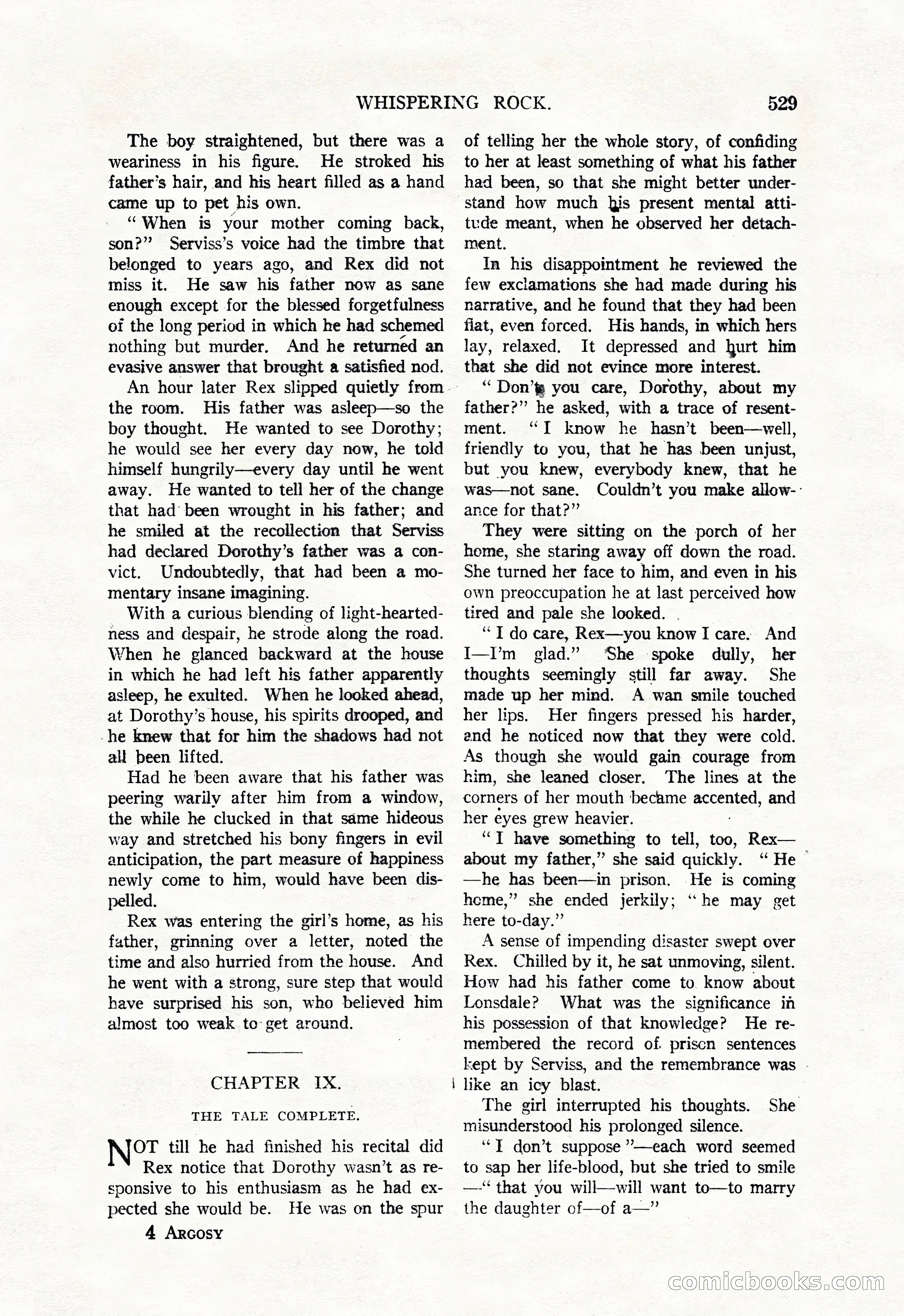
A restored page from Pulp Fiction, 1920. Page through the whole issue in the reader above.
📄 Transcribed text from this page (OCR, searchable)
Machine-transcribed from the original scan — historical spelling and the odd misread are preserved.
WHISPERING ROCK. The boy straightened, but there was a weariness in his figure. He stroked his father’s hair, and his heart filled as a hand came up to pet his own. “When is your mother coming back, son?” Serviss’s voice had the timbre that belonged to years ago, and Rex did not miss it. He saw his father now as sane enough except for the blessed forgetfulness of the long period in which he had schemed nothing but murder. And he returned an evasive answer that brought a satisfied nod. An hour later Rex slipped quietly from -- the room. His father was asleep—so the boy thought. He wanted to see Dorothy; he would see her every day now, he told himself hungrily—every day until he went away. He wanted to tell her of the change that had been wrought in his father; and he smiled at the recollection that Serviss had declared Dorothy’s father was a con- vict. Undoubtedly, that had been a mo- mentary insane imagining. With a curious blending of light-hearted- ness and despair, he strode along the road. When he glanced backward at the house in which he had left his father apparently asleep, he exulted. When he looked ahead, at Dorothy’s house, his spirits drooped, and -he knew that for him the shadows had not all been lifted. Had he been aware that his father was peering warily after him from a window, the while he clucked in that same hideous way and stretched his bony fingers in evil anticipation, the part measure of happiness newly come to him, would have been dis- pelled. Rex was entering the girl’s home, as his father, grinning over a letter, noted the time and also hurried from the house. And he went with a strong, sure step that would have surprised his son, who believed him almost too weak to get around. CHAPTER IX. THE TALE COMPLETE. OT till he had finished his recital did Rex notice that Dorothy wasn’t as re- sponsive to his enthusiasm as he had ex- pected she would be. He was on the spur 4 Arcosy — 529 of telling her the whole story, of confiding to her at least something of what his father had been, so that she might better under- stand how much gis present mental atti- tude meant, when he observed her détach- ment. In his disappointment he reviewed the few exclamations she had made during his narrative, and he found that they had been fiat, even forced. His hands, in which hers lay, relaxed. It depressed and hurt him that she did not evince more interest. ‘Don’ you care, Dorothy, about my father?” he asked, with a trace of resent- ment. ‘I know he hasn’t been—vwell, friendly to you, that he has been unjust, but you knew, everybody knew, that he Wwas—not sane. ance for that?” They were sitting on the porch of her home, she staring away off down the road. She turned her face to him, and even in his own preoccupation he at last perceived how tired and pale she looked. ‘““T do care, Rex—you know I care. And I—I’m_ glad.” ‘She spoke dully, her thoughts seemingly still far away. She made up her mind. A wan smile touched her lips. Her fingers pressed his harder, and he noticed now that they were cold. As though she would gain courage from him, she leaned closer. ‘The lines at the corners of her mouth became accented, and her eyes grew heavier. “TI have something to tell, too, Rex— about my father,” she said quickly. —he has been—in prison. He is coming heme,” she ended jerkily; ‘“‘ he may get here to-day.” A sense of impending disaster swept over Rex. Chilled by it, he sat unmoving, silent. How had his father come to know about Lonsdale? What was the significance in his possession of that knowledge? He re- membered the record of. priscn sentences Couldn’t you make allow-- “He - kept by Serviss, and the remembrance was - like an icy blast. The girl interrupted his thoughts. misunderstood his prolonged silence. ‘“T don’t suppose ”’—each word seemed to sap her life-blood, but she tried to smile —‘ that you will—will want to—to marry the daughter of—of a—” She NOOO (C(O) S (C(O)