
Pulp Fiction, 1920 · page 58 of 180
Argosy, Vol. 118, No. 4 — page 58: what you’re looking at
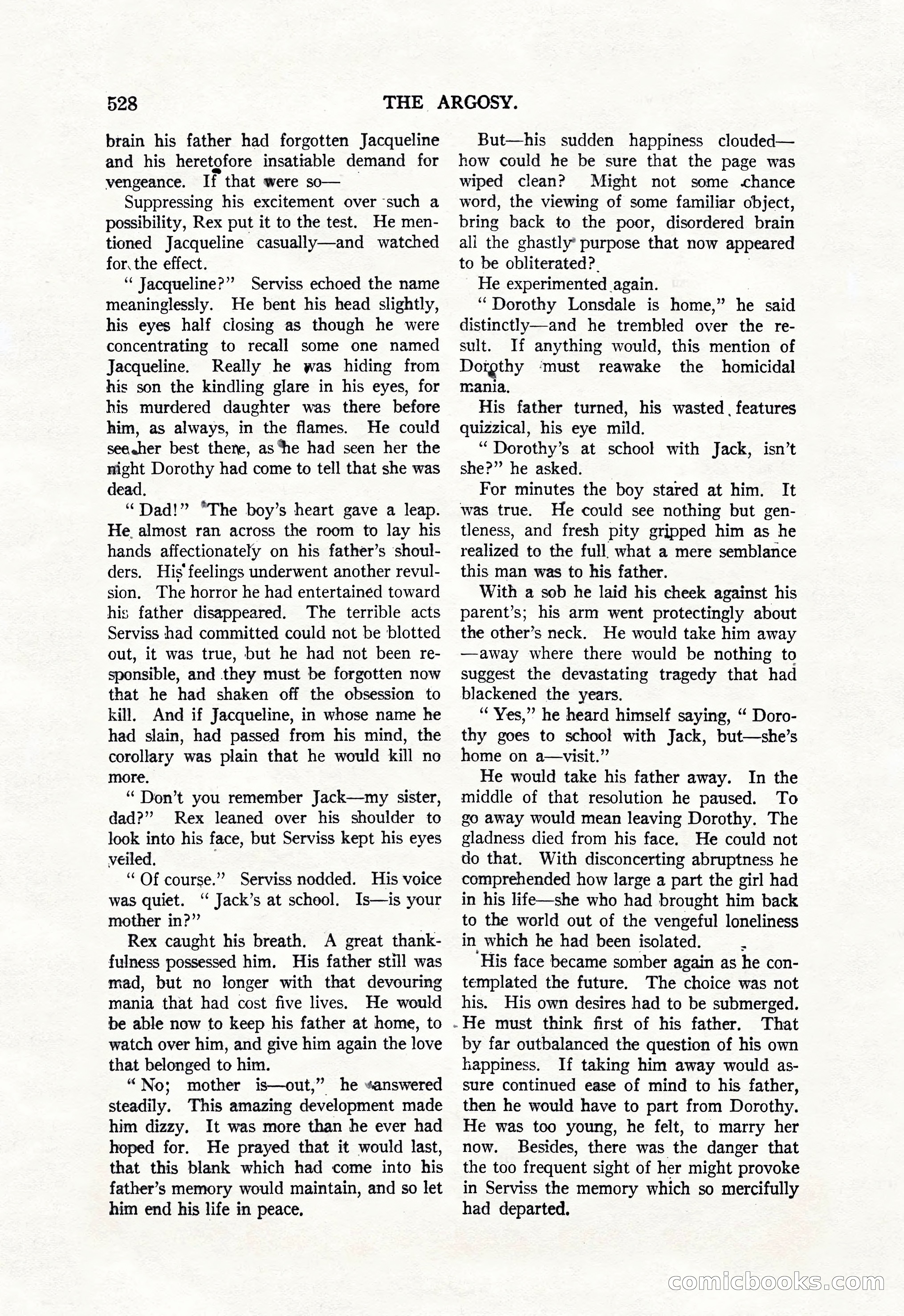
A restored page from Pulp Fiction, 1920. Page through the whole issue in the reader above.
📄 Transcribed text from this page (OCR, searchable)
Machine-transcribed from the original scan — historical spelling and the odd misread are preserved.
528 brain his father had forgotten Jacqueline and his heretofore insatiable demand for vengeance. If that were so— Suppressing his excitement over such a possibility, Rex put it to the test. He men- tioned Jacqueline casually—and watched for. the effect. ‘‘ Jacqueline?’ Serviss echoed the name meaninglessly. He bent his head slightly, his eyes half closing as though he were concentrating to recall some one named Jacqueline. Really he was hiding from his son the kindling glare in his eyes, for his murdered daughter was there before him, as always, in the flames. He could seasher best there, as ‘he had seen her the night Dorothy had come to tell that she was dead. “Dad!” °“The boy’s heart gave a leap. He almost ran across the room to lay his hands affectionately on his father’s shoul- ders. His feelings underwent another revul- sion. The horror he had entertained toward his father disappeared. The terrible acts Serviss had committed could not be blotted out, it was true, but he had not been re- sponsible, and they must be forgotten now that he had shaken off the obsession to kill. And if Jacqueline, in whose name he had slain, had passed from his mind, the corollary was plain that he would kill no more. ‘Don’t you remember Jack—my sister, dad?” Rex leaned over his shoulder to look into his face, but Serviss kept his eyes veiled. ‘Of course.” Serviss nodded. His voice was quiet. ‘‘ Jack’s at school. Is—is your mother in?” | Rex caught his breath. A great thank- fulness possessed him. His father still was mad, but no longer with that devouring mania that had cost five lives. He would be able now to keep his father at home, to watch over him, and give him again the love that belonged to him. “No; mother is—out,” he “answered steadily. This amazing development made him dizzy, It was more than he ever had hoped for. He prayed that it would last, that this blank which had come into his father’s memory would maintain, and so let him end his life in peace, THE ARGOSY. But—his sudden happiness clouded— how could he be sure that the page was wiped clean? Might not some chance word, the viewing of some familiar object, bring back to the poor, disordered brain ali the ghastly purpose that now appeared to be obliterated?. He experimented. again. ‘Dorothy Lonsdale is home,” he said distinctly—and he trembled over the re- sult. If anything would, this mention of Dorgthy ‘must reawake the homicidal mania. 7 His father turned, his wasted , features quizzical, his eye mild. ‘““Dorothy’s at school with Jack, isn’t she?” he asked. For minutes the boy stared at him. It was true. He could see nothing but gen- tleness, and fresh pity gripped him as he realized to the full. what a mere semblance this man was to his father. With a sob he laid his cheek against his parent’s; his arm went protectingly about the other’s neck. He would take him away —away where there would be nothing to suggest the devastating tragedy that had blackened the years. Yes,” he heard himself saying, “ Doro- thy goes to school with Jack, but—she’s home on a—visit.” He would take his father away. In the middle of that resolution he paused. To go away would mean leaving Dorothy. The gladness died from his face. He could not do that. With disconcerting abruptness he comprehended how large a part the girl had in his life—she who had brought him back to the world out of the vengeful loneliness in which he had been isolated. 3 His face became somber again as he con- templated the future. The choice was not his. His own desires had to be submerged. . He must think first of his father. That by far outbalanced the question of his own happiness. If taking him away would as- sure continued ease of mind to his father, then he would have to part from Dorothy. He was too young, he felt, to marry her now. Besides, there was the danger that the too frequent sight of her might provoke in Serviss the memory which so mercifully had departed. JOO (C(O) S (C(C)