
Pulp Fiction, 1920 · page 53 of 180
Argosy, Vol. 118, No. 4 — page 53: what you’re looking at
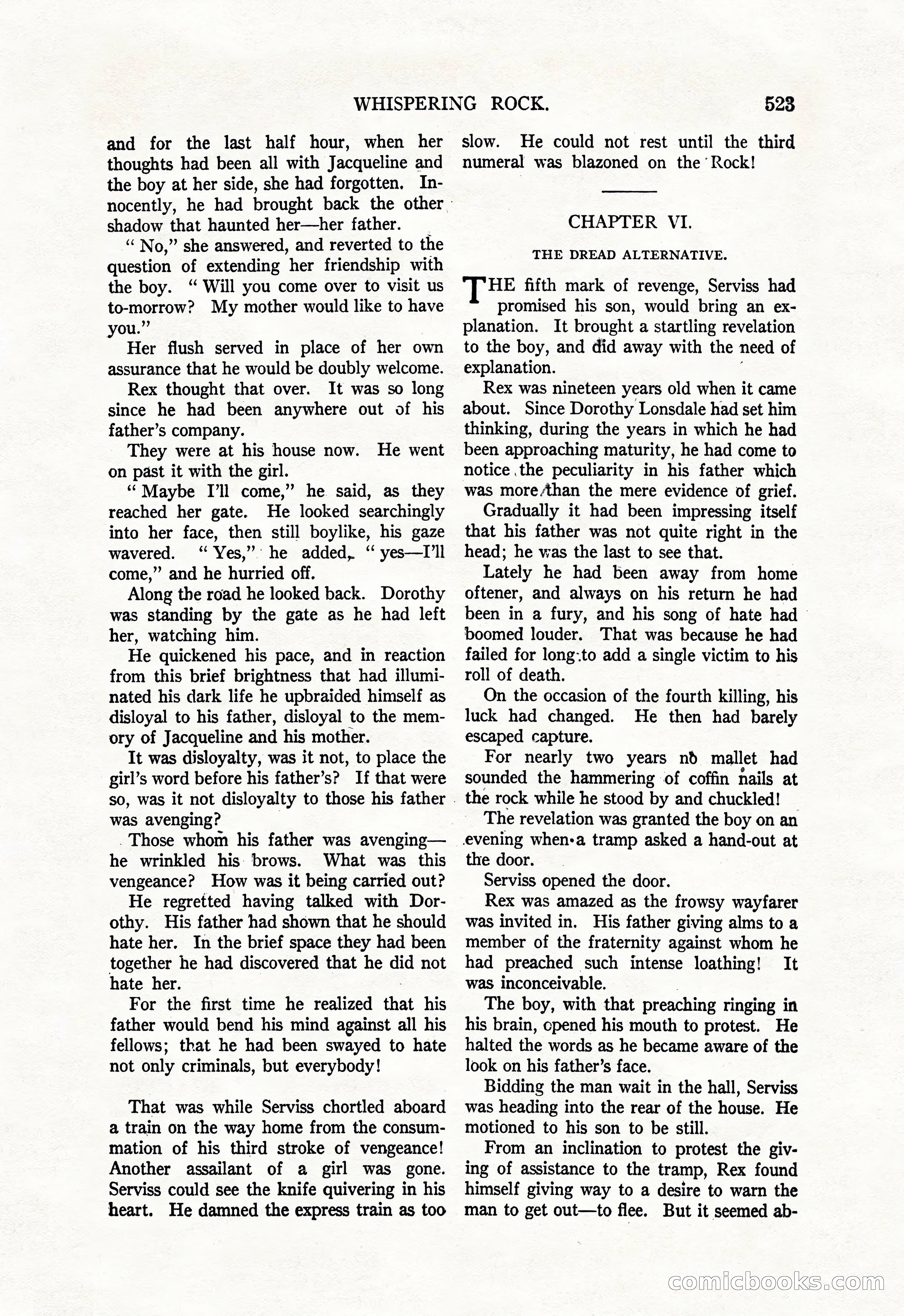
A restored page from Pulp Fiction, 1920. Page through the whole issue in the reader above.
📄 Transcribed text from this page (OCR, searchable)
Machine-transcribed from the original scan — historical spelling and the odd misread are preserved.
WHISPERING ROCK. and for the last half hour, when her thoughts had been all with Jacqueline and the boy at her side, she had forgotten. In- nocently, he had brought back the other » shadow that haunted her—her father. | “No,” she answered, and reverted to the question of extending her friendship with the boy. ‘“ Will you come over to visit us to-morrow? My mother would like to have you.” | Her flush served in place of her own assurance that he would be doubly welcome. Rex thought that over. It was so long since he had been anywhere out of his father’s company. They were at his house now. He went on past it with the girl. ‘Maybe I’ll come,” he said, as they reached her gate. He looked searchingly into her face, then still boylike, his gaze wavered. ‘“ Yes,” he added, ‘‘ yes—I’ll come,” and he hurried off. Along the road he looked back. Dorothy was standing by the gate as he had left her, watching him. He quickened his pace, and in reaction from this brief brightness that had illumi- nated his dark life he upbraided himself as disloyal to his father, disloyal to the mem- ory of Jacqueline and his mother. It was disloyalty, was it not, to place the girl’s word before his father’s? If that were so, was it not disloyalty to those his father . was avenging? Those whom his father was avenging— he wrinkled his brows. What was this vengeance? How was it being carried out? He regretted having talked with Dor- othy. His father had shown that he should hate her. In the brief space they had been together he had discovered that he did not hate her. For the first time he realized that his father would bend his mind against all his fellows; that he had been swayed to hate not only criminals, but everybody! That was while Serviss chortled aboard a train on the way home from the consum- mation of his third stroke of vengeance! Another assailant of a girl was gone. Serviss could see the knife quivering in his heart. He damned the express train as too 523 slow. He could not rest until the third numeral was blazoned on the’ Rock! CHAPTER VI. THE DREAD ALTERNATIVE. HE fifth mark of revenge, Serviss had promised his son, would bring an ex- planation. It brought a startling revelation to the boy, and did away with the need of explanation. Rex was nineteen years old when it came about. Since Dorothy Lonsdale had set him thinking, during the years in which he had been approaching maturity, he had come to notice the peculiarity in his father which was more‘than the mere evidence of grief. Gradually it had been impressing itself that his father was not quite right in the head; he was the last to see that. Lately he had been away from home oftener, and always on his return he had been in a fury, and his song of hate had boomed louder. That was because he had failed for long.to add a single victim to his roll of death. On the occasion of the fourth killing, his luck had changed. He then had barely escaped capture. For nearly two years nd mallet had sounded the hammering of coffin nails at the rock while he stood by and chuckled! The revelation was granted the boy on an evening when-a tramp asked a hand-out at the door. Serviss opened the door. Rex was amazed as the frowsy wayfarer was invited in. His father giving alms to a member of the fraternity against whom he had preached such intense loathing! It was inconceivable. 3 The boy, with that preaching ringing in his brain, cpened his mouth to protest. He halted the words as he became aware of the look on his father’s face. Bidding the man wait in the hall, Serviss was heading into the rear of the house. He motioned to his son to be still. From an inclination to protest the giv- ing of assistance to the tramp, Rex found himself giving way to a desire to warn the man to get out—to flee. But it seemed ab- (Cl QO) mn NOOK