
Pulp Fiction, 1920 · page 52 of 180
Argosy, Vol. 118, No. 4 — page 52: what you’re looking at
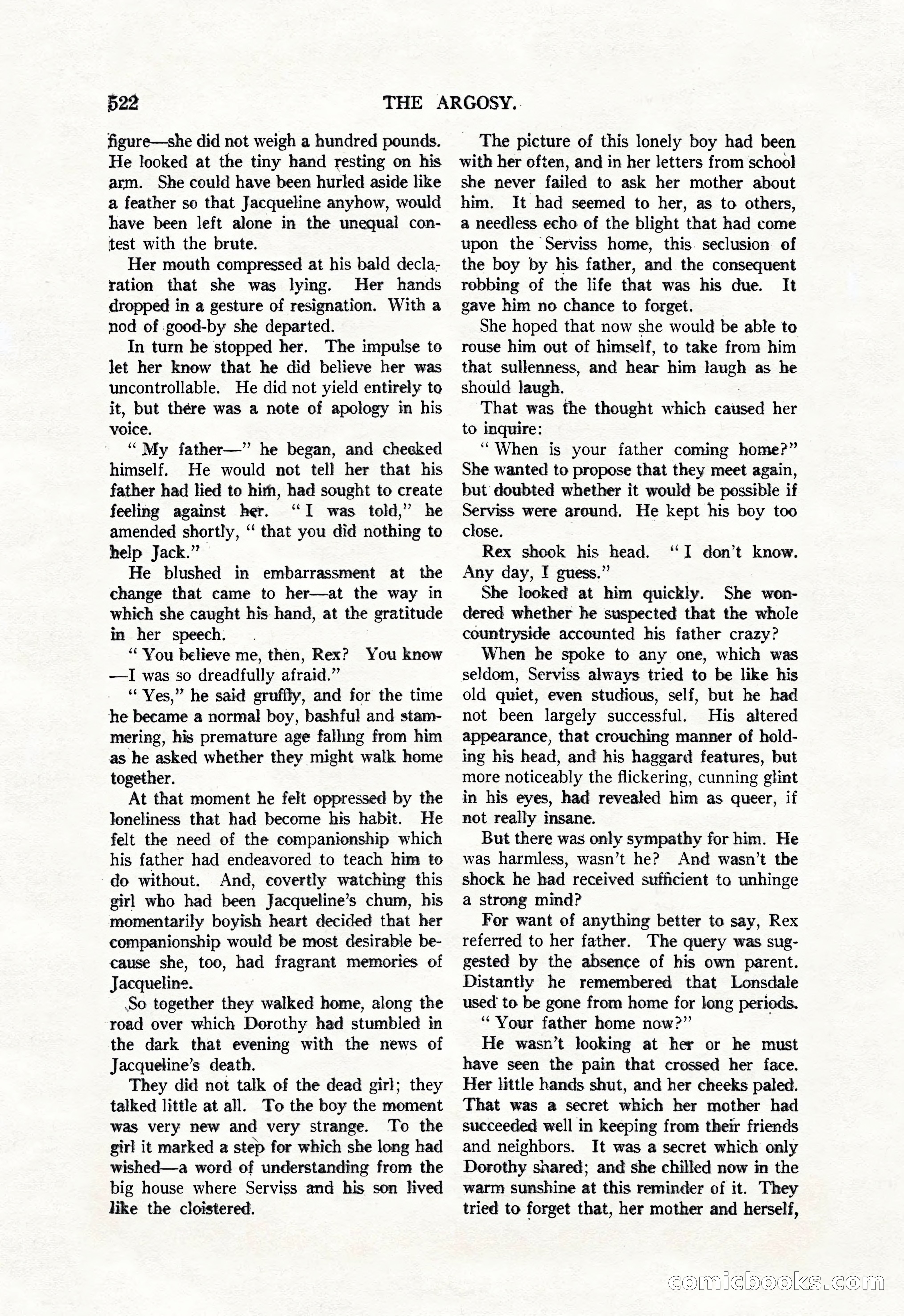
A restored page from Pulp Fiction, 1920. Page through the whole issue in the reader above.
📄 Transcribed text from this page (OCR, searchable)
Machine-transcribed from the original scan — historical spelling and the odd misread are preserved.
figure—she did not weigh a hundred pounds. He looked at the tiny hand resting on his arm. She could have been hurled aside like a feather so that Jacqueline anyhow, would have been left alone in the unequal con- test with the brute. Her mouth compressed at his bald decla- ration that she was lying. Her hands dropped in a gesture of resignation. With a nod of good-by she departed. In turn he stopped her. The impulse to let her know that he did believe her was uncontrollable. He did not yield entirely to it, but there was a note of apology in his voice. ‘““My father—” he began, and checked himself. He would not tell her that his father had lied to hirh, had sought to create feeling against her. “I was told,” he amended shortly, ‘“‘ that you did nothing to help Jack.” He blushed in embarrassment at the change that came to her—at the way in which she caught his hand, at the gratitude in her speech. ““'You believe me, then, Rex? You know —TI was so dreadfully afraid.” “Yes,” he said gruffly, and for the time he became a normal boy, bashful and stam- mering, his premature age falhng from him as he asked whether they might walk home together. At that moment he felt oppressed by the Toneliness that had become his habit. He felt the need of the companionship which his father had endeavored to teach him to do without. And, covertly watching this girl who had been Jacqueline’s chum, his momentarily boyish heart decided that her companionship would be most desirable be- cause she, too, had fragrant memories of Jacqueline. So together they walked home, along the road over which Dorothy had stumbled m the dark that evening with the news of Jacqueline’s death. They did not talk of the dead girl; they talked little at all. To the boy the moment was very new and very strange. To the girl it marked a step for which she long had wished—a word of understanding from the big house where Serviss and his son lived like the cloistered. THE ARGOSY.. _ The picture of this lonely boy had been with her often, and in her letters from school she never failed to ask her mother about him. It had seemed to her, as to others, a needless echo of the blight that had come upon the Serviss home, this. seclusion of the boy by his father, and the consequent robbing of the life that was his due. It gave him no chance to forget. She hoped that now she would be able to rouse him out of himself, to take from him that sullenness, and hear him laugh as he should laugh. That was the thought which enticed her to inquire: ‘“When is your father coming home?” She wanted to propose that they meet again, but doubted whether it would be possible if Serviss were around. He kept his boy too close. . Rex shook his head. Any day, I guess.” | She looked at him quickly. She won- dered whether he suspected that the whole countryside accounted his father crazy? When he spoke to any one, which was seldom, Serviss always tried to be like his old quiet, even studious, self, but he had not been largely successful. His altered appearance, that crouching manner of hold- ing his head, and his haggard features, but more noticeably the flickering, cunning glint in his eyes, had revealed him as queer, if not really insane. But there was only sympathy for him. He was harmless, wasn’t he? And wasn’t the shock he had received sufficient to unhinge a strong mind? For want of anything better to say, Rex referred to her father. The query was sug- gested by the absence of his own parent. Distantly he remembered that Lonsdale used to be gone from home for long periods. ‘Your father home now?” He wasn’t looking at her or he must have seen the pain that crossed her face. Her little hands shut, and her cheeks paled. That was a secret which her mother had succeeded well in keeping from their friends and neighbors. It was a secret which only Dorothy shared; and she chilled now in the warm sunshine at this reminder of it. They tried to forget that, her mother and herself, “T don’t know. GO IOO SJ (C(O)