
Pulp Fiction, 1920 · page 148 of 180
Argosy, Vol. 118, No. 4 — page 148: what you’re looking at
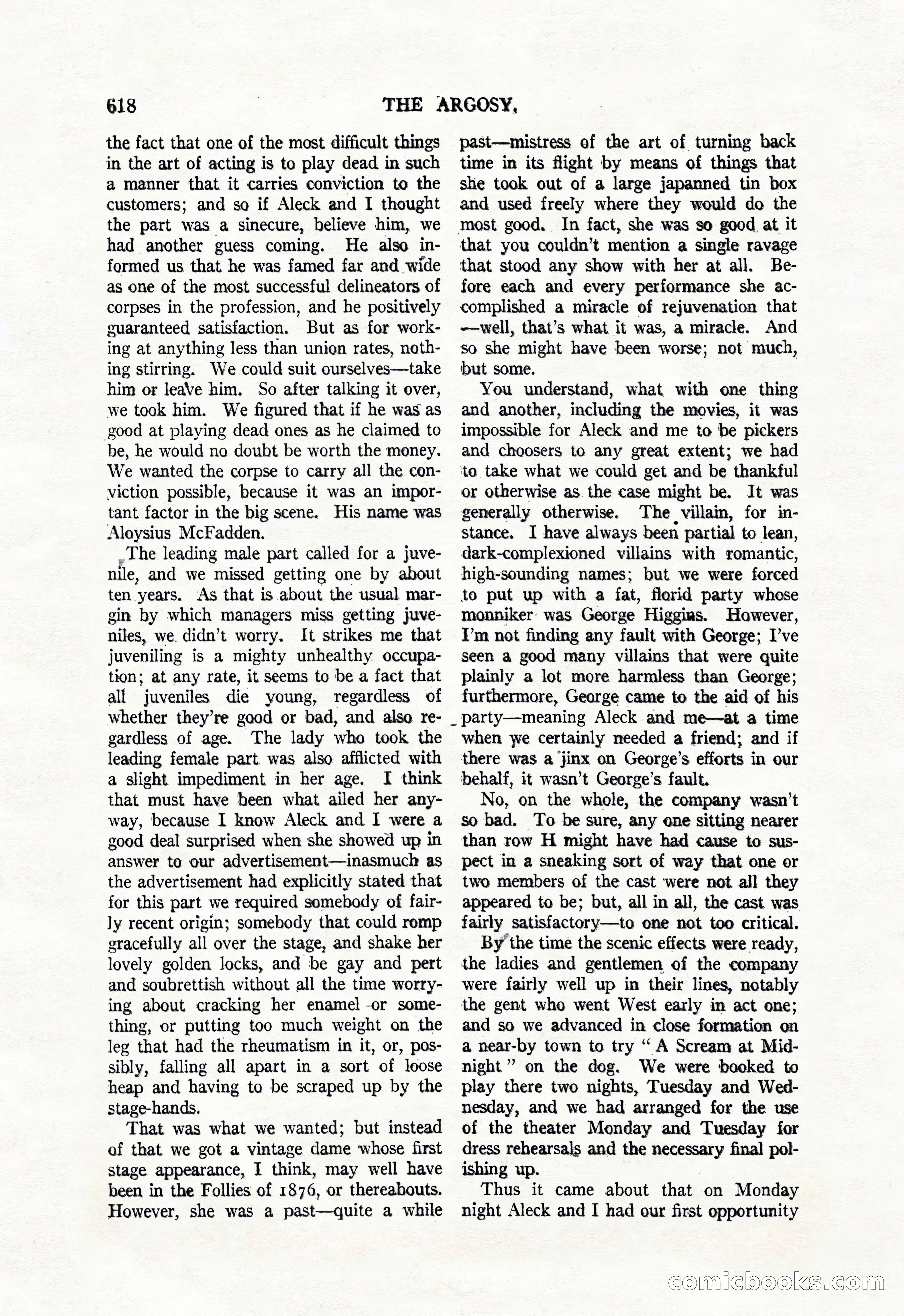
A restored page from Pulp Fiction, 1920. Page through the whole issue in the reader above.
📄 Transcribed text from this page (OCR, searchable)
Machine-transcribed from the original scan — historical spelling and the odd misread are preserved.
618 the fact that one of the most difficult things in the art of acting is to play dead in such a manner that it carries conviction to the customers; and so if Aleck and I thought the part was a sinecure, believe him, we had another guess coming. He also in- formed us that he was famed far and wide as one of the most successful delineators of corpses in the profession, and he positively guaranteed satisfaction. But as for work- ing at anything less than union rates, noth- ing stirring. We could suit ourselves—take him or leave him. So after talking it over, we took him. We figured that if he was as good at playing dead ones as he claimed to be, he would no doubt be worth the money. We wanted the corpse to carry all the con- viction possible, because it was an impor- tant factor in the big scene. His name was Aloysius McFadden. _The leading male part called for a juve- nile, and we missed getting one by about ten years. As that is about the usual mar- gin by which managers miss getting juve- niles, we. didn’t worry. It strikes me that juveniling is a mighty unhealthy occupa- tion; at any rate, it seems to be a fact that all juveniles die young, regardless of whether they’re good or bad, and also re- gardless of age. The lady who took the leading female part was also afflicted with a slight impediment in her age. I think that must have been what ailed her any- way, because I know Aleck and I were a good deal surprised when she showed up in answer to our advertisement—inasmuch as the advertisement had explicitly stated that for this part we required somebody of fair- ly recent origin; somebody that could remp gracefully all over the stage, and shake her lovely golden locks, and be gay and pert and soubrettish without all the time worry- ing about cracking her enamel -or some- thing, or putting too much weight on the leg that had the rheumatism in it, or, pos- sibly, falling all apart in a sort of loose heap and having to be scraped up by the stage-hands. That was what we wanted; but instead of that we got a vintage dame whose first stage appearance, I think, may well have been in the Follies of 1876, or thereabouts. However, she was a past—quite a while THE ARGOSY, past—mistress of the art of turning back time in its flight by means of things that she took out of a large japanned tin box and used freely where they would do the most good. In fact, she was so good at it that you couldn’t mention a single ravage that stood any show with her at all. Be- fore each and every performance she ac- complished a miracle of rejuvenation that —well, that’s what it was, a miracle. And so she might have been worse; not much, but some. You understand, what with one thing and another, including the movies, it was impossible for Aleck and me to be pickers and choosers to any great extent; we had to take what we could get and be thankful or otherwise as the case might be. It was generally otherwise. The villam, for in- stance. I have always been partial to lean, dark-complexioned villains with romantic, high-sounding names; but we were forced to put up with a fat, florid party whose monniker: was George Higgias. However, ‘Ym not finding any fault with George; I’ve seen a good many villains that were quite plainly a lot more harmless than George; furthermore, George came to the aid of his _party—meaning Aleck and me—at a time when we certainly needed a friend; and if there was a jinx on George’s efforts in our behalf, it wasn’t George’s fault. No, on the whole, the company wasn’t so bad. To be sure, any one sitting nearer than row H might have had cause to sus- pect in a sneaking sort of way that one or two members of the cast were not all they appeared to be; but, all in all, the cast was fairly satisfactory—to one not too critical. By the time the scenic effects were ready, the ladies and gentlemen of the company were fairly well up in their lines, notably the gent who went West early in act one; and so we advanced in close formation on a near-by town to try “A Scream at Mid- night’ on the dog. We were booked to play there two nights, Tuesday and Wed- nesday, and we had arranged for the use of the theater Monday and Tuesday for dress rehearsals and the necessary final pol- Thus it came about that on Monday night Aleck and I had our first opportunity ( Cl QO) a) Oy Q) SS (C(O)