
Pulp Fiction, 1920 · page 147 of 180
Argosy, Vol. 118, No. 4 — page 147: what you’re looking at
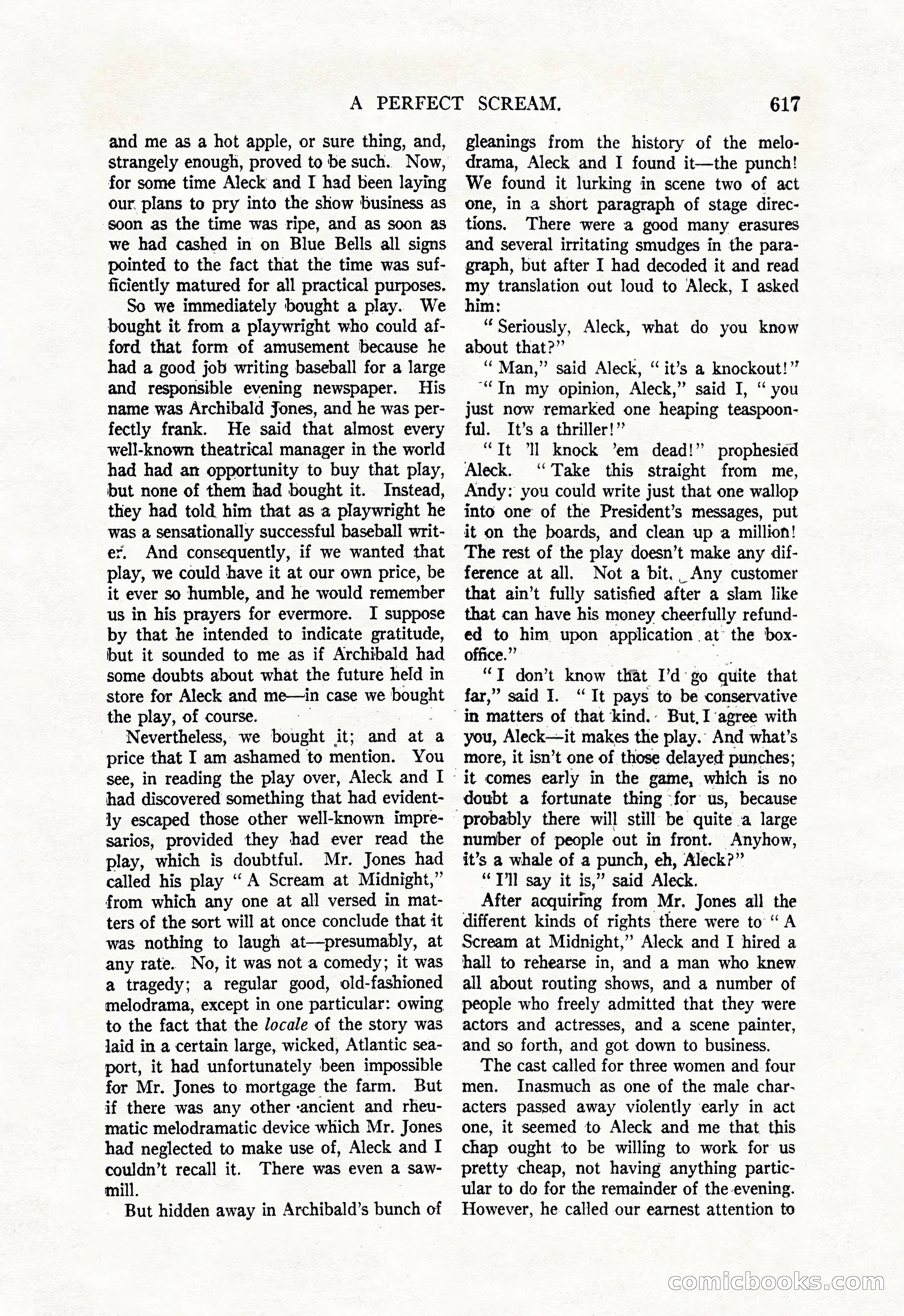
A restored page from Pulp Fiction, 1920. Page through the whole issue in the reader above.
📄 Transcribed text from this page (OCR, searchable)
Machine-transcribed from the original scan — historical spelling and the odd misread are preserved.
A PERFECT and me as a hot apple, or sure thing, and, strangely enough, proved to be such. Now, for some time Aleck and I had been laying our. plans to pry into the show business as soon as the time was ripe, and as soon as we had cashed in on Blue Bells all signs pointed to the fact that the time was suf- ficiently matured for all practical purposes. So we immediately bought a play. We bought it from a playwright who could af- ford that form of amusement because he had a good job writing baseball for a large and responsible evening newspaper. His name was Archibald Jones, and he was per- fectly frank. He said that almost every well-known theatrical manager in the world had had an opportunity to buy that play, but none of them had bought it. Instead, they had told him that as a playwright he was a sensationally successful baseball writ- er. And consequently, if we wanted that play, we could have it at our own price, be it ever so humble, and he would remember us in his prayers for evermore. I suppose by that he intended to indicate gratitude, but it sounded to me as if Archibald had some doubts about what the future held in store for Aleck and me—in case we Mae the play, of course. 7 Nevertheless, we bought it; and at a price that I am ashamed to mention. You see, in reading the play over, Aleck and I had discovered something that had evident- ly escaped those other well-known impre- sarios, provided they had ever read the play, which is doubtful. Mr. Jones had called his play ‘“‘ A Scream at Midnight,” from which any one at all versed in mat- ters of the sort will at once conclude that it was nothing to laugh at—presumably, at any rate. No, it was not a comedy; it was a tragedy; a regular good, old-fashioned melodrama, except in one particular: owing to the fact that the locale of the story was laid in a certain large, wicked, Atlantic sea- port, it had unfortunately been impossible for Mr. Jones to mortgage the farm. But if there was any other -ancient and rheu- matic melodramatic device which Mr. Jones had neglected to make use of, Aleck and I couldn’t recall it. There was even a saw- mill. - But hidden away in Archibald’s bunch of SCREAM. 617 gleanings from the history of the melo- drama, Aleck and I found it—the punch! We found it lurking in scene two of act one, in a short paragraph of stage direc- tions. There were a good many erasures and several irritating smudges in the para- graph, but after I had decoded it and read my translation out loud to Aleck, I asked him: “Seriously, Aleck, what do you know about that?” “Man,” said Aleck, “it’s a knockout!” ““Tn my opinion, Aleck,” said I, “ you just now remarked one heaping teaspoon- ful. It’s a thriller!” “Tt ‘ll knock ’em dead!” prophesied Aleck. ‘‘ Take this straight from me, Andy: you could write just that one wallop into one of the President’s messages, put it on the boards, and clean up a million! The rest of the play doesn’t make any dif- ference at all. Not a bit. Any customer that ain’t fully satisfied after a slam like that can have his money cheerfully refund- ed to him upon application at’ the box- office.” | . “T don’t know that I’'d go quite that far,” said I. “It pays to be conservative in matters of that kind.- But, I agree with you, Aleck—it makes the play. And what’s more, it isn’t one of those delayed punches; “it comes early in the game, which is no doubt a fortunate thing for us, because probably there will still be quite ‘a large number of people out in front. Anyhow, it’s a whale of a punch, eh, Aleck?” T'll say it is,” said Aleck. After acquiring from Mr. Jones all the different kinds of rights there were to “A scream at Midnight,” Aleck and I hired a hall to rehearse in: ‘and a man who knew all about routing shows, and a number of people who freely admitted that they were actors and actresses, and a scene painter, and so forth, and got down to business. The cast called for three women and four men. Inasmuch as one of the male char- acters passed away violently ‘early in act one, it seemed to Aleck and me that this chap ought to be willing to work for us pretty cheap, not having anything partic- ular to do for the remainder of the evening. However, he called our earnest attention to mM (S| QO) NOOLK