
Pulp Fiction, 1920 · page 107 of 180
Argosy, Vol. 118, No. 4 — page 107: what you’re looking at
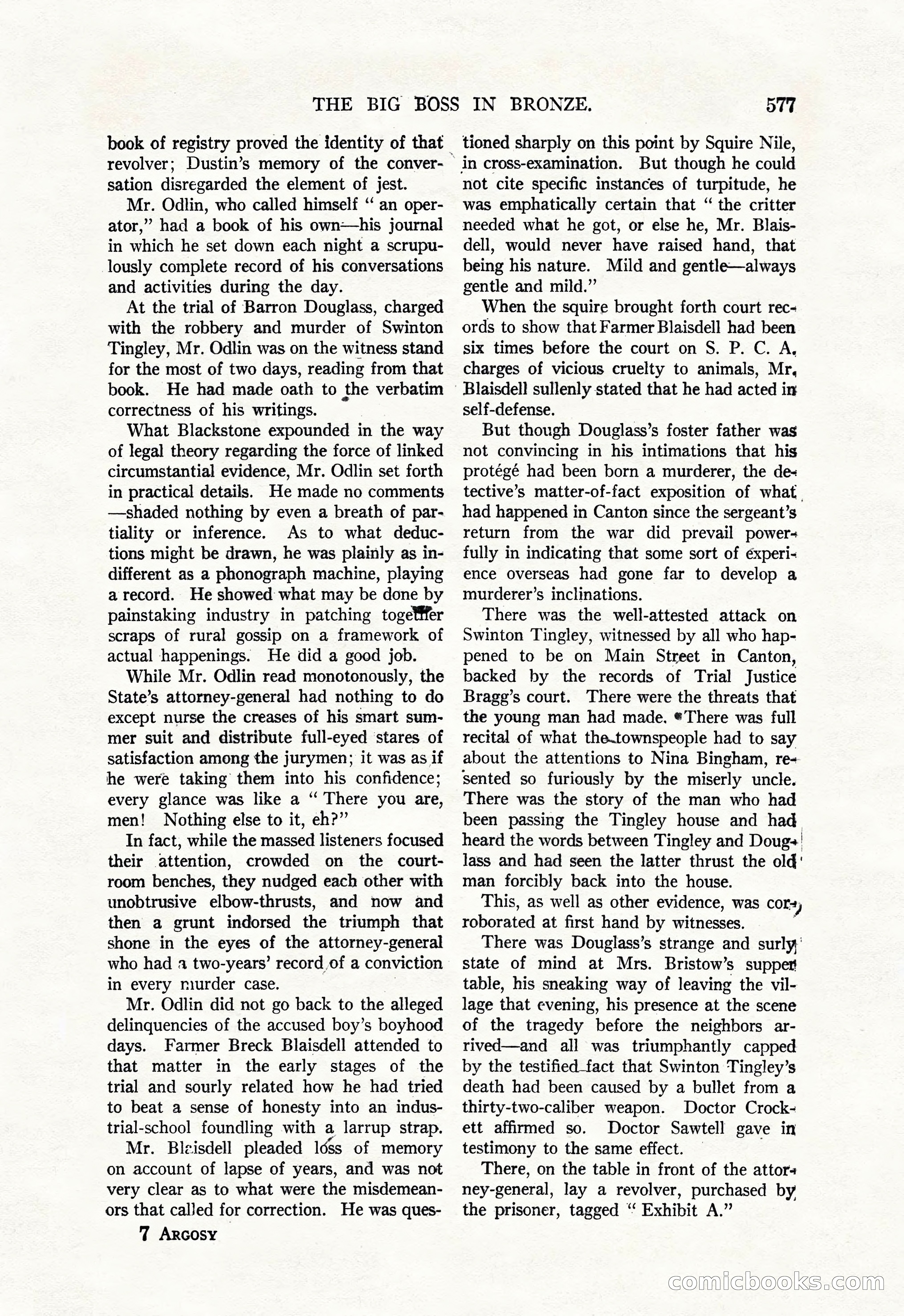
A restored page from Pulp Fiction, 1920. Page through the whole issue in the reader above.
📄 Transcribed text from this page (OCR, searchable)
Machine-transcribed from the original scan — historical spelling and the odd misread are preserved.
THE BIG BOSS IN BRONZE. book of registry proved the identity of that revolver; Dustin’s memory of the conver- sation disregarded the element of jest. Mr. Odlin, who called himself ‘‘ an oper- ator,” had a book of his own—his journal in which he set down each night a scrupu- -lously complete record of his conversations and activities during the day. At the trial of Barron Douglass, charged with the robbery and murder of Swinton Tingley, Mr. Odlin was on the witness stand for the most of two days, reading from that book. He had made oath to the verbatim correctness of his writings. 7 What Blackstone expounded in the way of legal theory regarding the force of linked circumstantial evidence, Mr. Odlin set forth in practical details. He made no comments —shaded nothing by even a breath of par- tiality or inference. As to what deduc- tions might be drawn, he was plainly as in- different as a phonograph machine, playing a record. He showed what may be done by painstaking industry in patching togefffer scraps of rural gossip on a framework of actual happenings. He did a good job. While Mr. Odlin read monotonously, the State’s attorney-general had nothing to do except nurse the creases of his smart sum- mer suit and distribute full-eyed stares of satisfaction among the jurymen; it was as if he were taking them into his confidence; every glance was like a ‘“‘ There you are, men! Nothing else to it, eh?” In fact, while the massed listeners focused their attention, crowded on the court- room benches, they nudged each other with unobtrusive elbow-thrusts, and now and then a grunt indorsed the triumph that shone in the eyes of the attorney-general who had 4 two-years’ record of a conviction 7 in every murder case. Mr. Odlin did not go back to the alleged delinquencies of the accused boy’s boyhood days. Farmer Breck Blaisdell attended to that matter in the early stages of the trial and sourly related how he had tried to beat a sense of honesty into an indus- trial-school foundling with a larrup strap. Mr. Bleisdell pleaded ldéss of memory on account of lapse of years, and was not very clear as to what were the misdemean- ors that called for correction. He was ques- 7 Arcosy 577 tioned sharply on this point by Squire Nile, In cross-examination. But though he could not cite specific instances of turpitude, he was emphatically certain that “ the critter needed what he got, or else he, Mr. Blais- dell, would never have raised hand, that being his nature. Mild and gentle—always gentle and mild.” When the squire brought forth court rec- ords to show that Farmer Blaisdell had been six times before the court on S. P. C. A, charges of vicious cruelty to animals, Mr, Blaisdell sullenly stated that he had acted in self-defense. But though Douglass’s foster father was not convincing in his intimations that his protégé had been born a murderer, the de- tective’s matter-of-fact exposition of what. had happened in Canton since the sergeant’s return from the war did prevail power- fully in indicating that some sort of éxperi- ence overseas had gone far to develop a murderer’s inclinations. There was the well-attested attack on Swinton Tingley, witnessed by all who hap- pened to be on Main Street in Canton, backed by the records of Trial Justice Bragg’s court. There were the threats that the young man had made. *There was full recital of what the.townspeople had to say about the attentions to Nina Bingham, re- sented so furiously by the miserly uncle. There was the story of the man who had been passing the Tingley house and had heard the words between Tingley and Doug-' lass and had seen the latter thrust the old' man forcibly back into the house. This, as well as other evidence, was cor, roborated at first hand by witnesses. There was Douglass’s strange and surly; state of mind at Mrs. Bristow’s supper table, his sneaking way of leaving the vil- lage that evening, his presence at the scene of the tragedy before the neighbors ar- rived—and all was triumphantly capped by the testified_fact that Swinton Tingley’s death had been caused by a bullet from a thirty-two-caliber weapon. Doctor Crock- ett affirmed so. Doctor Sawtell gave in testimony to the same effect. — There, on the table in front of the attors ney-general, lay a revolver, purchased by the prisoner, tagged “‘ Exhibit A.” JOO (C(O) SH (C(C)