
Pulp Fiction, 1917 · page 76 of 192
Argosy, Vol. 85, No. 3 — page 76: what you’re looking at
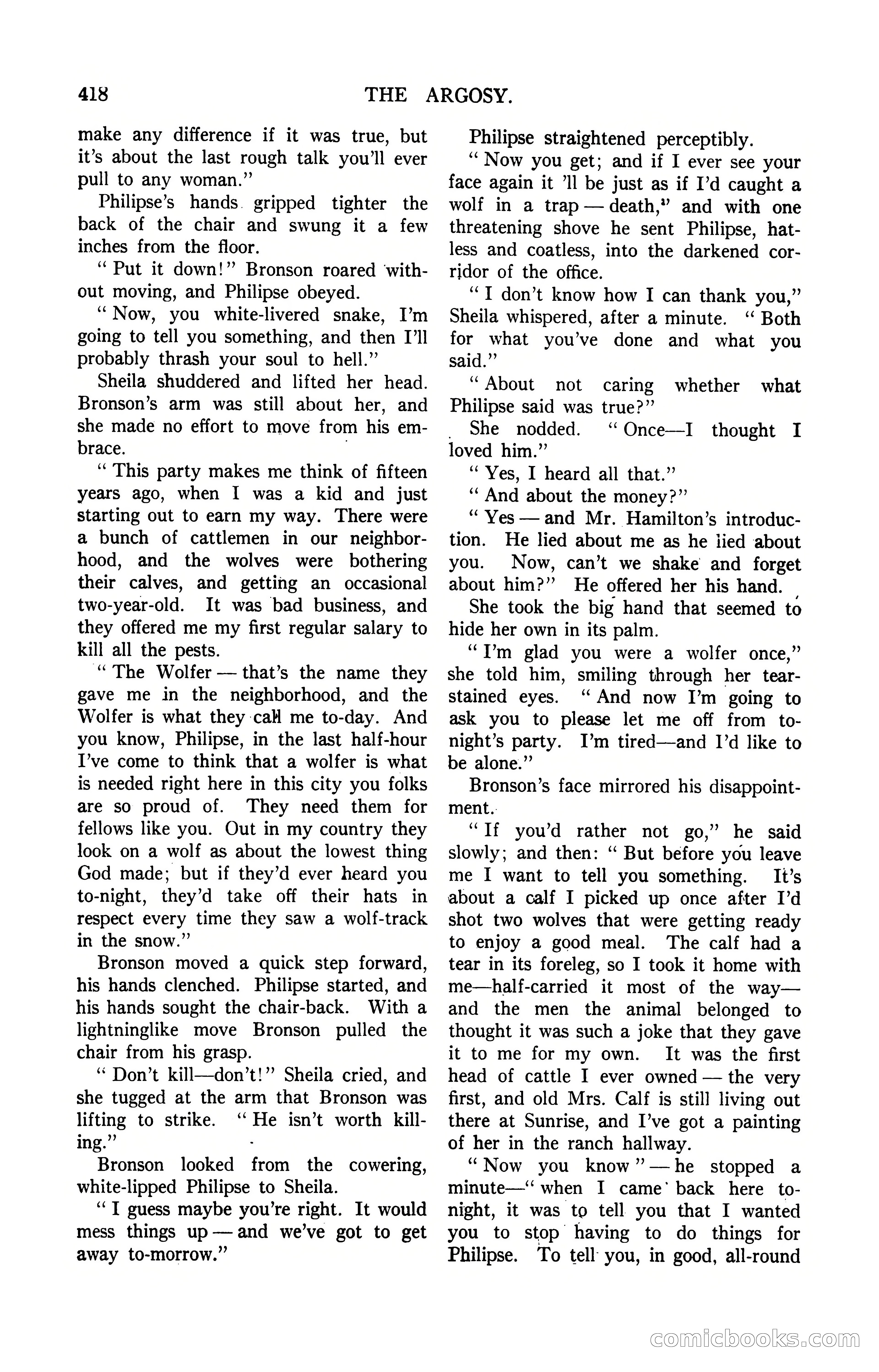
A restored page from Pulp Fiction, 1917. Page through the whole issue in the reader above.
📄 Transcribed text from this page (OCR, searchable)
Machine-transcribed from the original scan — historical spelling and the odd misread are preserved.
418 make any difference if it was true, but it’s about the last rough talk you'll ever pull to any woman.” Philipse’s hands. gripped tighter the back of the chair and swung it a few inches from the floor. ‘Put it down!” Bronson roared ‘with- out moving, and Philipse obeyed. “Now, you white-livered snake, I’m going to tell you something, and then I’ll probably thrash your soul to hell.” Sheila shuddered and lifted her head. Bronson’s arm was still about her, and she made no effort to move from his em- brace. . ‘This party makes me think of fifteen years ago, when I was a kid and just starting out to earn my way. There were a bunch of cattlemen in our neighbor- hood, and the wolves were bothering their calves, and getting an occasional two-year-old. It was bad business, and they offered me my first regular salary to kill all the pests. “The Wolfer — that’s the name they gave me in the neighborhood, and the Wolfer is what they cal me to-day. And you know, Philipse, in the last half-hour I’ve come to think that a wolfer is what is needed right here in this city you folks are so proud of. They need them for fellows like you. Out in my country they look on a wolf as about the lowest thing God made; but if they’d ever heard you to-night, they’d take off their hats in respect every time they saw a wolf-track in the snow.” Bronson moved a quick step forward, his hands clenched. Philipse started, and his hands sought the chair-back. With a lightninglike move Bronson pulled the chair from his grasp. “ Don’t kill—don’t!” Sheila cried, and she tugged at the arm that Bronson was lifting to strike. ‘‘ He isn’t worth kill- ing.” Bronson looked from the cowering, white-lipped Philipse to Sheila. ‘““T guess maybe you're right. It would mess things up — and we’ve got to get away to-morrow.” THE ARGOSY. Philipse straightened perceptibly. ‘“ Now you get; and if I ever see your face again it ’ll be just as if I’d caught a wolf in a trap — death,” and with one threatening shove he sent Philipse, hat- less and coatless, into the darkened cor- ridor of the office. “I don’t know how I can thank you,” Sheila whispered, after a minute. ‘“ Both for what you’ve done and what you said.” “About not caring whether what Philipse said was true?” She nodded. ‘“ Once—I thought I loved him.” “Yes, I heard all that.’ ‘And about the money?”’ “Yes — and Mr. Hamilton’s introduc- tion. He lied about me as he lied about you. Now, can’t we shake and forget about him?” He offered her his hand. _ She took the big hand that seemed to hide her own in its palm. “I’m glad you were a wolfer once,” she told him, smiling through her tear- stained eyes. “And now I’m going to ask you to please let me off from to- night’s party. I’m tired—and I’d like to be alone.” Bronson’s face mirrored his disappoint- ment. “Tf you’d rather not go,” he said slowly; and then: ‘“ But before you leave me I want to tell you something. It’s about a calf I picked up once after I’d shot two wolves that were getting ready to enjoy a good meal. The calf had a tear in its foreleg, so I took it home with me—half-carried it most of the way— and the men the animal belonged to thought it was such a joke that they gave it to me for my own. It was the first head of cattle I ever owned — the very first, and old Mrs. Calf is still living out there at Sunrise, and I’ve got a painting of her in the ranch hallway. “Now you know” —he stopped a minute—‘‘ when I came’ back here to- night, it was to tell you that I wanted you to stop having to do things for Philipse. To tell: you, in good, all-round comicloool C©