
Pulp Fiction, 1917 · page 75 of 192
Argosy, Vol. 85, No. 3 — page 75: what you’re looking at
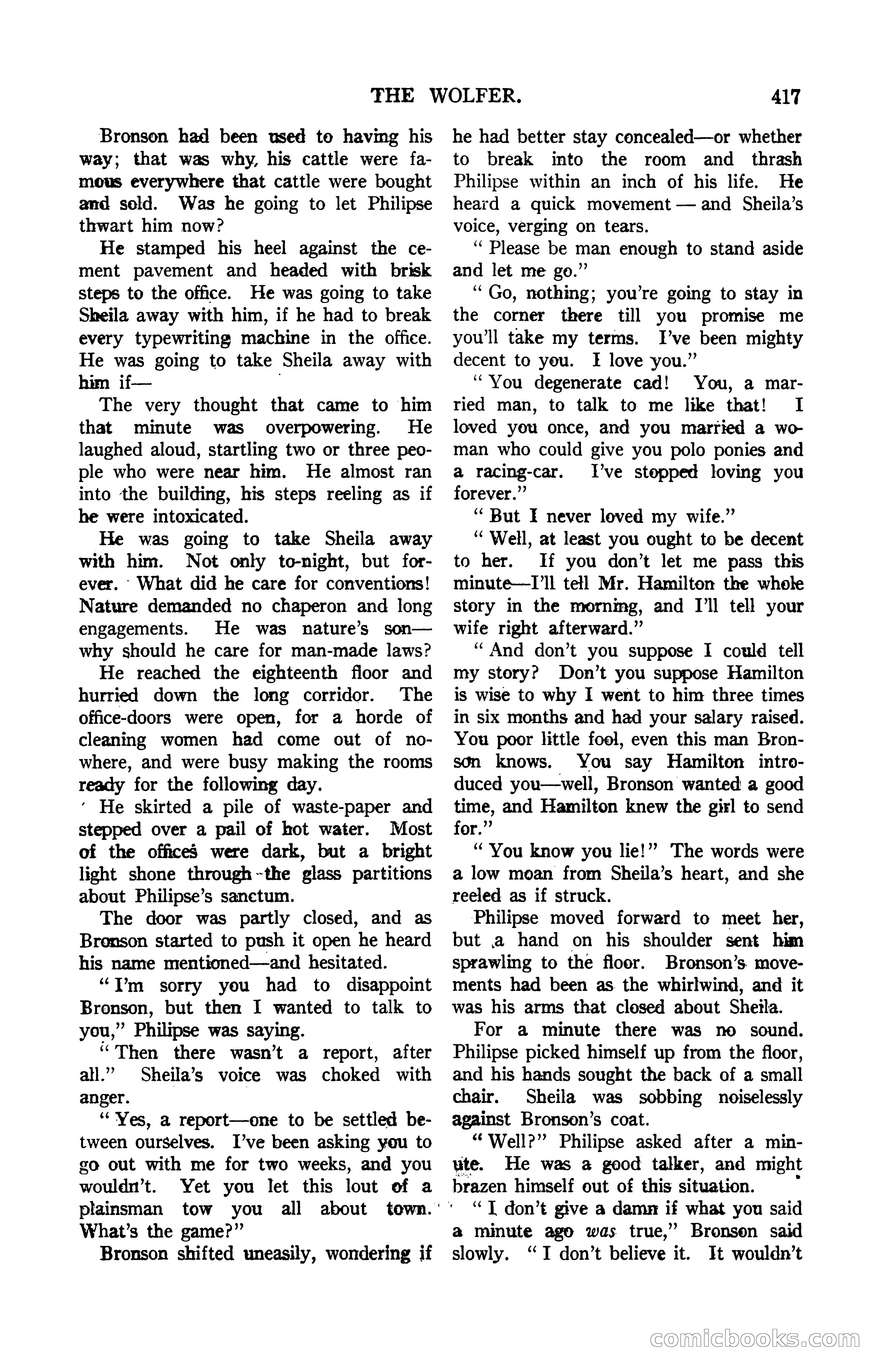
A restored page from Pulp Fiction, 1917. Page through the whole issue in the reader above.
📄 Transcribed text from this page (OCR, searchable)
Machine-transcribed from the original scan — historical spelling and the odd misread are preserved.
THE WOLFER. Bronson had been used to having his way; that was why, his cattle were fa- mous everywhere that cattle were bought and sold. Was he going to let Philipse thwart him now? He stamped his heel against the ce- ment pavement and headed with brisk steps to the office. He was going to take Sheila away with him, if he had to break every typewriting machine in the office. He was going to take Sheila away with him if— The very thought that came to him that minute was overpowering. He laughed aloud, startling two or three peo- ple who were near him. He almost ran into the building, his steps reeling as if he were intoxicated. He was going to take Sheila away with him. Not only to-night, but for- ever. What did he care for conventions! Nature demanded no chaperon and long engagements. He was nature’s son— why should he care for man-made laws? He reached the eighteenth floor and hurried down the long corridor. The office-doors were open, for a horde of cleaning women had come out of no- where, and were busy making the rooms ready for the following day. ‘ He skirted a pile of waste-paper and stepped over a pail of hot water. Most of the offices were dark, but a bright light shone through-the glass partitions about Philipse’s sanctum. The door was partly closed, and as Bronson started to push it open he heard his name mentioned—and hesitated. “Ym sorry you had to disappoint Bronson, but then I wanted to talk to you,” Philipse was saying. “Then there wasn’t a report, after all.” Sheila’s voice was choked with anger. | “Yes, a report—one to be settled be- tween ourselves. I’ve been asking you to go out with me for two weeks, and you wouldn’t. Yet you let this lout of a plainsman tow you all about town.’ ' What’s the game?” Bronson shifted uneasily, wondering if AlT he had better stay concealed—or whether to break into the room and _ thrash Philipse within an inch of his life. He heard a quick movement — and Sheila’s voice, verging on tears. ‘“ Please be man enough to stand aside and let me go.” ‘“Go, nothing; you're going to stay in the corner there till you promise me you'll take my terms. I’ve been mighty decent to you. I love you.” ‘You degenerate cad! You, a mar- ried man, to talk to me like that! I loved you once, and you married a wo- man who could give you polo ponies and a racing-car. I’ve stepped loving you forever.” ‘But EF never loved my wife.” “Well, at least you ought to be decent to her. If you don’t let me pass this minute—TI’ll tell Mr. Hamilton the whole story in the morning, and I’ll tell your wife right afterward.” ‘““And don’t you suppose I could tell my story? Don’t you suppose Hamilton is wise to why I went to him three times in six months and had your salary raised. You poor little fool, even this man Bron- son knows. You say Hamilton intro- duced you—well, Bronson wanted a good time, and Hamilton knew the girl to send for.” “You know you lie!’”’ The words were a low moan from Sheila’s heart, and she reeled as if struck. Philipse moved forward to meet her, but .a hand on his shoulder sent him sprawling to the floor. Bronson’s. move- ments had been as the whirlwind, and it was his arms that closed about Sheila. For a minute there was no sound. Philipse picked himself up from the floor, and his hands sought the back of a small chair. Sheila was sobbing noiselessly against Bronson’s coat. “Well?” Philipse asked after a min- ute. He was a good talker, and might brazen himself out of this situation. ‘YT don’t give a damn if what you said @ minute ago was true,” Bronson said slowly. ‘I don’t believe it. It wouldn’t comicloool C©