
Pulp Fiction, 1917 · page 73 of 192
Argosy, Vol. 85, No. 3 — page 73: what you’re looking at
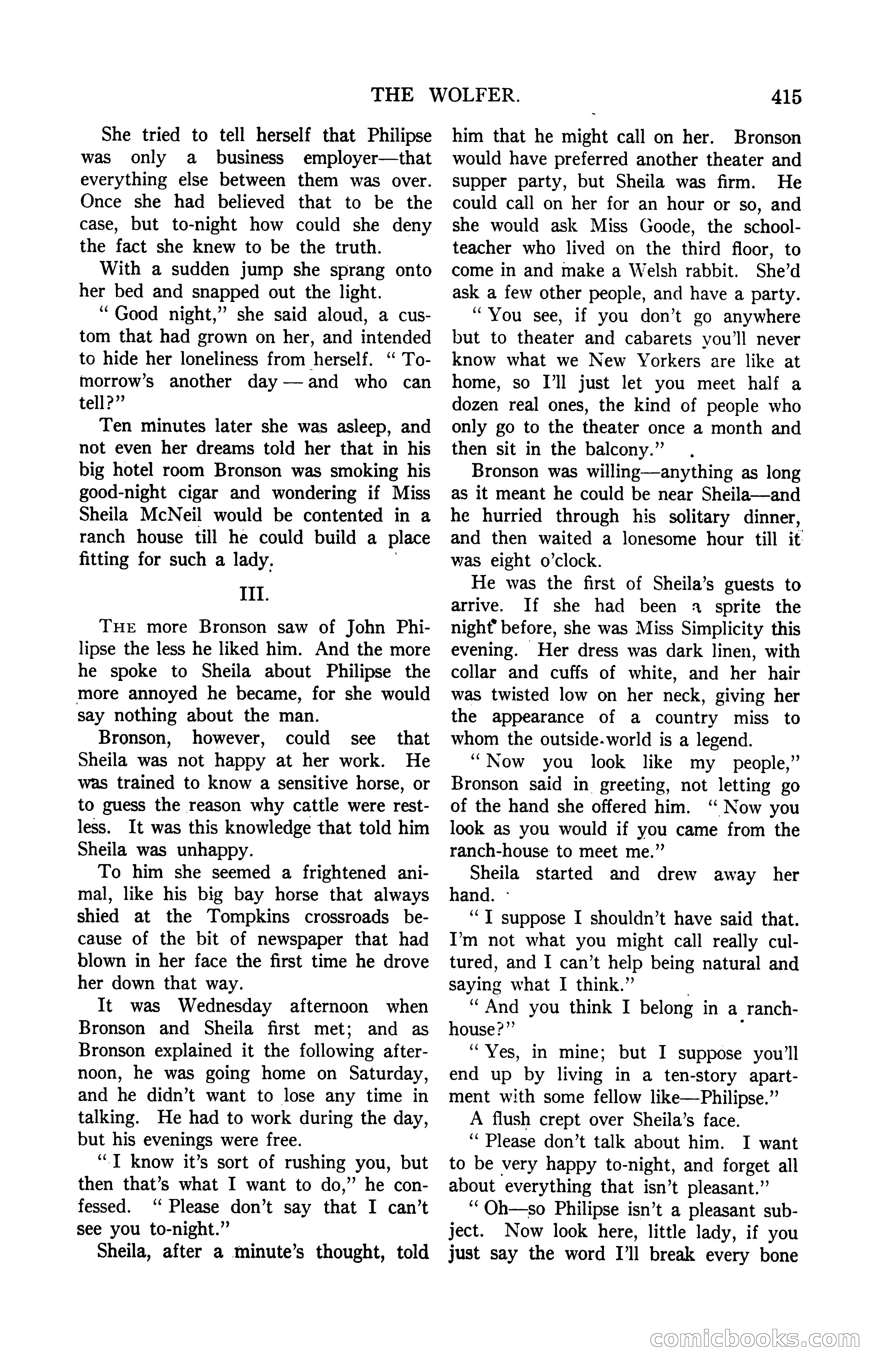
A restored page from Pulp Fiction, 1917. Page through the whole issue in the reader above.
📄 Transcribed text from this page (OCR, searchable)
Machine-transcribed from the original scan — historical spelling and the odd misread are preserved.
THE WOLFER. She tried to tell herself that Philipse was only a _ business employer—that everything else between them was over. Once she had believed that to be the case, but to-night how could she deny the fact she knew to be the truth. With a sudden jump she sprang onto her bed and snapped out the light. ‘““Good night,” she said aloud, a cus- tom that had grown on her, and intended to hide her loneliness from herself. ‘“ To- morrow’s another day— and who can tell?” Ten minutes later she was asleep, and not even her dreams told her that in his big hotel room Bronson was smoking his good-night cigar and wondering if Miss Sheila McNeil would be contented in a ranch house till he could build a place fitting for such a lady. IIT. THE more Bronson saw of John Phi- lipse the less he liked him. And the more he spoke to Sheila about Philipse the more annoyed he became, for she would say nothing about the man. Bronson, however, could see _ that Sheila was not happy at her work. He was trained to know a sensitive horse, or to guess the reason why cattle were rest- less. It was this knowledge that told him Sheila was unhappy. To him she seemed a frightened ani- mal, like his big bay horse that always shied at the Tompkins crossroads _ be- cause of the bit of newspaper that had blown in her face the first time he drove her down that way. It was Wednesday afternoon when Bronson and Sheila first met; and as Bronson explained it the following after- noon, he was going home on Saturday, and he didn’t want to lose any time in talking. He had to work during the day, but his evenings were free. ‘““T know it’s sort of rushing you, but then that’s what I want to do,” he con- fessed. ‘‘ Please don’t say that I can’t see you to-night.” Sheila, after a minute’s thought, told 415 him that he might call on her. Bronson would have preferred another theater and supper party, but Sheila was firm. He could call on her for an hour or so, and she would ask Miss Goode, the school- teacher who lived on the third floor, to come in and make a Welsh rabbit. She’d ask a few other people, and have a party. “ You see, if you don’t go anywhere but to theater and cabarets you'll never know what we New Yorkers are like at home, so I’ll just let you meet half a dozen real ones, the kind of people who only go to the theater once a month and then sit in the balcony.” Bronson was willing—anything as long as it meant he could be near Sheila—and he hurried through his solitary dinner, and then waited a lonesome hour till it: was eight o’clock. He was the first of Sheila’s guests to arrive. If she had been 4 sprite the night’ before, she was Miss Simplicity this evening. Her dress was dark linen, with collar and cuffs of white, and her hair was twisted low on her neck, giving her the appearance of a country miss to whom the outside-world is a legend. “Now you look like my _ people,” Bronson said in greeting, not letting go of the hand she offered him. ‘Now you look as you would if you came from the ranch-house to meet me.” Sheila started and drew away her hand. - ‘“I suppose I shouldn’t have said that. I’m not what you might call really cul- tured, and I can’t help being natural and saying what I think.” “And you think I belong in a _ranch- house?” “Yes, in mine; but I suppose you'll end up by living in a ten-story apart- ment with some fellow like—Philipse.” A flush crept over Sheila’s face. ‘Please don’t talk about him. I want to be very happy to-night, and forget all about everything that isn’t pleasant.” ‘““Oh—so Philipse isn’t a pleasant sub- ject. Now look here, little lady, if you just say the word I’ll break every bone comicloool C©