
Pulp Fiction, 1917 · page 72 of 192
Argosy, Vol. 85, No. 3 — page 72: what you’re looking at
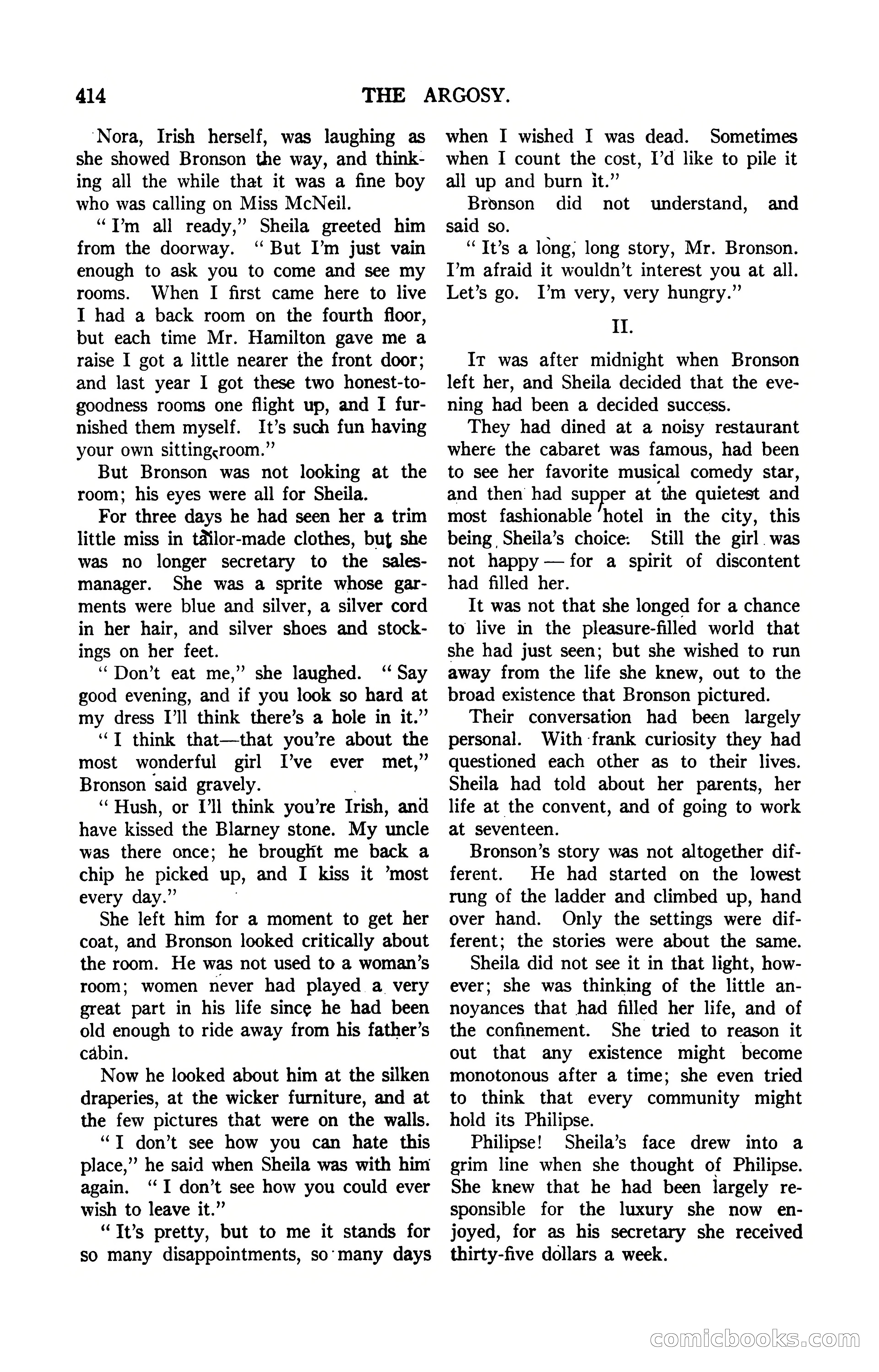
A restored page from Pulp Fiction, 1917. Page through the whole issue in the reader above.
📄 Transcribed text from this page (OCR, searchable)
Machine-transcribed from the original scan — historical spelling and the odd misread are preserved.
414 ‘Nora, Irish herself, was laughing as she showed Bronson the way, and think- ing all the while that it was a fine boy who was calling on Miss McNeil. “Tm all ready,” Sheila greeted him from the doorway. ‘ But I’m just vain enough to ask you to come and see my rooms. When I first came here to live I had a back room on the fourth floor, but each time Mr. Hamilton gave me a raise I got a little nearer the front door; and last year I got these two honest-to- goodness rooms one flight up, and I fur- nished them myself. It’s such fun having your own sitting,room.” But Bronson was not looking at the room; his eyes were all for Sheila. For three days he had seen her a trim little miss in tailor-made clothes, but she was no longer secretary to the sales- manager. She was a sprite whose gar- ments were blue and silver, a silver cord in her hair, and silver shoes and stock- ings on her feet. ‘“Don’t eat me,” she laughed. ‘“ Say good evening, and if you look so hard at my dress I’ll think there’s a hole in it.” ‘“T think that—that you’re about the most wonderful girl I’ve ever met,” Bronson said gravely. | ‘Hush, or I'll think you’re Irish, and have kissed the Blarney stone. My uncle was there once; he brought me back a chip he picked up, and I kiss it ’most every day.” | She left him for a moment to get her coat, and Bronson looked critically about the room. He was not used to a woman’s room; women never had played a very great part in his life since he had been old enough to ride away from his father’s cabin. Now he looked about him at the silken draperies, at the wicker furniture, and at the few pictures that were on the walls. “TI don’t see how you can hate this place,”’ he said when Sheila was with him again. ‘I don’t see how you could ever wish to leave it.” “Tt’s pretty, but to me it stands for SO many disappointments, so'-many days THE ARGOSY. when I wished I was dead. Sometimes when I count the cost, I’d like to pile it all up and burn it.” Bronson did not understand, and said so. “Tt’s a long; long story, Mr. Bronson. I’m afraid it wouldn’t interest you at all. Let’s go. I’m very, very hungry.” II. Ir was after midnight when Bronson left her, and Sheila decided that the eve- ning had been a decided success. They had dined at a noisy restaurant where the cabaret was famous, had been to see her favorite musical comedy star, and then had supper at the quietest and most fashionable ‘hotel in the city, this being Sheila’s choice: Still the girl. was not happy — for a spirit of discontent had filled her. It was not that she longed for a chance to live in the pleasure-filled world that she had just seen; but she wished to run away from the life she knew, out to the broad existence that Bronson pictured. Their conversation had been largely personal. With frank curiosity they had questioned each other as to their lives. Sheila had told about her parents, her life at the convent, and of going to work at seventeen. Bronson’s story was not altogether dif- ferent. He had started on the lowest rung of the ladder and climbed up, hand over hand. Only the settings were dif- ferent; the stories were about the same. Sheila did not see it in that light, how- ever; she was thinking of the little an- noyances that had filled her life, and of the confinement. She tried to reason it out that any existence might become monotonous after a time; she even tried to think that every community might hold its Philipse. Philipse! Sheila’s face drew into a grim line when she thought of Philipse. She knew that he had been largely re- sponsible for the luxury she now en- joyed, for as his secretary she received thirty-five dollars a week. CO DOOK AMUC C©