
Pulp Fiction, 1916 · page 171 of 220
The Argosy, April 1916 — page 171: what you’re looking at
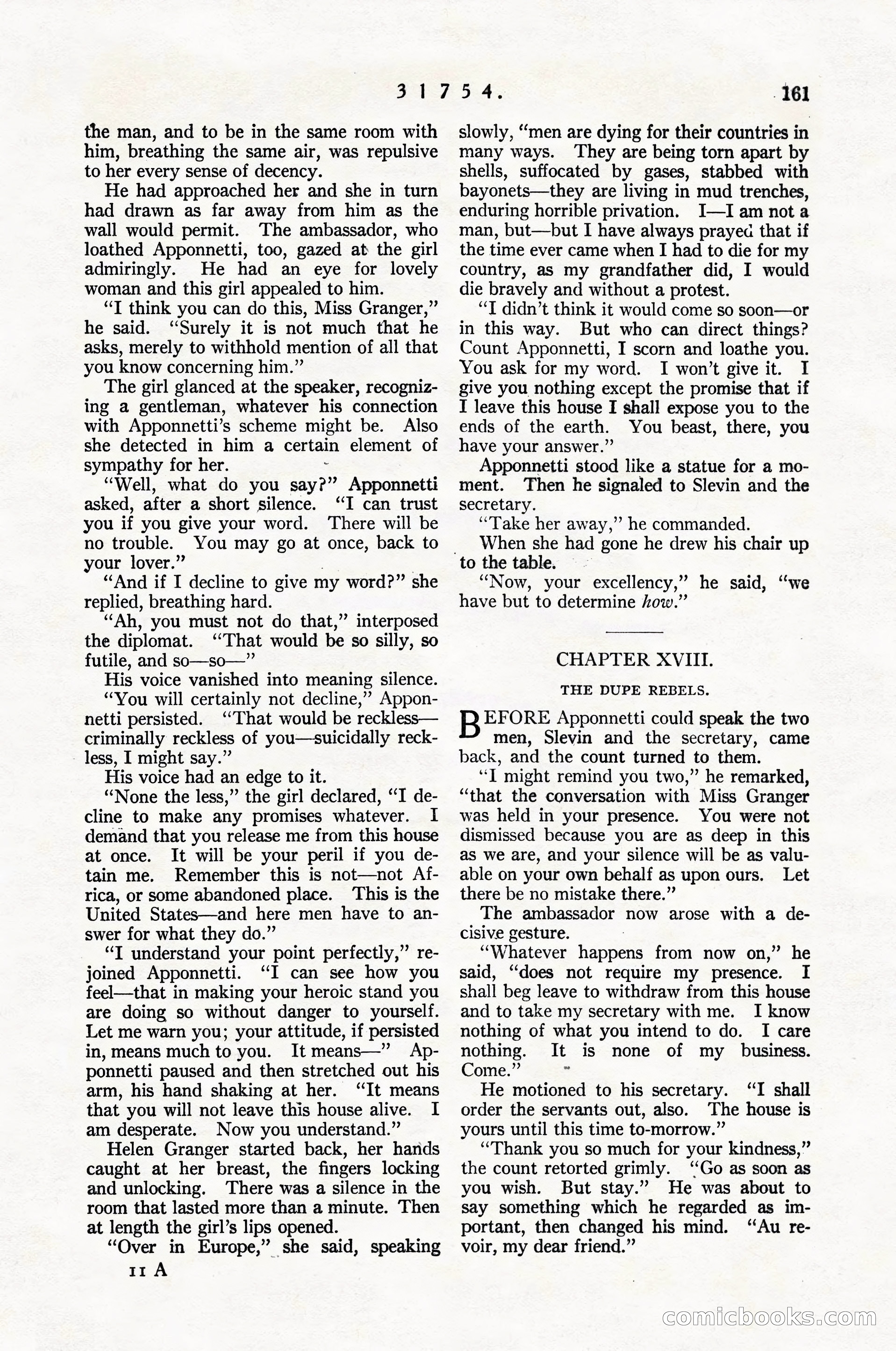
A restored page from Pulp Fiction, 1916. Page through the whole issue in the reader above.
📄 Transcribed text from this page (OCR, searchable)
Machine-transcribed from the original scan — historical spelling and the odd misread are preserved.
31754. the man, and to be in the same room with him, breathing the same air, was repulsive to her every sense of decency. He had approached her and she in turn had drawn as far away from him as the wall would permit. The ambassador, who loathed Apponnetti, too, gazed at the girl admiringly. He had an eye for lovely woman and this girl appealed to him. “T think you can do this, Miss Granger,” he said. “Surely it is not much that he asks, merely to withhold mention of all that you know concerning him.” The girl glanced at the speaker, recogniz- ing a gentleman, whatever his connection with Apponnetti’s scheme might be. Also she detected in him a certain element of sympathy for her. : “Well, what do you say?” Apponnetti asked, after a short silence. “I can trust you if you give your word. ‘There will be no trouble. You may go at once, back to your lover.” 3 7 “And if I decline to give my word?” she replied, breathing hard. ‘“‘Ah, you must not do that,’ interposed the diplomat. ‘That would be so silly, so futile, and so—so—”’ His voice vanished into meaning silence. “Vou will certainly not decline,” Appon- netti persisted. ‘That would be reckless— criminally reckless of you—suicidally reck- less, I might say.” His voice had an edge to it. “None the less,” the girl declared, ‘‘I de- cline to make any promises whatever. I demand that you release me from this house at once. It will be your peril if you de- tain me. Remember this is not—not Af- rica, or some abandoned place. ‘This is the United States—and here men have to an- swer for what they do.” “T understand your point perfectly,” re- joined Apponnetti. “I can see how you feel—that in making your heroic stand you are doing so without danger to yourself. Let me warn you; your attitude, if persisted in, means much to you. It means—” Ap- ponnetti paused and then stretched out his arm, his hand shaking at her. “It means that you will not leave this house alive. I am desperate. Now you understand.” Helen Granger started back, her hands caught at her breast, the fingers locking and unlocking. There was a silence in the room that lasted more than a minute. Then at length the girl’s lips opened. “Over in Europe,” she said, speaking 11 A 161 slowly, “‘men are dying for their countries in many ways. ‘They are being torn apart by Shells, suffocated by gases, stabbed with bayonets—they are living in mud trenches, enduring horrible privation. I—I am nota man, but—but I have always prayec that if the time ever came when I had to die for my country, as my grandfather did, I would die bravely and without a protest. ‘T didn’t think it would come so soon—or in this way. But who can direct things? Count Apponnetti, I scorn and loathe you. You ask for my word. I won’t give it. I give you nothing except the promise that if I leave this house I shall expose you to the ends of the earth. You beast, there, you have your answer.” Apponnetti stood like a statue for a mo- ment. Then he signaled to Slevin and the secretary. ‘Take her away,” he commanded. When she had gone he drew his chair up ‘to the table. ‘“‘Now, your excellency,” he said, ‘we have but to determine how.” CHAPTER XVIII. THE DUPE REBELS. B EFORE Apponnetti could speak the two men, Slevin and the secretary, came back, and the count turned to them. ‘‘T might remind you two,” he remarked, “that the conversation with Miss Granger was held in your presence. You were not dismissed because you are as deep in this as we are, and your silence will be as valu- able on your own behalf as upon ours. Let there be no mistake there.” The ambassador now arose with a de- cisive gesture. “Whatever happens from now on,’ he said, “does not require my presence. I shall beg leave to withdraw from this house and to take my secretary with me. I know nothing of what you intend to do. I care nothing. It is none of my _ business. Come.” ¥ He motioned to his secretary. “I shall order the servants out, also. The house is yours until this time to-morrow.” “Thank you so much for your kindness,” the count retorted grimly. ‘Go as soon as you wish. But stay.” He was about to say something which he regarded as im- portant, then changed his mind. “Au re- voir, my dear friend.” MICLOOOK (C@