
Pulp Fiction, 1916 · page 170 of 220
The Argosy, April 1916 — page 170: what you’re looking at
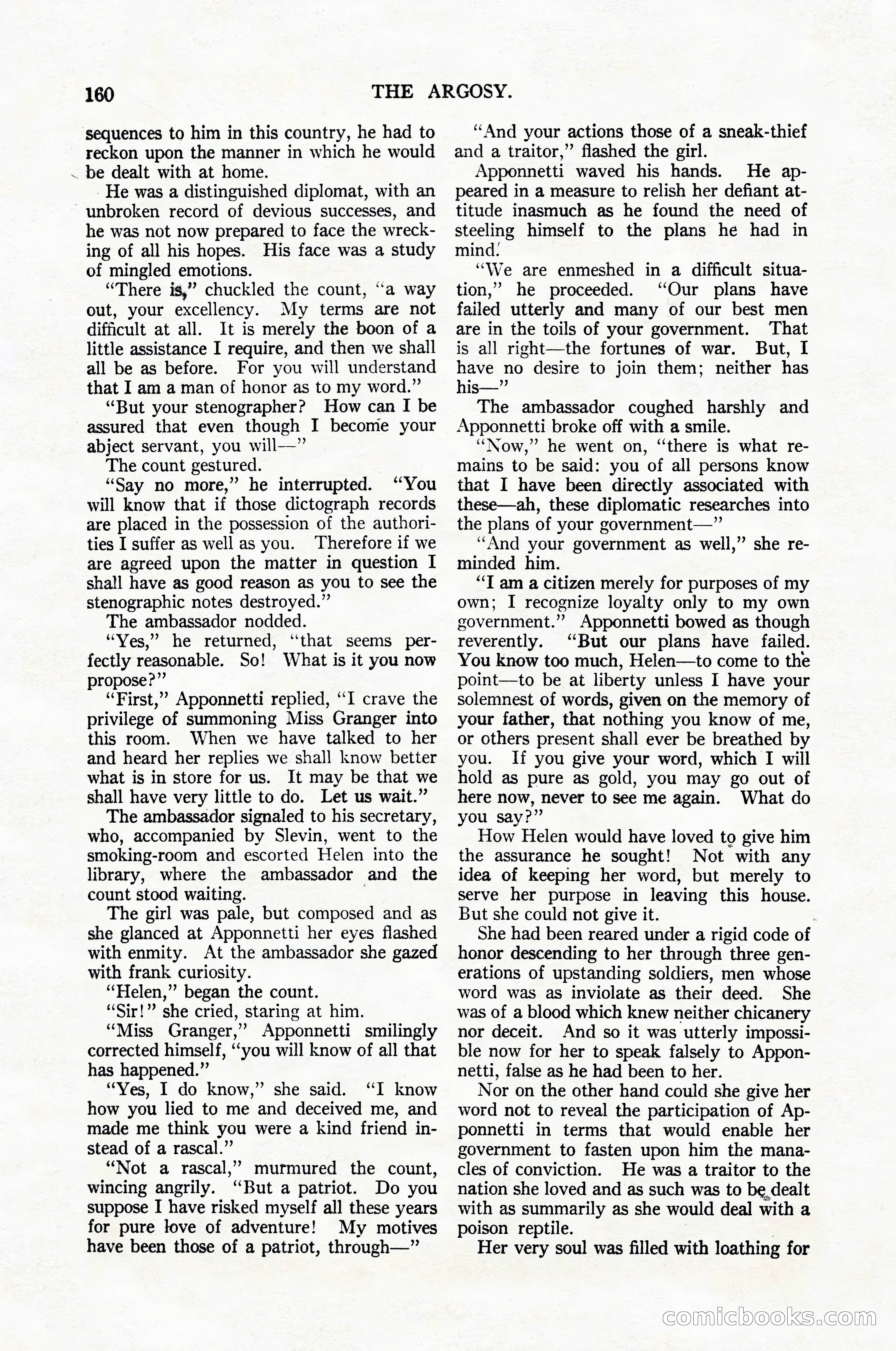
A restored page from Pulp Fiction, 1916. Page through the whole issue in the reader above.
📄 Transcribed text from this page (OCR, searchable)
Machine-transcribed from the original scan — historical spelling and the odd misread are preserved.
160 ‘sequences to him in this country, he had to reckon upon the manner in which he would . be dealt with at home. -He was a distinguished diplomat, with an ~ unbroken record of devious successes, and he was not now prepared to face the wreck- ing of all his hopes. His face was a study of mingled emotions. “There is,” chuckled the count, “a way out, your excellency. My terms are not difficult at all. It is merely the boon of a little assistance I require, and then we shall all be as before. For you will understand that I am a man of honor as to my word.” “But your stenographer? How can I be assured that even though I become your abject servant, you will—”’ The count gestured. “Say no more,” he interrupted. “You will know that if those dictograph records are placed in the possession of the authori- ties I suffer as well as you. Therefore if we are agreed upon the matter in question I shall have as good reason as you to see the stenographic notes destroyed.” The ambassador nodded. “Ves,” he returned, ‘‘that seems per- fectly reasonable. So! What is it you now propose?” “First,” Apponnetti replied, “I crave the privilege of summoning Miss Granger into this room. When we have talked to her and heard her replies we shall know better what is in store for us. It may be that we shall have very little to do. Let us wait.” The ambassador signaled to his secretary, who, accompanied by Slevin, went to the smoking-room and escorted Helen into the library, where the ambassador and the count stood waiting. The girl was pale, but composed and as she glanced at Apponnetti her eyes flashed with enmity. At the ambassador she gazed with frank curiosity. “Helen,” began the count. “Sir!” she cried, staring at him. “Miss Granger,” Apponnetti smilingly corrected himself, ‘“‘you will know of all that has happened.” “Yes, I do know,” she said. “I know how you lied to me and deceived me, and made me think you were a kind friend in- stead of a rascal.” “Not a rascal,’ murmured the count, wincing angrily. “But a patriot. Do you suppose I have risked myself all these years for pure love of adventure! My motives have been those of a patriot, through—”’ THE ARGOSY. “And your actions those of a sneak-thief and a traitor,” flashed the girl. Apponnetti waved his hands. He ap- peared in a measure to relish her defiant at- titude inasmuch as he found the need of steeling himself to the plans he had in mind. ‘We are enmeshed in a difficult situa- tion,” he proceeded. ‘Our plans have failed utterly and many of our best men are in the toils of your government. That is all right—the fortunes of war. But, I have no desire to join them; neither has his—”’ The ambassador coughed harshly and Apponnetti broke off with a smile. ‘““‘Now,” he went on, “there is what re- mains to be said: you of all persons know that I have been directly associated with these—ah, these diplomatic researches into the plans of your government—” ‘‘And your government as well,” she re- minded him. “I am a citizen merely for purposes of my own; I recognize loyalty only to my own government.” Apponnetti bowed as though reverently. ‘But our plans have failed. You know too much, Helen—to come to the point—to be at liberty unless I have your solemnest of words, given on the memory of your father, that nothing you know of me, or others present shall ever be breathed by you. If you give your word, which I will hold as pure as gold, you may go out of here now, never to see me again. What do you say?” How Helen would have loved to give him the assurance he sought! Not with any idea of keeping her word, but merely to serve her purpose in leaving this house. But she could not give it. She had been reared under a rigid code of honor descending to her through three gen- erations of upstanding soldiers, men whose word was as inviolate as their deed. She was of a blood which knew neither chicanery nor deceit. And so it was utterly impossi- ble now for her to speak falsely to Appon- netti, false as he had been to her. Nor on the other hand could she give her word not to reveal the participation of Ap- ponnetti in terms that would enable her government to fasten upon him the mana- cles of conviction. He was a traitor to the nation she loved and as such was to be dealt with as summarily as she would deal with a poison reptile. | Her very soul was filled with loathing for Co DOO im SS (C©@