
Pulp Fiction, 1916 · page 144 of 220
The Argosy, April 1916 — page 144: what you’re looking at
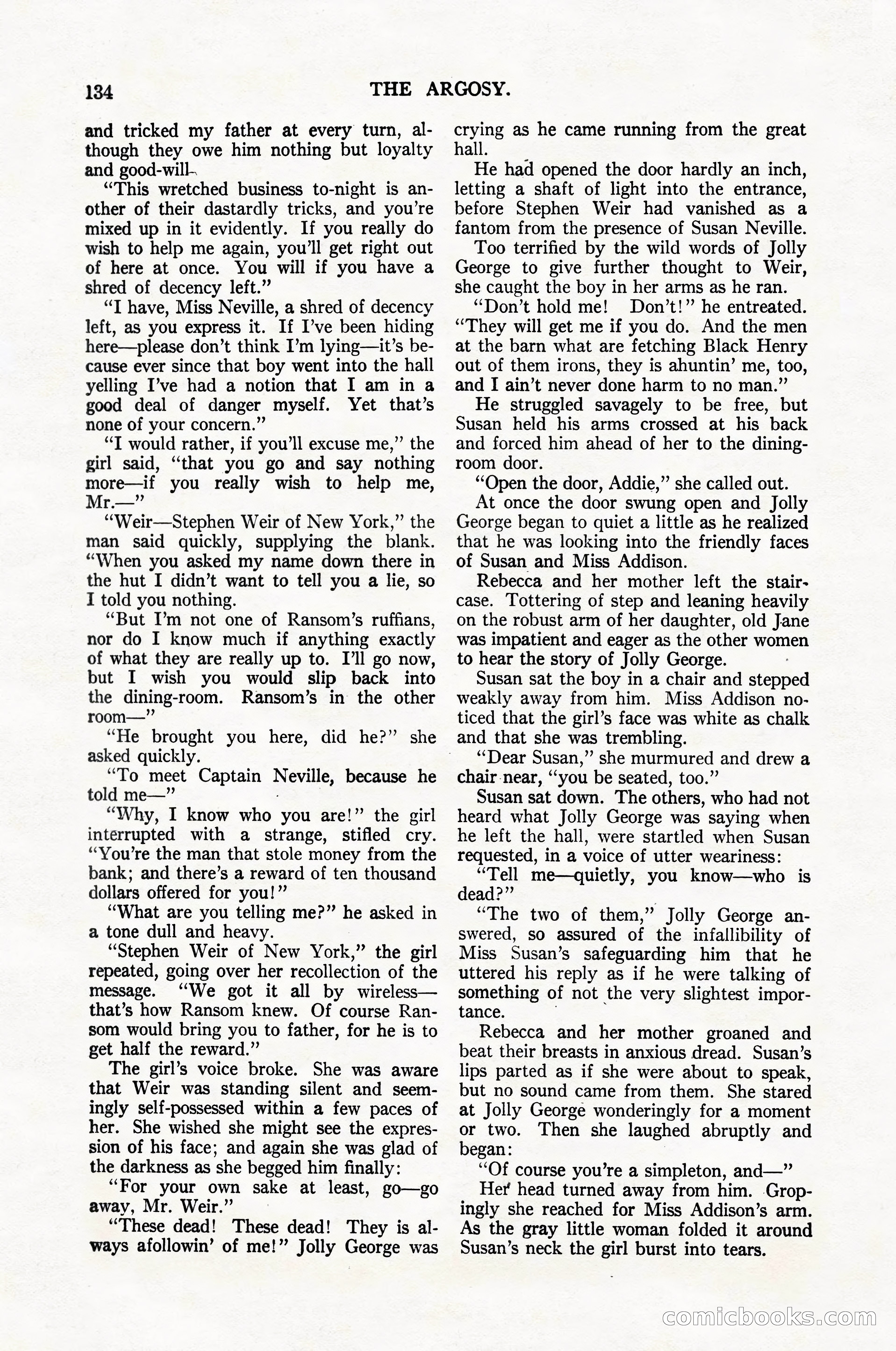
A restored page from Pulp Fiction, 1916. Page through the whole issue in the reader above.
📄 Transcribed text from this page (OCR, searchable)
Machine-transcribed from the original scan — historical spelling and the odd misread are preserved.
134 and tricked my father at every turn, al- though they owe him nothing but loyalty and good-will. “This wretched business to-night is an- other of their dastardly tricks, and you’re mixed up in it evidently. If you really do wish to help me again, you'll get right out of here at once. You will if you have a shred of decency left.” “T have, Miss Neville, a shred of decency left, as you express it. If I’ve been hiding here—please don’t think I’m lying—it’s be- cause ever since that boy went into the hall yelling I’ve had a notion that I am in a good deal of danger myself. Yet that’s none of your concern.” “T would rather, if you'll excuse me,” the girl said, ‘‘that you go and say nothing more—if you really wish to help me, Mr.—” ‘“‘Weir—Stephen Weir of New York,” the man said quickly, supplying the blank. “When you asked my name down there in the hut I didn’t want to tell you a lie, so I told you nothing. “But I’m not one of Ransom’s ruffians, nor do I know much if anything exactly of what they are really up to. Ill go now, but I wish you would slip back into the dining-room. Ransom’s in the other room—”’ ‘He brought you here, did he?” she asked quickly. ‘To meet Captain Neville, because he told me—” : “Why, I know who you are!” the girl interrupted with a strange, stifled cry. “You're the man that stole money from the bank; and there’s a reward of ten thousand dollars offered for you!” ‘‘What are you telling me?” he asked in a tone dull and heavy. “Stephen Weir of New York,” the girl repeated, going over her recollection of the message. “We got it all by wireless— that’s how Ransom knew. Of course Ran- som would bring you to father, for he is to get half the reward.”’ The girl’s voice broke. She was aware that Weir was standing silent and seem- ingly self-possessed within a few paces of her. She wished she might see the expres- sion of his face; and again she was glad of the darkness as she begged him finally: “For your own sake at least, go—go away, Mr. Weir.” “These dead! These dead! They is al- ways afollowin’ of me!” Jolly George was THE ARGOSY. crying as he came running from the great hall. He had opened the door hardly an inch, letting a shaft of light into the entrance, before Stephen Weir had vanished as a fantom from the presence of Susan Neville. Too terrified by the wild words of Jolly George to give further thought to Weir, she caught the boy in her arms as he ran. “Don’t hold me! Don’t!” he entreated. “They will get me if you do. And the men at the barn what are fetching Black Henry out of them irons, they is ahuntin’ me, too, and I ain’t never done harm to no man.” He struggled savagely to be free, but Susan held his arms crossed at his back and forced him ahead of her to the dining- room door. “Open the door, Addie,” she called out. At once the door swung open and Jolly George began to quiet a little as he realized that he was looking into the friendly faces of Susan and Miss Addison. Rebecca and her mother left the stair- case. Tottering of step and leaning heavily on the robust arm of her daughter, old Jane was impatient and eager as the other women to hear the story of Jolly George. Susan sat the boy in a chair and stepped weakly away from him. Miss Addison no- ticed that the girl’s face was white as chalk and that she was trembling. ‘Dear Susan,” she murmured and drew a chair -near, ‘‘you be seated, too.” Susan sat down. The others, who had not heard what Jolly George was saying when he left the hall, were startled when Susan requested, in a voice of utter weariness: “Tell me—quietly, you know—who is dead?” | “The two of them,” Jolly George an- swered, so assured of the infallibility of Miss Susan’s safeguarding him that he uttered his reply as if he were talking of something of not the very slightest impor- tance. Rebecca and her mother groaned and beat their breasts in anxious dread. Susan’s lips parted as if she were about to speak, but no sound came from them. She stared at Jolly George wonderingly for a moment or two. Then she laughed abruptly and began: | ‘Of course you’re a simpleton, and—”’ Her head turned away from him. Grop- ingly she reached for Miss Addison’s arm. As the gray little woman folded it around Susan’s neck the girl burst into tears. Gomiicovdook C@