
Pulp Fiction, 1916 · page 143 of 220
The Argosy, April 1916 — page 143: what you’re looking at
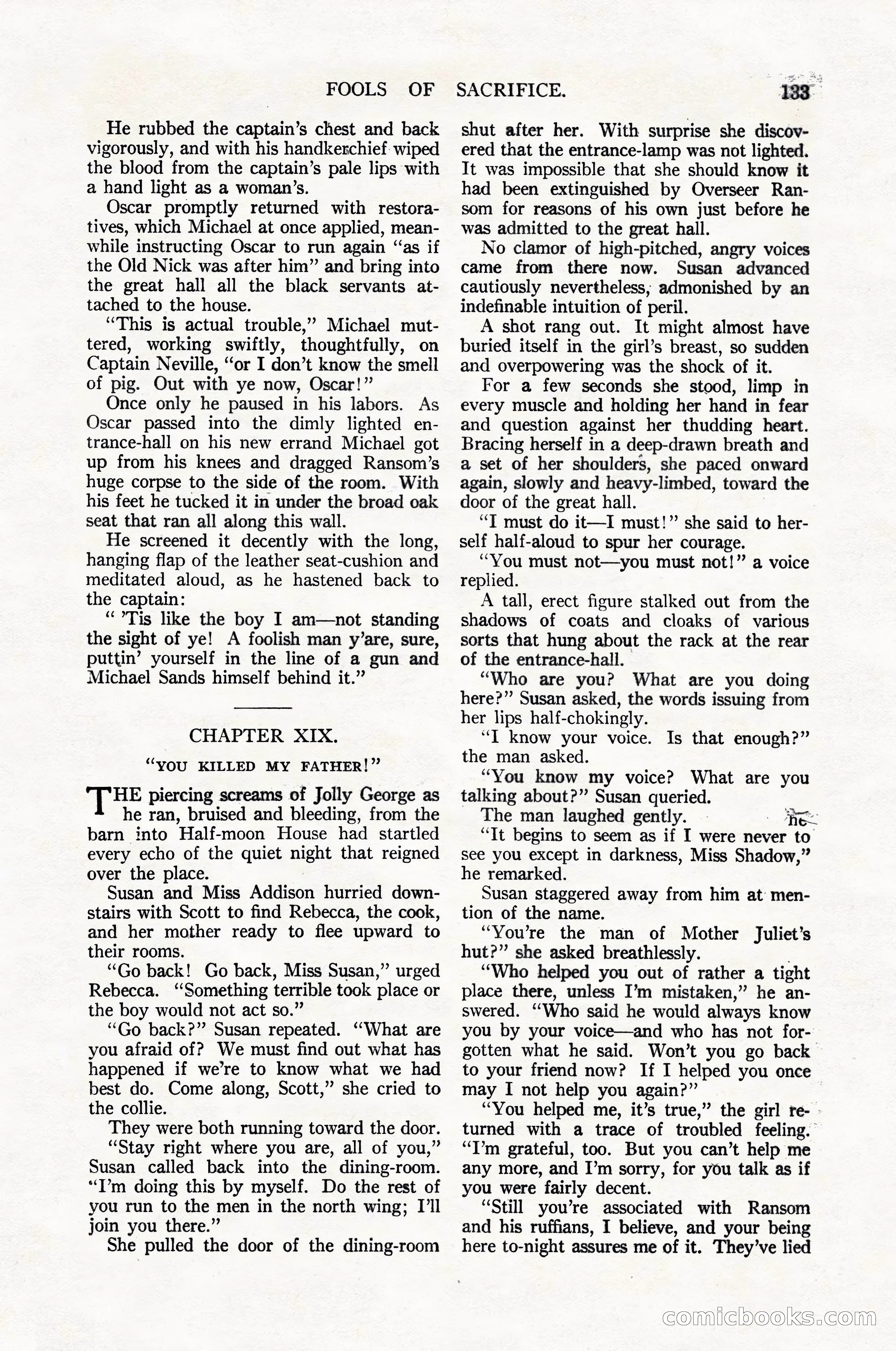
A restored page from Pulp Fiction, 1916. Page through the whole issue in the reader above.
📄 Transcribed text from this page (OCR, searchable)
Machine-transcribed from the original scan — historical spelling and the odd misread are preserved.
FOOLS OF He rubbed the captain’s chest and back vigorously, and with his handkerchief: wiped the blood from the captain’s pale lips with a hand light as a woman’s. Oscar promptly returned with restora- tives, which Michael at once applied, mean- while instructing Oscar to run again “as if the Old Nick was after him” and bring into the great hall all the black servants at- tached to the house. “This is actual trouble,” Michael mut- tered, working swiftly, thoughtfully, on Captain Neville, “or I don’t know the smell of pig. Out with ye now, Oscar!” Once only he paused in his labors. As Oscar passed into the dimly lighted en- trance-hall on his new errand Michael got up from his knees and dragged Ransom’s huge corpse to the side of the room. With his feet he tucked it in under the broad oak seat that ran all along this wall. He screened it decently with the long, hanging flap of the leather seat-cushion and meditated aloud, as he hastened back to the captain: “°Tis like the boy I am—not standing the sight of ye! A foolish man y’are, sure, puttin’ yourself in the line of a gun and Michael Sands himself behind it.” CHAPTER XIX. “YoU KILLED MY FATHER!” "THE piercing screams of Jolly George as he ran, bruised and bleeding, from the barn into Half-moon House had startled every echo of the quiet night that reigned over the place. Susan and Miss Addison hurried down- stairs with Scott to find Rebecca, the cook, and her mother ready to flee upward to their rooms. “Go back! Go back, Miss Susan,” urged Rebecca. ‘Something terrible took place or the boy would not act so.” “Go back?” Susan repeated. ‘‘What are you afraid of? We must find out what has happened if we’re to know what we had best do. Come along, Scott,” she cried to the collie. They were both running toward the door. “Stay right where you are, all of you,” Susan called back into the dining-room. “I’m doing this by myself. Do the rest of you run to the men in the north wing; I'll join you there.” She pulled the door of the dining-room SACRIFICE, shut after her. With surprise she discov- ered that the entrance-lamp was not lighted. It was impossible that she should know it had been extinguished by Overseer Ran- som for reasons of his own just before he was admitted to the great hall. No clamor of high-pitched, angry voices came from there now. Susan advanced cautiously nevertheless, admonished by an indefinable intuition of peril. A shot rang out. It might almost have buried itself in the girl’s breast, so sudden and overpowering was the shock of it. For a few seconds she stood, limp in every muscle and holding her hand in fear and question against her thudding heart. Bracing herself in a deep-drawn breath and a set of her shoulders, she paced onward again, slowly and heavy-limbed, toward the door of the great hall. “T must do it—I must!” she said to her- self half-aloud to spur her courage. ‘You must not—you must not!” a voice replied. A tall, erect figure stalked out from the shadows of coats and cloaks of various sorts that hung about the rack at the rear of the entrance-hall. “Who are your? What are you doing here?” Susan asked, the words issuing from her lips half-chokingly. ‘I know your voice. Is that enough?” the man asked. “You know my voice? What are you talking about?” Susan queried. The man laughed gently. “It begins to seem as if I were never to see you except in darkness, Miss Shadow,” he remarked. Susan staggered away from him at men- tion of the name. ‘“You’re the man of Mother Juliet’s hut?” she asked breathlessly. ‘Who helped you out of rather a tight place there, unless I’m mistaken,” he an- swered. “Who said he would always know you by your voice—and who has not for- gotten what he said. Won’t you go back to your friend now? If I helped you once may I not help you again?” ‘You helped me, it’s true,” the girl re- - turned with a trace of troubled feeling. “I’m grateful, too. But you can’t help me any more, and I’m sorry, for you talk as if you were fairly decent. “Still you’re associated with Ransom and his ruffians, I believe, and your being here to-night assures me of it. They’ve lied COnmiclbooks Ly a C@©