
Pulp Fiction, 1916 · page 103 of 220
The Argosy, April 1916 — page 103: what you’re looking at
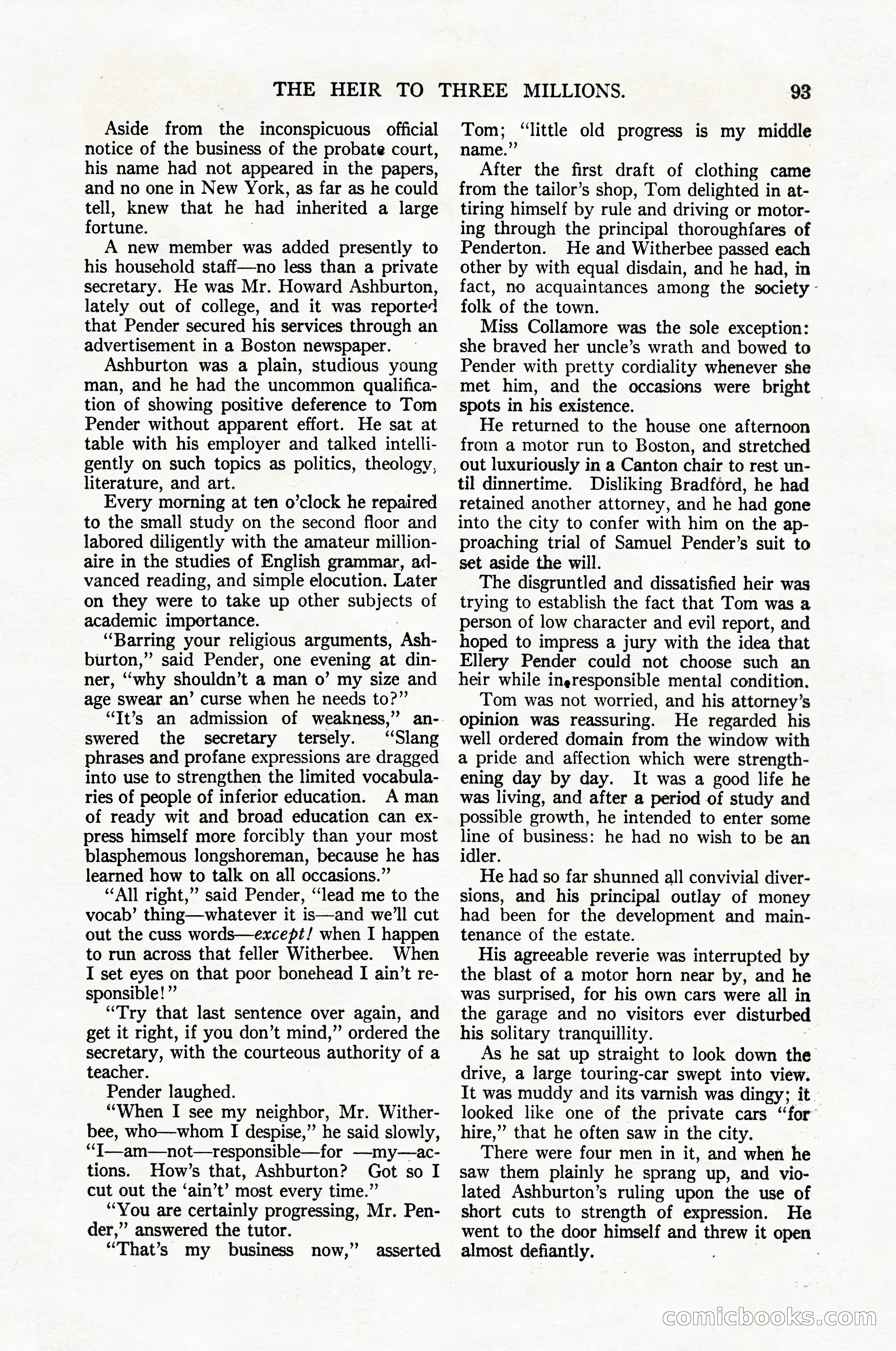
A restored page from Pulp Fiction, 1916. Page through the whole issue in the reader above.
📄 Transcribed text from this page (OCR, searchable)
Machine-transcribed from the original scan — historical spelling and the odd misread are preserved.
THE HEIR TO THREE MILLIONS. Aside from the inconspicuous official notice of the business of the probate court, his name had not appeared in the papers, and no one in New York, as far as he could tell, knew that he had inherited a large fortune. A new member was added presently to his household staff—no less than a private secretary. He was Mr. Howard Ashburton, lately out of college, and it was reported that Pender secured his services through an advertisement in a Boston newspaper. Ashburton was a plain, studious young man, and he had the uncommon qualifica- tion of showing positive deference to Tom Pender without apparent effort. He sat at table with his employer and talked intelli- gently on such topics as politics, theology, literature, and art. Every morning at ten o’clock he repaired to the small study on the second floor and labored diligently with the amateur million- aire in the studies of English grammar, ad- vanced reading, and simple elocution. Later on they were to take up other sup etts of academic importance. “Barring your religious arguments, ‘Ash- burton,” said Pender, one evening at din- ner, “why shouldn’t a man o’ my size and age swear an’ curse when he needs to?”’ “It’s an admission of weakness,” an- swered the secretary tersely. ‘Slang phrases and profane expressions are dragged into use to strengthen the limited vocabula- ries of people of inferior education. A man of ready wit and broad education can ex- press himself more forcibly than your most blasphemous longshoreman, because he has learned how to talk on all occasions.”’ ‘“‘All right,”’ said Pender, ‘‘lead me to the vocab’ thing—whatever it is—and we'll cut out the cuss words—except!/ when I happen to run across that feller Witherbee. When I set eyes on that poor bonehead I ain’t re- sponsible!” “Try that last sentence over again, and get it right, if you don’t mind,” ordered the secretary, with the courteous authority of a teacher. Pender laughed. “‘When I see my neighbor, Mr. Wither- bee, who—whom I despise,” he said slowly, ‘“‘{—am—not—responsible—for —-my—ac- tions. How’s that, Ashburton? Got so I cut out the ‘ain’t’ most every time.” “You are certainly progressing, Mr. Pen- der,”’ answered the tutor. “That’s my business now,’ asserted 93 Tom; name.” After the first draft of clothing came from the tailor’s shop, Tom delighted in at- tiring himself by rule and driving or motor- ing through the principal thoroughfares of Penderton. He and Witherbee passed each other by with equal disdain, and he had, in “little old progress is my middle fact, no acquaintances among the society - folk of the town. Miss Collamore was the sole exception: she braved her uncle’s wrath and bowed to Pender with pretty cordiality whenever she met him, and the occasions were bright — spots in his existence. He returned to the house one afternoon from a motor run to Boston, and stretched out luxuriously in a Canton chair to rest un- til dinnertime. Disliking Bradford, he had retained another attorney, and he had gone into the city to confer with him on the ap- proaching trial of Samuel Pender’s suit to set aside the will. : The disgruntled and dissatisfied heir was trying to establish the fact that Tom was a person of low character and evil report, and hoped to impress a jury with the idea that Ellery Pender could not choose such an heir while ineresponsible mental condition. Tom was not worried, and his attorney’s opinion was reassuring. He regarded his well ordered domain from the window with a pride and affection which were strength- ening day by day. It was a good life he was living, and after a period of study and possible growth, he intended to enter some line of business: he had no wish to be an idler. He had so far shunned all convivial diver- sions, and his principal outlay of money had been for the development and main- tenance of the estate. His agreeable reverie was interrupted by the blast of a motor horn near by, and he was surprised, for his own cars were all in the garage and no visitors ever disturbed his solitary tranquillity. As he sat up straight to look down the drive, a large touring-car swept into view. It was muddy and its varnish was dingy; it looked like one of the private cars “for- hire,” that he often saw in the city. There were four men in it, and when he saw them plainly he sprang up, and vio- lated Ashburton’s ruling upon the use of short cuts to strength of expression. He went to the door himself and threw it open almost defiantly. 1OOOLK C@