
Pulp Fiction, 1916 · page 102 of 220
The Argosy, April 1916 — page 102: what you’re looking at
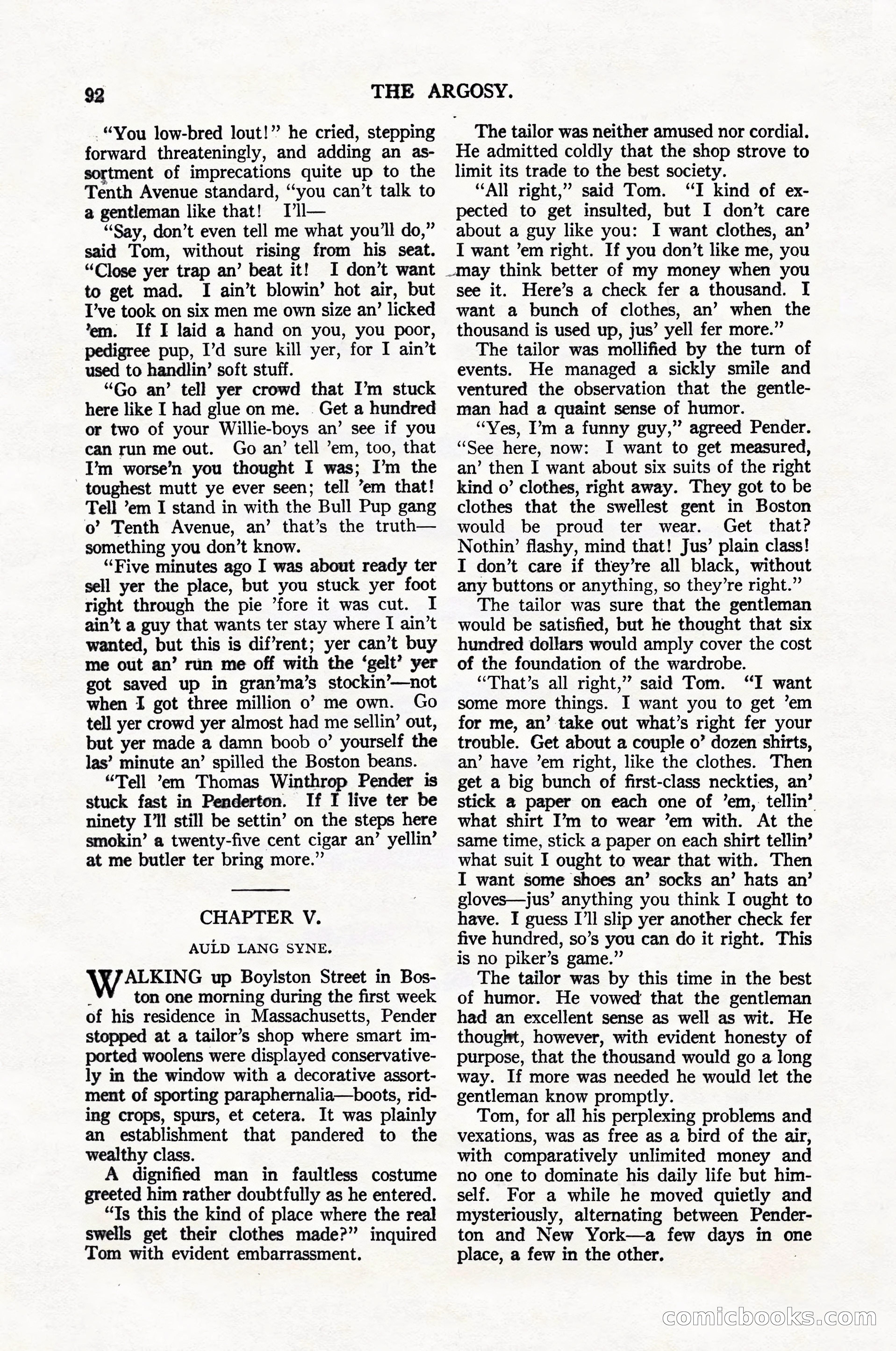
A restored page from Pulp Fiction, 1916. Page through the whole issue in the reader above.
📄 Transcribed text from this page (OCR, searchable)
Machine-transcribed from the original scan — historical spelling and the odd misread are preserved.
92 “You low-bred lout!’ he cried, stepping forward threateningly, and adding an as- rtment of imprecations quite up to the Tenth Avenue standard, “you can’t talk to a gentleman like that! T’ll— “Say, don’t even tell me what you'll do,” said Tom, without rising from his seat. “Close yer trap an’ beat it! I don’t want to get mad. I ain’t blowin’ hot air, but I’ve took on six men me own size an’ licked ’em. If I laid a hand on you, you poor, pedigree pup, I’d sure kill yer, for I ain’t used to handlin’ soft stuff. “Go an’ tell yer crowd that I’m stuck here like I had glue on me. . Get a hundred or two of your Willie-boys an’ see if you can run me out. Go an’ tell ’em, too, that I’m worse’n you thought I was; I’m the toughest mutt ye ever seen; tell ’em that! Tell ’em I stand in with the Bull Pup gang o’ Tenth Avenue, an’ that’s the truth— something you don’t know. “Five minutes ago I was about ready ter sell yer the place, but you stuck yer foot right through the pie ’fore it was cut. I ain’t a guy that wants ter stay where I ain’t wanted, but this is dif’rent; yer can’t buy me out an’ run me off with the ‘gelt’ yer got saved up in gran’ma’s stockin’—not when I got three million 0’ me own. Go tell yer crowd yer almost had me sellin’ out, but yer made a damn boob o’ yourself the las’ minute an’ spilled the Boston beans. “Tell ’em Thomas Winthrop Pender is stuck fast in Penderton. If I live ter be ninety I’ll still be settin’ on the steps here smokin’ a twenty-five cent cigar an’ yellin’ at me butler ter bring more.” CHAPTER V. AULD LANG SYNE. SE fares G up Boylston Street in Bos- ; ton one morning during the first week of his residence in Massachusetts, Pender stopped at a tailor’s shop where smart im- ported woolens were displayed conservative- ly in the window with a decorative assort- ment of sporting paraphernalia—boots, rid- ing crops, spurs, et cetera. It was plainly an establishment that pandered to the wealthy class. A dignified man in faultless costume greeted him rather doubtfully as he entered. “Ts this the kind of place where the real swells get their clothes made?” inquired Tom with evident embarrassment. THE ARGOSY. The tailor was neither amused nor cordial. He admitted coldly that the shop strove to limit its trade to the best society. “All right,” said Tom. “I kind of ex- pected to get insulted, but I don’t care about a guy like you: I want clothes, an’ I want ’em right. If you don’t like me, you _may think better of my money when you see it. Here’s a check fer a thousand. I want a bunch of clothes, an’ when the thousand is used up, jus’ yell fer more.” The tailor was mollified by the turn of events. He managed a sickly smile and ventured the observation that the gentle- man had a quaint sense of humor. “Ves, I’m a funny guy,” agreed Pender. “See here, now: I want to get measured, an’ then I want about six suits of the right kind o’ clothes, right away. They got to be clothes that the swellest gent in Boston would be proud ter wear. Get that? Nothin’ flashy, mind that! Jus’ plain class! I don’t care if they’re all black, without any buttons or anything, so they’re right.” The tailor was sure that the gentleman would be satisfied, but he thought that six hundred dollars would amply cover the cost of the foundation of the wardrobe. “That’s all right,” said Tom. “I want some more things. I want you to get ’em for me, an’ take out what’s right fer your trouble. Get about a couple o’ dozen shirts, an’ have ’em right, like the clothes. Then get a big bunch of first-class neckties, an’ stick a paper on each one of ’em, tellin’ what shirt I’m to wear ’em with. At the same time, stick a paper on each shirt tellin’ what suit I ought to wear that with. Then I want some shoes an’ socks an’ hats an’ gloves—jus’ anything you think I ought to have. I guess I’ll slip yer another check fer five hundred, so’s you can do it right. This is no piker’s game.” The tailor was by this time in the best of humor. He vowed that the gentleman had an excellent sense as well as wit. He thougkt, however, with evident honesty of purpose, that the thousand would go a long way. If more was needed he would let the gentleman know promptly. Tom, for all his perplexing problems and vexations, was as free as a bird of the air, with comparatively unlimited money and no one to dominate his daily life but him- self. For a while he moved quietly and mysteriously, alternating between Pender- ton and New York—a few days in on place, a few in the other. 7 conmicloool (C©