
Pulp Fiction, 1912 · page 157 of 276
The Argosy, Christmas 1912 — page 157: what you’re looking at
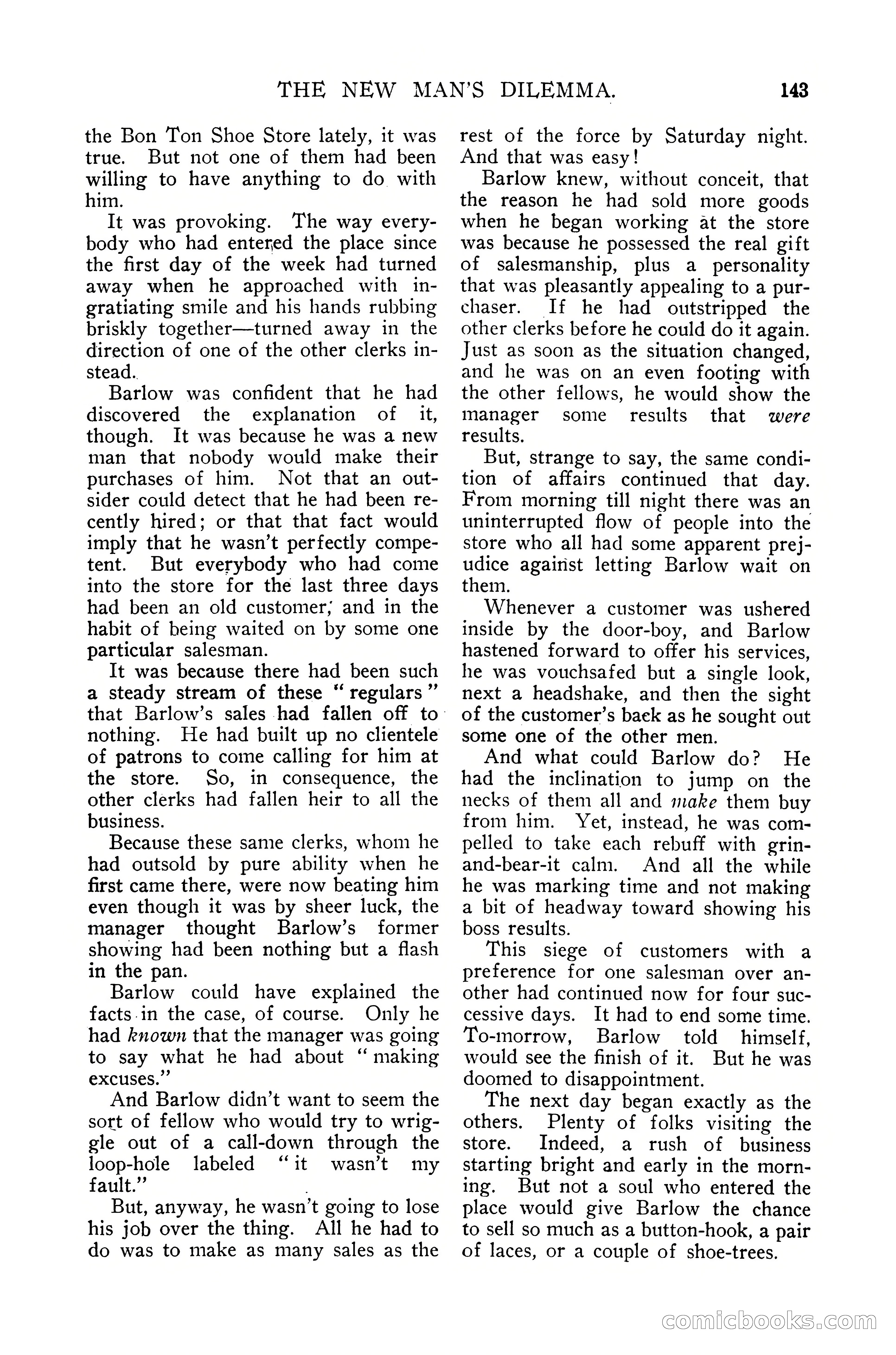
A restored page from Pulp Fiction, 1912. Page through the whole issue in the reader above.
📄 Transcribed text from this page (OCR, searchable)
Machine-transcribed from the original scan — historical spelling and the odd misread are preserved.
THE NEW MAN’S DILEMMA. the Bon Ton Shoe Store lately, it was true. But not one of them had been willing to have anything to do with him. It was provoking. The way every- body who had entered the place since the first day of the week had turned away when he approached with in- gratiating smile and his hands rubbing briskly together—turned away in the direction of one of the other clerks in- stead. Barlow was confident that he had discovered the explanation of it, though. It was because he was a new man that nobody would make their purchases of him. Not that an out- sider could detect that he had been re- cently hired; or that that fact would imply that he wasn’t perfectly compe- tent. But everybody who had come into the store for the last three days had been an old customer; and in the habit of heing waited on by some one particular salesman. It was because there had been such a steady stream of these “ regulars ”’ that Barlow’s sales had fallen off to nothing. He had built up no clientele of patrons to come calling for him at the store. So, in consequence, the other clerks had fallen heir to all the business. Because these same clerks, whom he had outsold by pure ability when he first came there, were now beating him even though it was by sheer luck, the manager thought Barlow’s former showing had been nothing but a flash in the pan. Barlow could have explained the facts.in the case, of course. Only he had known that the manager was going to say what he had about “ making excuses.” And Barlow didn’t want to seem the sort of fellow who would try to wrig- gle out of a call-down through the loop-hole labeled “it wasn’t my fault.” But, anyway, he wasn’t going to lose his job over the thing. All he had to do was to make as many sales as the 143 rest of the force by Saturday night. And that was easy! Barlow knew, without conceit, that the reason he had sold more goods when he began working at the store was because he possessed the real gift of salesmanship, plus a personality that was pleasantly appealing to a pur- chaser. If he had outstripped the other clerks before he could do it again. Just as soon as the situation changed, and he was on an even footing with the other fellows, he would show the manager some results that were results. But, strange to say, the same condi- tion of affairs continued that day. From morning till night there was an uninterrupted flow of people into the store who all had some apparent prej- udice agairist letting Barlow wait on them. Whenever a customer was ushered inside by the door-boy, and Barlow hastened forward to offer his services, he was vouchsafed but a single look, next a headshake, and then the sight of the customer’s baek as he sought out some one of the other men. And what could Barlow do? He had the inclination to jump on the necks of them all and make them buy from him. Yet, instead, he was com- pelled to take each rebuff with grin- and-bear-it calm. And all the while he was marking time and not making a bit of headway toward showing his boss results. This siege of customers with a preference for one salesman over an- other had continued now for four suc- cessive days. It had to end some time. To-morrow, Barlow told himself, would see the finish of it. But he was doomed to disappointment. The next day began exactly as the others. Plenty of folks visiting the store. Indeed, a rush of business starting bright and early in the morn- ing. But not a soul who entered the place would give Barlow the chance to sell so much as a button-hook, a pair of laces, or a couple of shoe-trees. oO CoOMmicbook CO