
Pulp Fiction, 1909 · page 46 of 227
The Argosy for May — page 46: what you’re looking at
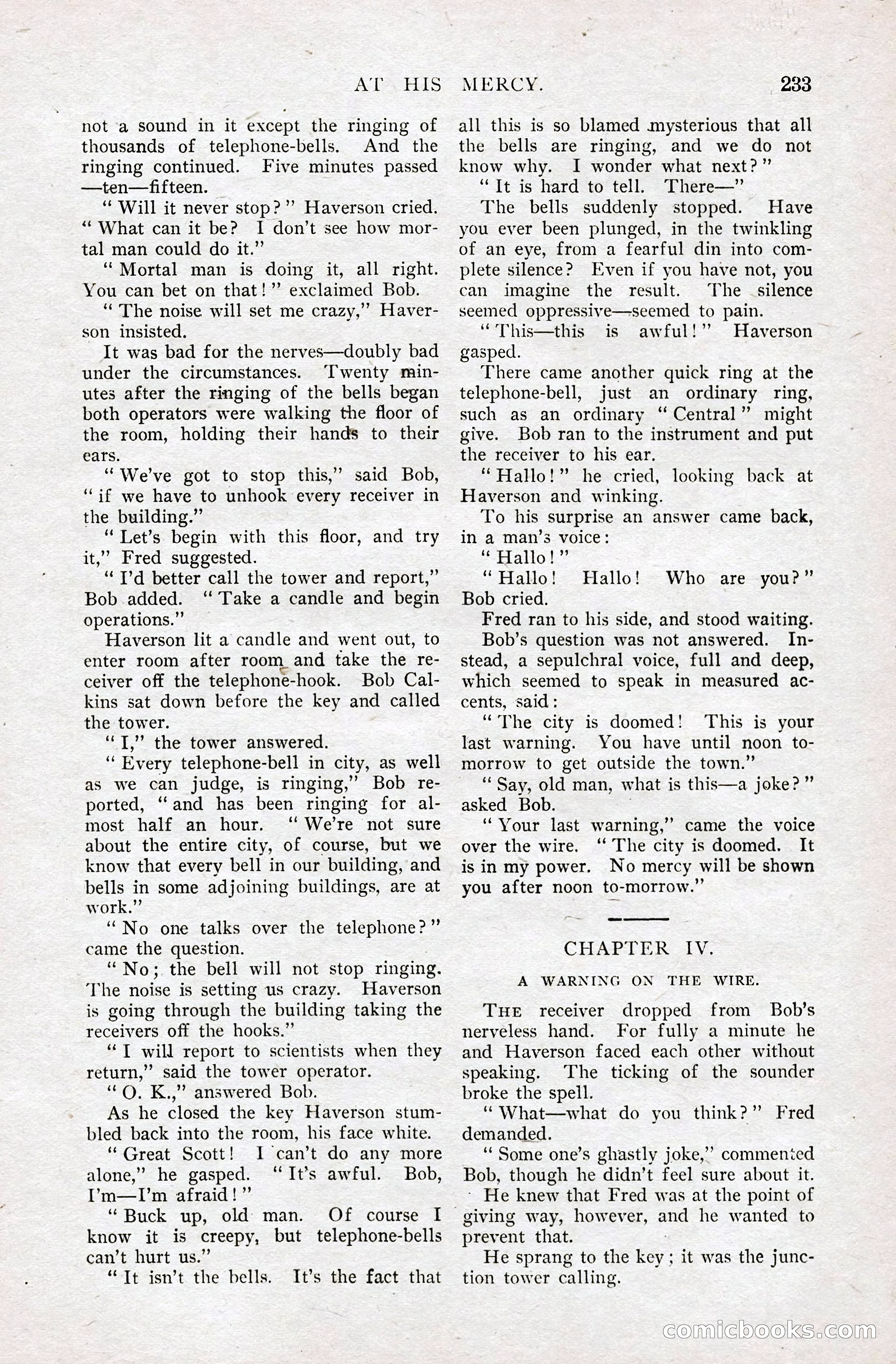
A restored page from Pulp Fiction, 1909. Page through the whole issue in the reader above.
📄 Transcribed text from this page (OCR, searchable)
Machine-transcribed from the original scan — historical spelling and the odd misread are preserved.
AL-SHAS not a sound in it except the ringing of thousands of telephone-bells. And the ringing continued. Five minutes passed —ten—fifteen. ‘Will it never stop? ’’ Haverson cried. “What can it be? I don’t see how mor- tal man could do it.” ‘Mortal man is doing it, all right. You can bet on that!” exclaimed Bob. ‘The noise will set me crazy,” Haver- son insisted. It was bad for the nerves—doubly bad under the circumstances. ‘“TWenty min- utes after the ringing of the bells began both operators were walking the floor of the room, holding their hands to their ears. ‘We've got to stop this,’ said Bob, ‘‘if we have to unhook every receiver in the building.” ‘“Let’s begin with this floor, and try it,’ Fred suggested. ‘“T’d better call the tower and report,” Bob added. ‘“‘ Take a candle and begin operations.” Haverson lit a candle and went out, to enter room after room and take the re- ceiver off the telephone- -hook. Bob Cal- kins sat down before the key and called the tower. ‘“T,”’ the tower answered. ‘Every telephone-bell in city, as well as we can judge, is ringing,” Bob re- ported, “and has been ringing for al- most half an hour. “ We’re not sure about the entire city, of course, but we know that every bell in our building, and bells in some adjoining buildings, are at work.” “No one talks over the telephone?” came the question. “No; the bell will not stop ringing. The noise is setting us crazy. Haverson is going through the building taking the receivers off the hooks.” “T will report to scientists when they return,” said the tower operator. “QO. K.,” answered Bob. As he closed the key Haverson stum- bled back into the room, his face white. “Great Scott! 1 can’t do any more alone,’ he gasped. “It’s awful. Bob, I’m—I’m afraid!”’ “Buck up, old man. Of course I know it is creepy, but telephone-bells can’t hurt us.” “Tt isn’t the bells. It’s the fact that MERCY. 233 all this is so blamed mysterious that all the bells are ringing, and we do not know why. I wonder what next?” ‘It is hard to tell, There—” The bells suddenly stopped. Have you ever been plunged, in the twinkling of an eye, from a fearful din into com- plete silence? Even if you have not, you can imagine the result. The silence seemed oppressive—seemed to pain. “This—this is awful!” Haverson gasped. There came another quick ring at the telephone-bell, just an ordinary ring, such as an ordinary “ Central” might give. Bob ran to the instrument and put the receiver to his ear. “Hallo!” he cried, looking back at Haverson and winking. To his surprise an answer came back, in a man’s voice: ‘ Hallo!” “ Hallo! Bob cried. Fred ran to his side, and stood waiting. Bob’s question was not answered. In- stead, a sepulchral voice, full and deep, which seemed to speak in measured ac- cents, said: “The city is doomed! This is your last warning. You have until noon to- morrow to get outside the town.” Say, old man, w hat is this—a joke?” asked Bob. “Your last warning,” over the wire. “‘ The city is doomed. It is in my power. No mercy will be shown you after noon to-morrow.” Hallo! Who are you?” came the voice CHAPTER IV. ON A WARNING THE WIRE. THE receiver dropped from Bob’s nerveless hand. For fully a minute he and Haverson faced each other without speaking. The ticking of the sounder broke the spell. “What—what do you think?” Fred demanded. ‘‘ Some one’s ghastly joke,’’ commenied Bob, though he didn’t feel sure about it. He knew that Fred was at the point of giving way, however, and he wanted to prevent that. He sprang to the ioe it was the junc- tion tower calling. (C@ DOOLK (C©)