
Pulp Fiction, 1909 · page 186 of 227
The Argosy for May — page 186: what you’re looking at
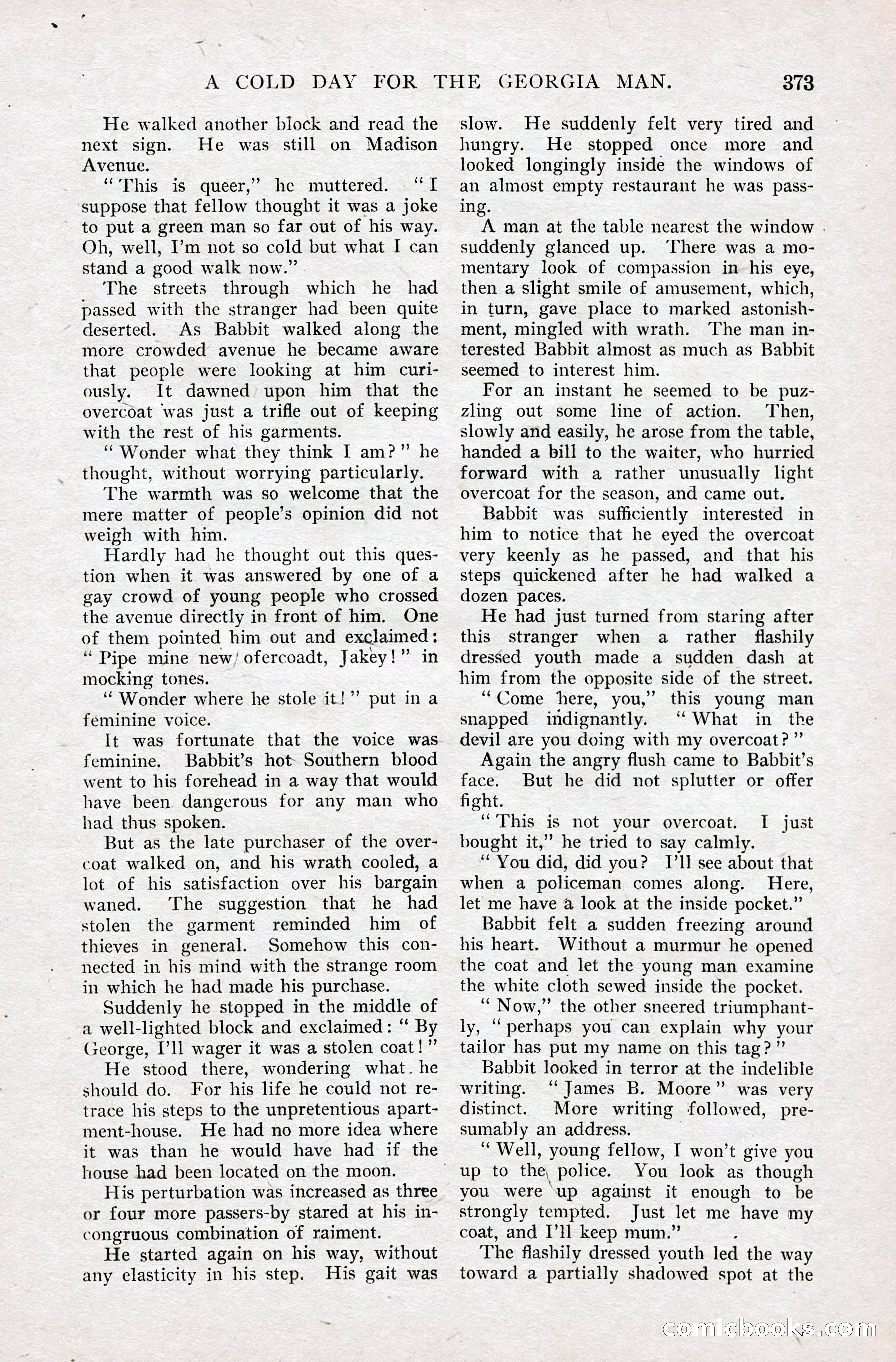
A restored page from Pulp Fiction, 1909. Page through the whole issue in the reader above.
📄 Transcribed text from this page (OCR, searchable)
Machine-transcribed from the original scan — historical spelling and the odd misread are preserved.
A COLD DAY He walked another block and read the next sign. He was still on Madison Avenue. “This is queer,” he muttered. “I ‘suppose that fellow thought it was a joke to put a green man so far out of his way. Oh, well, I’m not so cold but what I can stand a good walk now.” The streets through which he had passed with the stranger had been quite deserted. As Babbit walked along the more crowded avenue he became aware that people were looking at him curi- ously. It dawned upon him that the overcoat was just a trifle out of keeping with the rest of his garments. ‘Wonder what they think I am?” he thought, without worrying particularly. The warmth was so welcome that the mere matter of people’s opinion did not weigh with him. Hardly had he thought out this ques- tion when it was answered by one of a gay crowd of young people who crossed the avenue directly in front of him. One of them pointed him out and exclaimed : “ Pipe mine new/ ofercoadt, Jakey!” in mocking tones. ‘Wonder where he stole it!’’ put in a feminine voice. It was fortunate that the voice was feminine. Babbit’s hot- Southern blood went to his forehead in a way that would have been dangerous for any man who had thus spoken. But as the late purchaser of the over- coat walked on, and his wrath cooled, a lot of his satisfaction over his bargain waned. The suggestion that he had stolen the garment reminded him of thieves in general. Somehow this con- nected in his mind with the strange room in which he had made his purchase. Suddenly he stopped in the middle of a well-lighted block and exclaimed: “ By George, I’ll wager it was a stolen coat!” He stood there, wondering what. he should do. For his life he could not re- trace his steps to the unpretentious apart- ment-house. He had no more idea where it was than he would have had if the louse had been located on the moon. His perturbation was increased as three or four more passers-by stared at his in- congruous combination of raiment. He started again on his way, without any elasticity in his step. His gait was 2% FOR THE GEORGIA MAN. up to the, police. 373 slow. He suddenly felt very tired and hungry. He stopped once more and looked longingly inside the windows of an almost empty restaurant he was pass- ing. A man at the table nearest the window . suddenly glanced up. ‘There was a mo- mentary look of compassion in his eye, then a slight smile of amusement, which, in turn, gave place to marked astonish- ment, mingled with wrath. The man in- terested Babbit almost as much as Babbit seemed to interest him. For an instant he seemed to be puz- zling out some line of action. Then, slowly and easily, he arose from the table, handed a bill to the waiter, who hurried forward with a rather unusually light overcoat for the season, and came out. Babbit was sufficiently interested in him to notice that he eyed the overcoat very keenly as he passed, and that his steps quickened after he had walked a dozen paces. He had just turned from staring after this stranger when a rather flashily dressed youth made a sudden dash at him from the opposite side of the street. ‘Come here, you,’ this young man snapped itidignantly. “What in the devil are you doing with my overcoat?” Again the angry flush came to Babbit’s face. But he did not splutter or offer fight. “This is not your overcoat. bought it,” he tried to say calmly. “ You did, did you? I’ll see about that when a policeman comes along. Here, let me have @ look at the inside pocket.” Babbit felt a sudden freezing around his heart. Without a murmur he opened the coat and let the young man examine the white cloth sewed inside the pocket. ‘“ Now,” the other sneered triumphant- lye perhaps you can explain why your tailor has put my name on this tag?” Babbit looked in terror at the indelible writing. “James B. Moore” was very distinct. More writing followed, pre- sumably an address. ‘ Well, young fellow, I won’t give you You look as though you were up against it enough to be strongly tempted. Just let me have my coat, and I’ll keep mum.” The flashily dressed youth led the way toward a partially shadowed spot at the T just (EO) 0)(0)(6) ANC S (C©)