
Pulp Fiction, 1909 · page 185 of 227
The Argosy for May — page 185: what you’re looking at
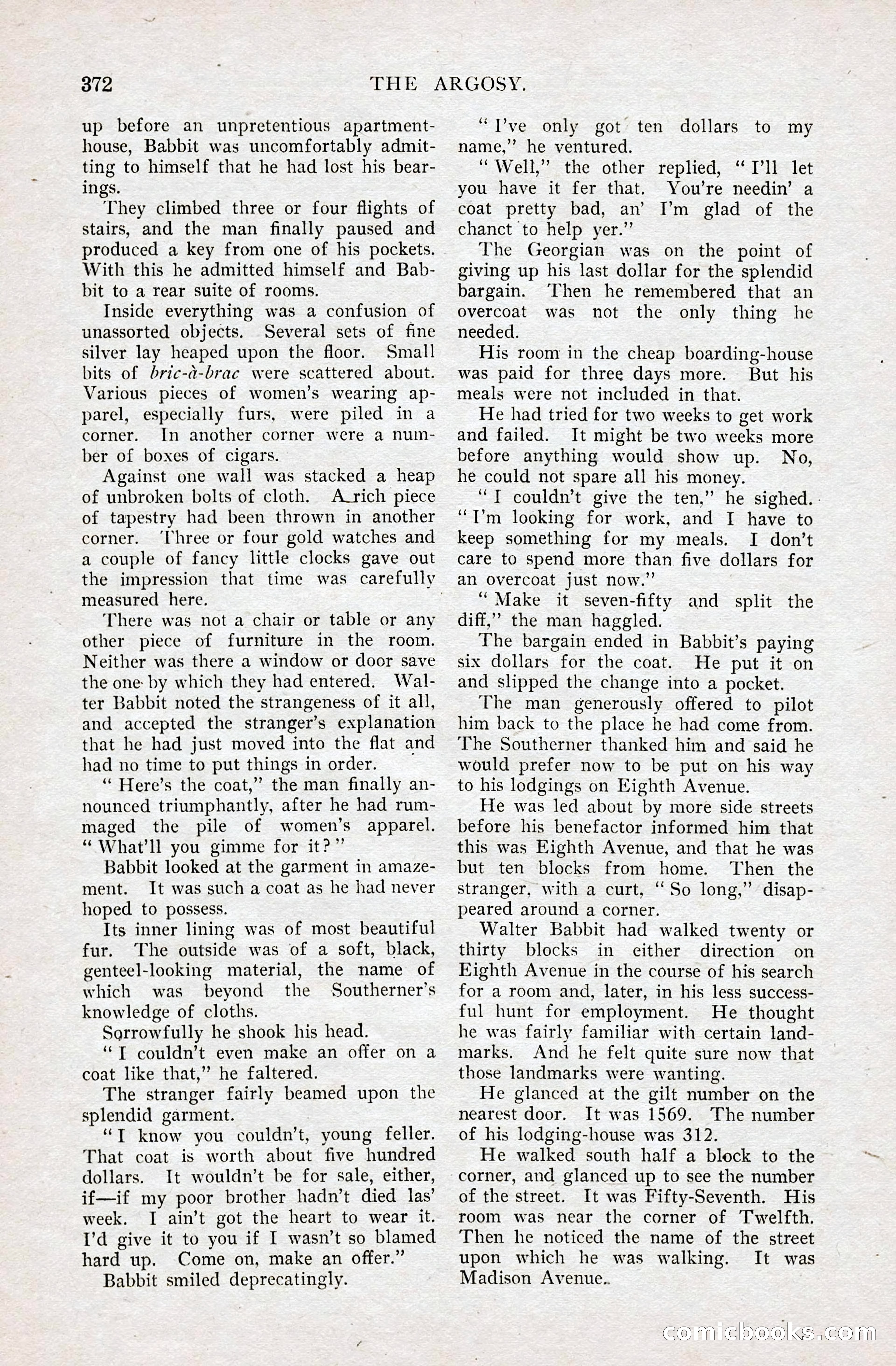
A restored page from Pulp Fiction, 1909. Page through the whole issue in the reader above.
📄 Transcribed text from this page (OCR, searchable)
Machine-transcribed from the original scan — historical spelling and the odd misread are preserved.
372 THE up before an unpretentious apartment- house, Babbit was uncomfortably admit- ting to himself that he had lost his bear- ings. They climbed three or four flights of stairs, and the man finally paused and produced a key from one of his pockets. With this he admitted himself and Bab- bit to a rear suite of rooms. Inside everything was a confusion of unassorted objects. Several sets of fine silver lay heaped upon the floor. Small bits of bric-a-brac were scattered about. Various pieces of women’s wearing ap- parel, especially furs, were piled in a corner. In another corner were a nuin- ber of boxes of cigars. Against one wall was stacked a heap of unbroken bolts of cloth. A_rich piece of tapestry had been thrown in another corner. ‘Three or four gold watches and a couple of fancy little clocks gave out the impression that time was carefully measured here. There was not a chair or table or any other piece of furniture in the room. Neither was there a window or door save the one by which they had entered. Wal- ter Babbit noted the strangeness of it all, and accepted the stranger’s explanation that he had just moved into the flat and had no time to put things in order. ‘“Here’s the coat,” the man finally an- nounced triumphantly, after he had rum- maged the pile of women’s apparel. “ What’ll you gimme for it?” Babbit looked at the garment in amaze- ment. It was such a coat as he had never hoped to possess. Its inner lining was of most beautiful fur. The outside was of a soft, black, genteel-looking material, the name of which was beyond the Southerner’s knowledge of cloths. Serrowfully he shook his head. ‘““T couldn’t even make an offer on a coat like that,’”’ he faltered. The stranger fairly beamed upon the splendid garment. “T know you couldn’t, young feller. That coat is worth about five hundred dollars. It wouldn’t be for sale, either, if—if my poor brother hadn’t died las’ week. I ain’t got the heart to wear it. I'd give it to you if I wasn’t so blamed hard up. Come on, make an offer.” Babbit smiled deprecatingly. ARGOSY. ‘“T’ve only got ten dollars to my name,” he ventured. “Well,” the other replied, ‘ I’ll let you have it fer that. You’re needin’ a coat pretty bad, an’ I’m glad of the chanct to help yer.” The Georgian was on the point of giving up his last dollar for the splendid bargain. ‘Then he remembered that an overcoat was not the only thing he needed. His room in the cheap boarding-house was paid for three days more. But his meals were not included in that. He had tried for two weeks to get work and failed. It might be two weeks more before anything would show up. No, he could not spare all his money. “IT couldn’t give the ten,” he sighed. - “I’m looking for work, and I have to keep something for my meals. I don’t care to spend more than five dollars for an overcoat just now.” “Make it seven-fifty and split the diff,”’ the man haggled. The bargain ended in Babbit’s paying six dollars for the coat. He put it on and slipped the change into a pocket. The man generously offered to pilot him back to the place he had come from. The Southerner thanked him and said he would prefer now to be put on his way to his lodgings on Eighth Avenue. He was led about by more side streets before his benefactor informed him that this was Eighth Avenue, and that he was but ten blocks from home. Then the stranger, with a curt, “So long,” disap- peared around a corner. Walter Babbit had walked twenty or thirty blocks in either direction on Eighth Avenue in the course of his search for a room and, later, in his less success- ful hunt for employment. He thought he was fairly familiar with certain land- marks. And he felt quite sure now that those landmarks were wanting. He glanced at the gilt number on the nearest door. It was 1569. The number of his lodging-house was 312. He walked south half a block to the corner, and glanced up to see the number of the street. It was Fifty-Seventh. His room was near the corner of Twelfth. Then he noticed the name of the street upon which he was walking. It was Madison Avenue.. noolk (C@