
Pulp Fiction, 1909 · page 115 of 227
The Argosy for May — page 115: what you’re looking at
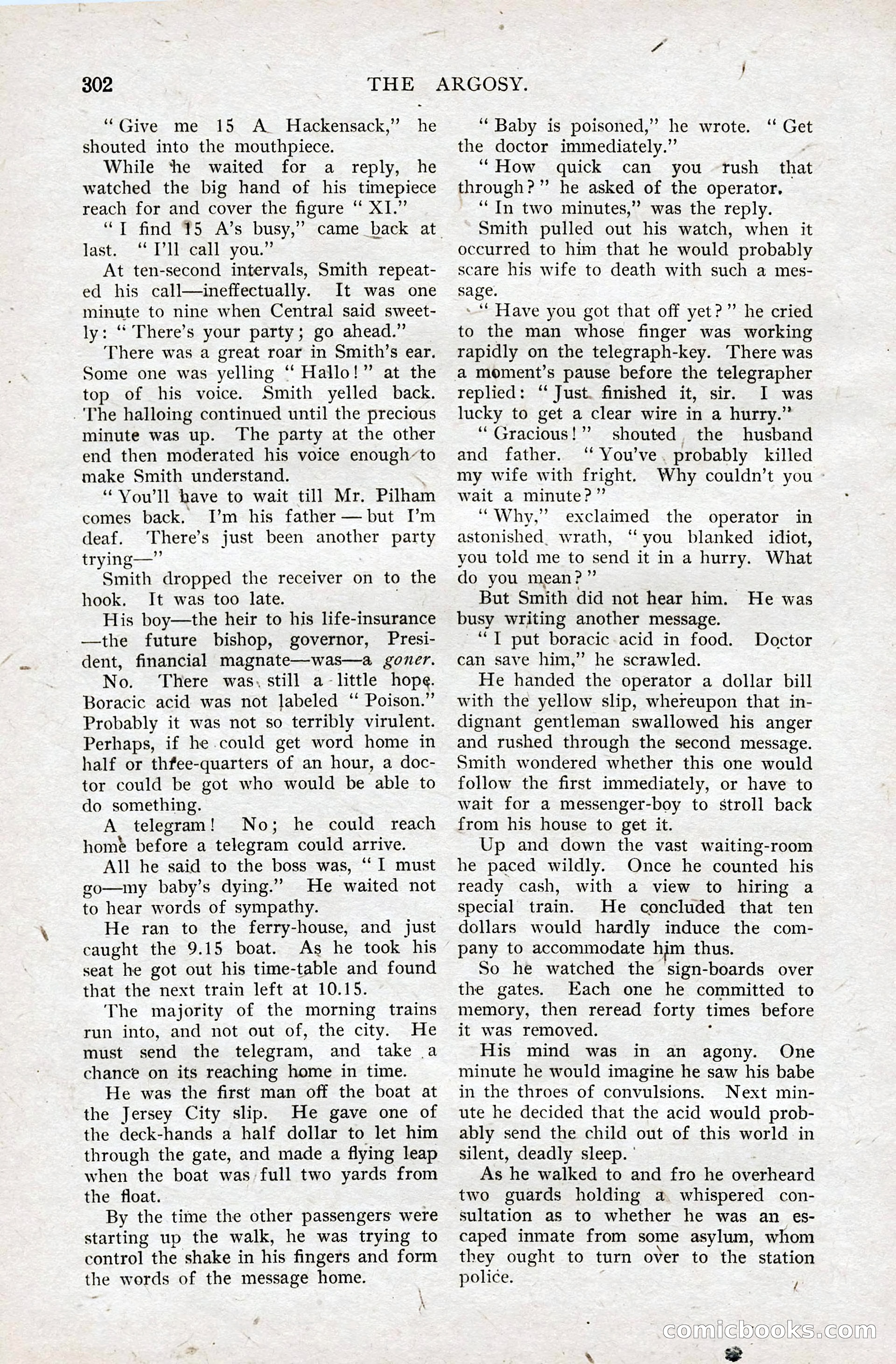
A restored page from Pulp Fiction, 1909. Page through the whole issue in the reader above.
📄 Transcribed text from this page (OCR, searchable)
Machine-transcribed from the original scan — historical spelling and the odd misread are preserved.
302 ‘Give me 15 A_ Hackensack,” he shouted into the mouthpiece. While ‘he waited for a reply, he watched the big hand of his timepiece reach for and cover the figure “ X1.” “TY find 15 A’s busy,” came back at last. ‘‘ T'll call you.” At ten-second intervals, Smith repeat- ed his call—ineffectually. It was one minute to nine when Central said sweet- ly: “ There’s your party; go ahead.” There was a great roar in Smith’s ear. Some one was yelling ‘‘ Hallo!” at the top of his voice. Smith yelled back. . The halloing continued until the precious minute was up. The party at the other end then moderated his voice enough-~to make Smith understand. ‘“Vou'll have to wait till Mr. Pilham comes back. I’m his father — but I’m deaf. There’s just been another party trying—”’ Smith dropped the receiver on to the hook. It was too late. His boy—the heir to his life-insurance —the future bishop, governor, Presi- dent, financial magnate—was—a goner. No. There was, still alittle hope. Boracic acid was not labeled “ Poison.” Probably it was not so terribly virulent. Perhaps, if he could get word home in half or thfee-quarters of an hour, a doc- tor could be got who would be able to do something. A telegram! No; he could reach home before a telegram could arrive. All he said to the boss was, “‘ Il must go—my baby’s dying.” He waited not to hear words of sympathy. He ran to the ferry-house, and just caught the 9.15 boat. As he took his seat he got out his time-table and found that the next train left at 10.15. The majority of the morning trains run into, and not out of, the city. He must send the telegram, and take .a chance on its reaching home in time. He was the first man off the boat at the Jersey City slip. He gave one of the deck-hands a half dollar to let him through the gate, and made a flying leap when the boat was full two yards from the float. By the time the other passengers were starting up the walk, he was trying to control the shake in his fingers and form the words of the message home. THE ARGOSY. ‘Baby is poisoned,” he wrote. ‘‘ Get the doctor immediately.” “How quick can you rush _ that through?” he asked of the operator, ‘In two minutes,” was the reply. Smith pulled out his watch, when it occurred to him that he would probably scare his wife to death with such a mes- sage. ~** Have you got that off yet?” he cried to the man whose finger was working rapidly on the telegraph-key. There was a moment’s pause before the telegrapher replied: ‘ Just. finished it, sir. I was lucky to get a clear wire in a hurry.” ‘“ Gracious!” shouted the husband and father. ‘‘ You’ve. probably killed my wife with fright. wait a minute?” “Why,” exclaimed the operator in astonished. wrath, “you blanked idiot, you told me to send it in a hurry. What do you mean?” But Smith did not hear him. He was busy writing another message. ~“*T put boracic acid in food. Doctor can save him,” he scrawled. He handed the operator a dollar bill with the yellow slip, whereupon that in- dignant gentleman swallowed his anger and rushed through the second message. Smith wondered whether this one would follow the first immediately, or have to wait for a messenger-boy to stroll back from his house to get it. Up and down the vast waiting-room he paced wildly. Once he counted his ready cash, with a view to hiring a special train. He concluded that ten dollars would hardly induce the com- pany to accommodate him thus. So he watched the sign-boards over the gates. Each one he committed to memory, then reread forty times before it was removed. His mind was in an agony. One minute he would imagine he saw his babe in the throes of convulsions. Next min- ute he decided that the acid would prob- ably send the child out of this world in silent, deadly sleep. ' As he walked to and fro he overheard two guards holding a whispered con- sultation as to whether he was an es- caped inmate from some asylum, whom they ought to turn over to the station police. j iMICIOOKS Why couldn’t you - (C@ ¥ Pr