
Pulp Fiction, 1909 · page 114 of 227
The Argosy for May — page 114: what you’re looking at
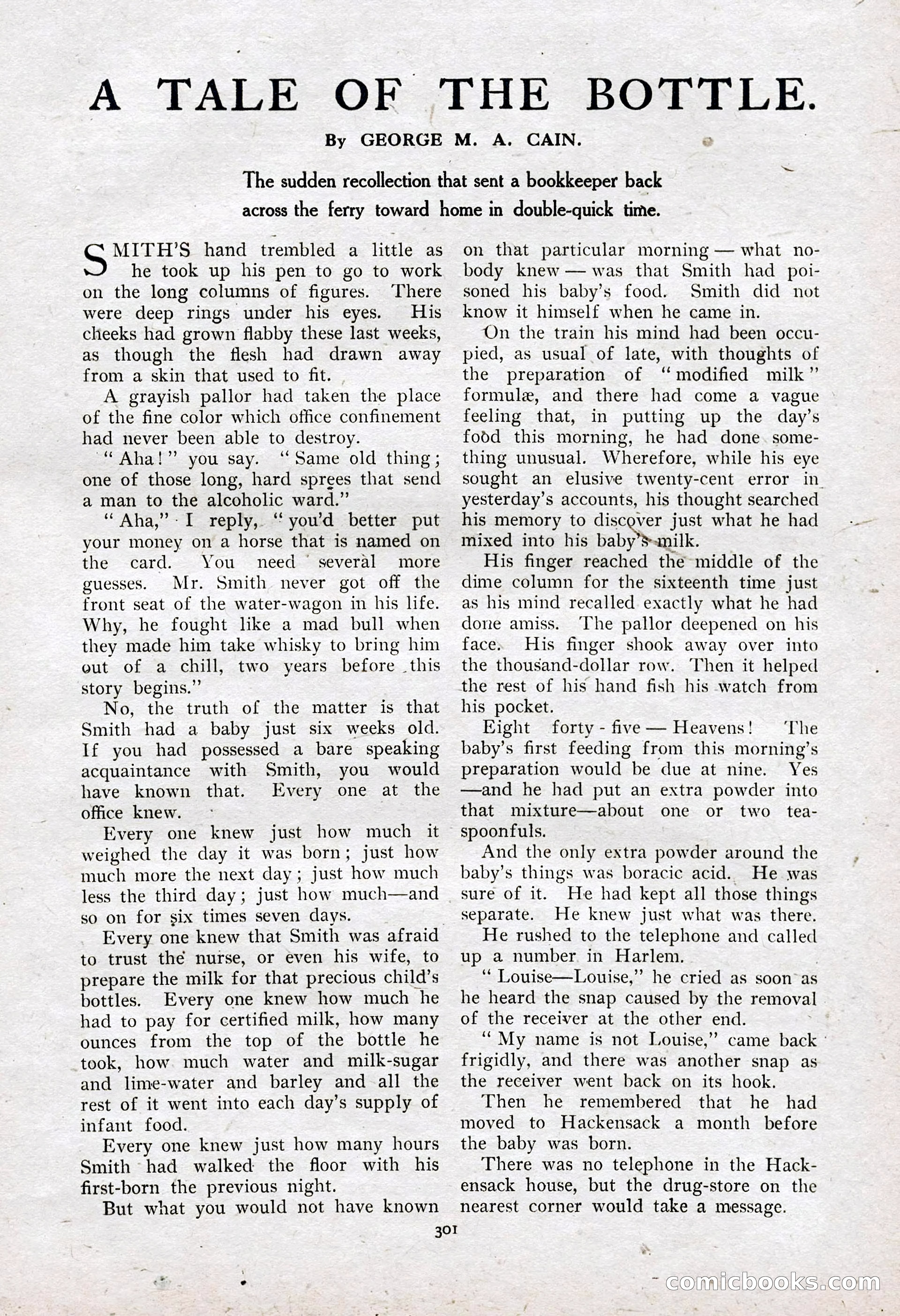
A restored page from Pulp Fiction, 1909. Page through the whole issue in the reader above.
📄 Transcribed text from this page (OCR, searchable)
Machine-transcribed from the original scan — historical spelling and the odd misread are preserved.
A TALE OF THE BOTTLE. By GEORGE M. A. CAIN. © The sudden recollection that sent a bookkeeper back across the ferry toward home in double-quick time. MITH’S hand trembled a little as he took up his pen to go to work on the long columns of figures. ‘There were deep rings under his eyes. His cheeks had grown flabby these last weeks, as though the flesh had drawn away from a skin that used to fit. A grayish pallor had taken the place of the fine color which office confinement had never been able to destroy. “ Aha!” you say. “Same old thing ; one of those long, hard sprees that send a man to the alcoholic ward.” “Aha,” -I reply, “‘ you’d better put your money on a horse that is named on the card. You need several more guesses. Mr. Smith never got off the front seat of the water-wagon in his life. Why, he fought like a mad bull when they made him take whisky to bring him out of a chill, two years before _ this story begins.” No, the truth of the matter is that Smith had a baby just six weeks old. If you had possessed a bare speaking acquaintance with Smith, you would have known that. Every one at the office knew. Every one knew just how much it weighed the day it was born; just how much more the next day; just how much less the third day; just how much—and so on for six times seven days. Every one knew that Smith was afraid to trust the nurse, or even his wife, to prepare the milk for that precious child’s bottles. Every one knew how much he had to pay for certified milk, how many ounces from the top of the bottle he took, how much water and milk-sugar and lime-water and barley and all the rest of it went into each day’s supply of infant food. Every one knew just how many hours Smith had walked the floor with his first-born the previous night. But what you would not have known 301 on that particular morning — what no- body knew — was that Smith had _ poi- soned his baby’s food. Smith did not know it himself when he came in. On the train his mind had been occu- pied, as usual of late, with thoughts of the preparation of “modified milk” formule, and there had come a vague feeling that, in putting up the day’s fodd this morning, he had done. some- thing unusual. Wherefore, while his eye sought an elusive twenty-cent error in. yesterday’s accounts, his thought searched his memory to discover just what he had mixed into his baby sanilk. His finger reached the middle of the dime column for the sixteenth time just as his mind recalled exactly what he had done amiss. ‘The pallor deepened on his face. His finger shook away over into the thousand-dollar row. Then it helped the rest of his hand fish his watch from his pocket. Eight forty - five— Heavens! ‘The baby’s first feeding from this morning’s preparation would be due at nine. Yes —and he had put an extra powder into that mixture—about one or two _ tea- spoonfuls. And the only extra powder around the baby’s things was boracic acid. He was sure of it. He had kept all those things separate. He knew just what was there. He rushed to the telephone and called up a number in Harlem. ‘‘ Louise—Louise,” he cried as soon as he heard the snap caused by the removal of the receiver at the other end. | “ My name is not Louise,” frigidly, and there was another snap as the receiver went back on its hook. Then he remembered that he had moved to Hackensack a month before the baby was born. There was no telephone in the Hack- ensack house, but the drug-store on the nearest corner would take a message. WOOK came back ° (C©)