
Pulp Fiction, 1955 · page 33 of 146
Argosy: The Short Story Magazine — page 33: what you’re looking at
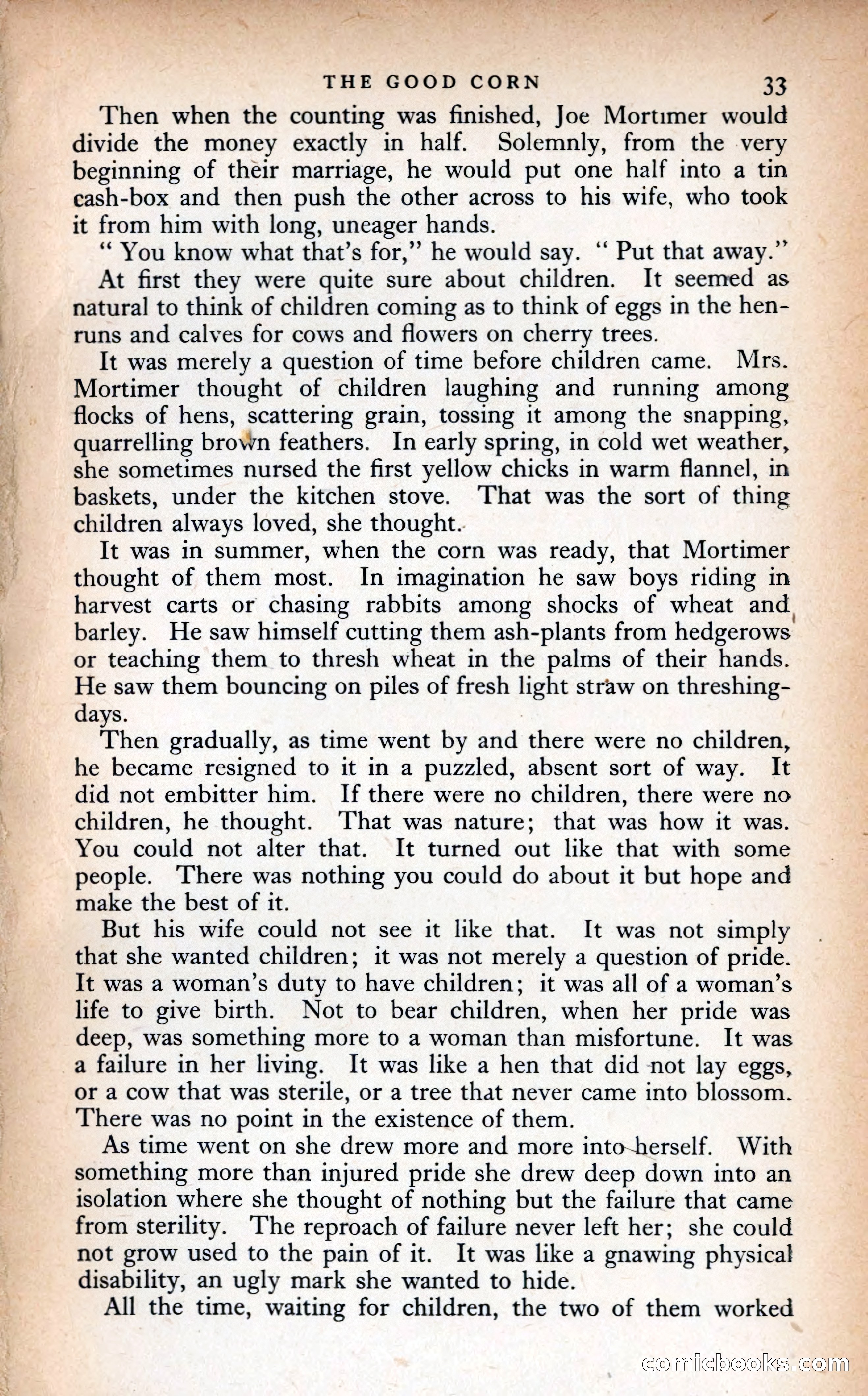
A restored page from Pulp Fiction, 1955. Page through the whole issue in the reader above.
📄 Transcribed text from this page (OCR, searchable)
Machine-transcribed from the original scan — historical spelling and the odd misread are preserved.
PO Lae THE GOOD CORN 33 Then when the counting was finished, Joe Mortimer would divide the money exactly in half. Solemnly, from the very beginning of their marriage, he would put one half into a tin cash-box and then push the other across to his wife, who took it from him with long, uneager hands. ‘You know what that’s for,” he would say. “ Put that away.”’ At first they were quite sure about children. It seemed as natural to think of children coming as to think of eggs in the hen- runs and calves for cows and flowers on cherry trees. It was merely a question of time before children came. Mrs. Mortimer thought of children laughing and running among flocks of hens, scattering grain, tossing it among the snapping, quarrelling brown feathers. In early spring, in cold wet weather, she sometimes nursed the first yellow chicks in warm flannel, in baskets, under the kitchen stove. ‘That was the sort of thing children always loved, she thought. It was in summer, when the corn was ready, that Mortimer thought of them most. In imagination he saw boys riding in harvest carts or chasing rabbits among shocks of wheat and. barley. He saw himself cutting them ash-plants from hedgerows or teaching them to thresh wheat in the palms of their hands. He saw them bouncing on piles of fresh light straw on threshing- days. Then gradually, as time went by and there were no children, he became resigned to it in a puzzled, absent sort of way. It did not embitter him. If there were no children, there were no children, he thought. ‘That was nature; that was how it was. You could not alter that. It turned out like that with some people. ‘There was nothing you could do about it but hope and make the best of it. But his wife could not see it like that. It was not simply that she wanted children; it was not merely a question of pride. It was a woman’s duty to have children; it was all of a woman’s life to give birth. Not to bear children, when her pride was deep, was something more to a woman than misfortune. It was a failure in her living. It was like a hen that did not lay eggs, or a cow that was sterile, or a tree that never came into blossom. There was no point in the existence of them. As time went on she drew more and more into-herself. With something more than injured pride she drew deep down into an isolation where she thought of nothing but the failure that came from sterility. ‘The reproach of failure never left her; she could not grow used to the pain of it. It was like a gnawing physical disability, an ugly mark she wanted to hide. All the time, waiting for children, the two of them worked comiclbooks.comn