
Pulp Fiction, 1865 · page 43 of 399
The Argosy — page 43: what you’re looking at
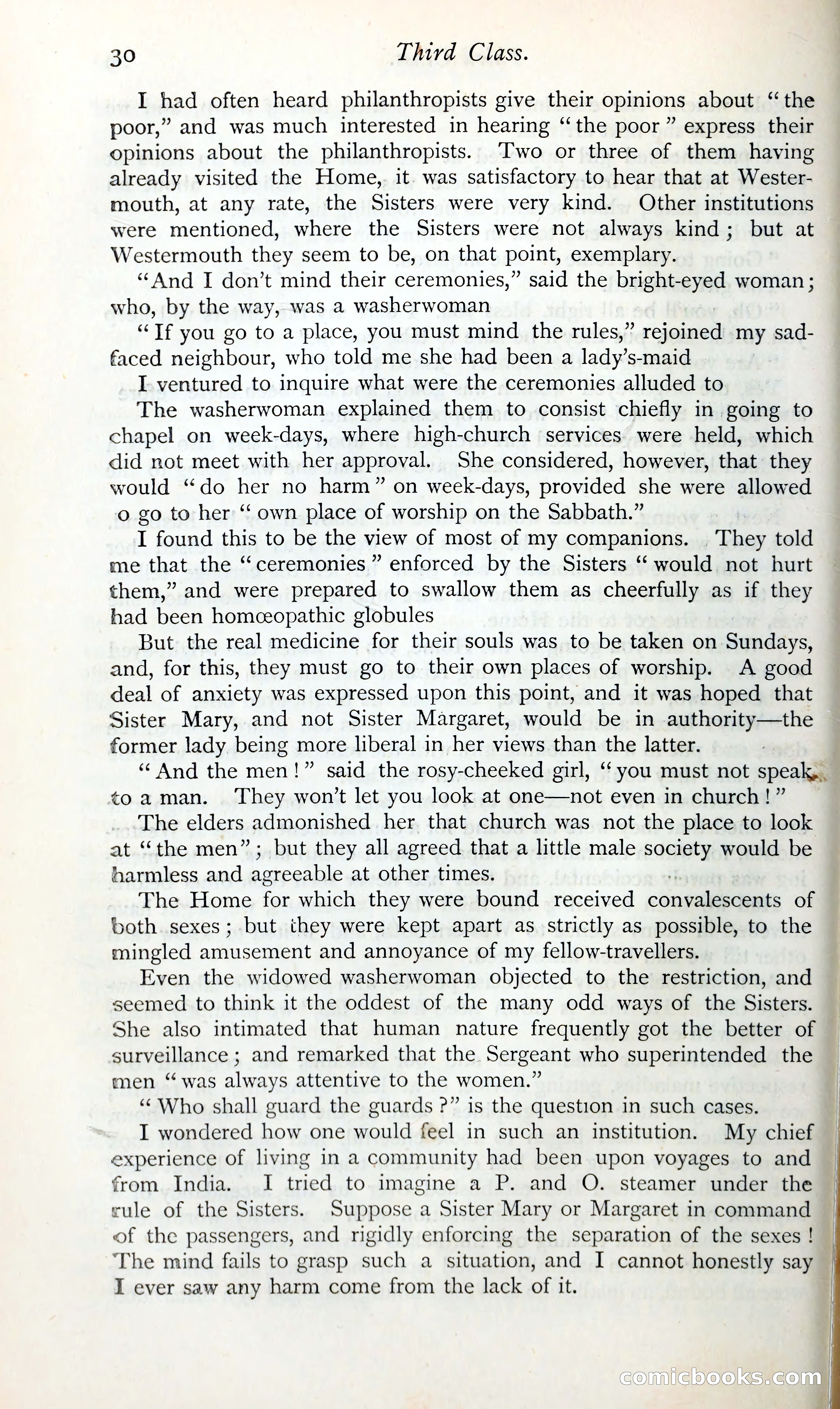
A restored page from Pulp Fiction, 1865. Page through the whole issue in the reader above.
📄 Transcribed text from this page (OCR, searchable)
Machine-transcribed from the original scan — historical spelling and the odd misread are preserved.
30 Third Class. I had often heard philanthropists give their opinions about “the poor,” and was much interested in hearing “the poor” express their opinions about the philanthropists. Two or three of them having already visited the Home, it. was satisfactory to hear that at Wester- mouth, at any rate, the Sisters were very kind. Other institutions were mentioned, where the Sisters were not always kind; but at Westermouth they seem to be, on that point, exemplary. ‘And I don’t mind their ceremonies,” said the bright-eyed woman; who, by the way, was a washerwoman ce “Tf you go to a place, you must mind the rules,” rejoined my sad- faced neighbour, who told me she had been a lady’s-maid I ventured to inquire what were the ceremonies alluded to The washerwoman explained them to consist chiefly in going to chapel on week-days, where high-church services were held, which did not meet with her approval. She considered, however, that they would “do her no harm” on week-days, provided she were allowed o go to her ‘‘ own place of worship on the Sabbath.” I found this to be the view of most of my companions. | They told me that the “ceremonies ” enforced by the Sisters ‘ would not hurt them,” and were prepared to swallow them as cheerfully as if they had been homeceopathic globules But the real medicine for their souls was to be taken on Sundays, and, for this, they must go to their own places of worship. A good deal of anxiety was expressed upon this point, and it was hoped that Sister Mary, and not Sister Margaret, would be in authority—the former lady being more liberal in her views than the latter. ‘And the men!” said the rosy-cheeked girl, ‘‘ you must not speak, toaman. ‘They won’t let you look at one—not even in church!” The elders admonished her that church was not the place to look at “the men”; but they all agreed that a little male society would be harmless and agreeable at other times. The Home for which they were bound received ae owinl of both sexes; but they were kept apart as strictly as possible, to the mingled amusement and annoyance of my fellow-travellers. Even the widowed washerwoman objected to the restriction, and seemed to think it the oddest of the many odd ways of the Sisters. She also intimated that human nature frequently got the better of surveillance ; and remarked that the Sergeant who superintended the men “was always attentive to the women.” ‘Who shall guard the guards ?” is the question in such cases. I wondered how one would feel in such an institution. My chief experience of living in a community had been upon voyages to and from India. I tried to imagine a P. and O. steamer under the rule of the Sisters. Suppose a Sister Mary or Margaret in command of the passengers, and rigidly enforcing the separation of the sexes! ‘The mind fails to grasp such a situation, and I cannot honestly say I ever saw any harm come from the lack of it. ECORNIELIOO KSa(eCvial