
Pulp Fiction, 1865 · page 42 of 399
The Argosy — page 42: what you’re looking at
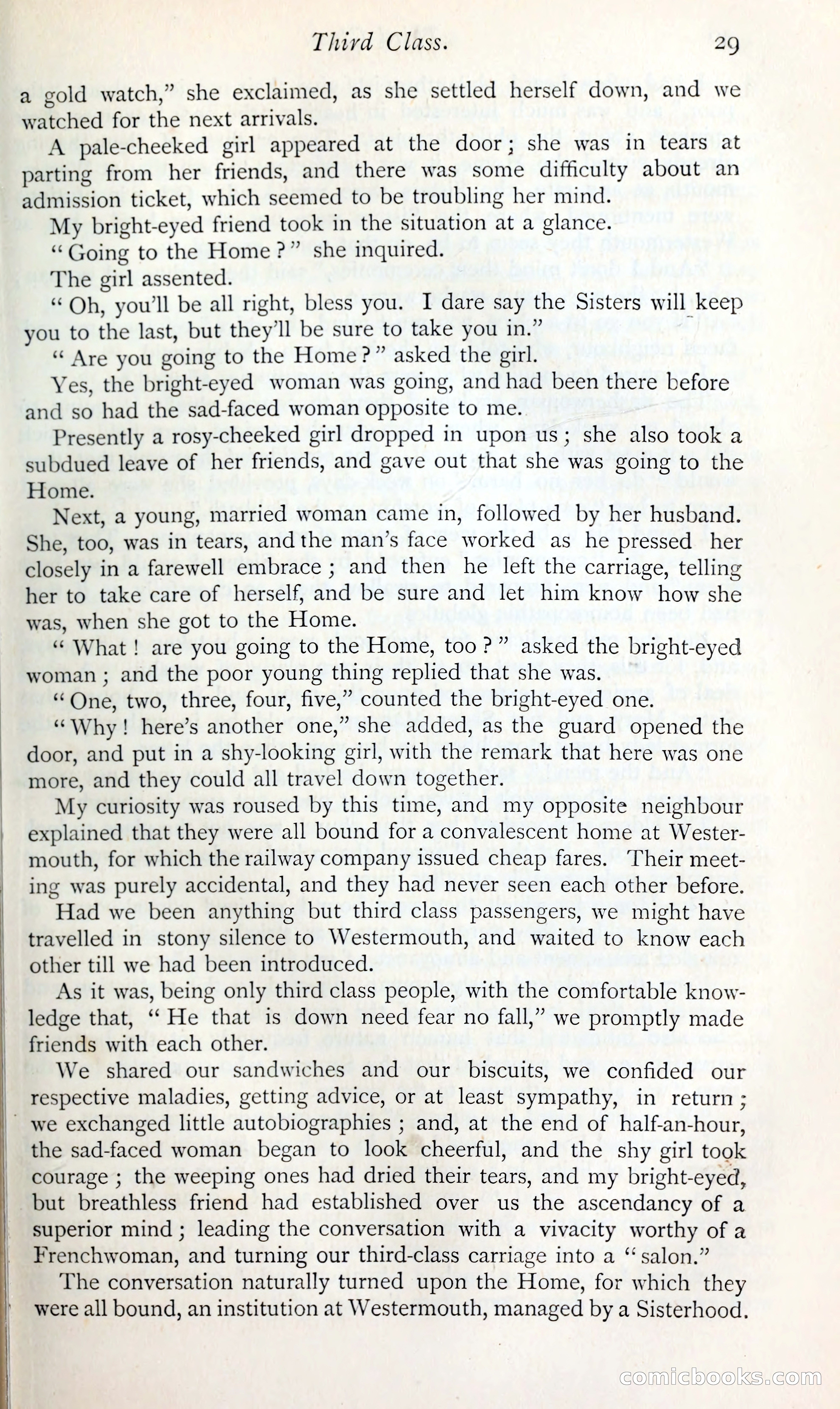
A restored page from Pulp Fiction, 1865. Page through the whole issue in the reader above.
📄 Transcribed text from this page (OCR, searchable)
Machine-transcribed from the original scan — historical spelling and the odd misread are preserved.
aS —— aS — Third Class. 29 a gold watch,” she exclaimed, as she settled herself down, and we watched for the next arrivals. A pale-cheeked girl appeared at the door; she was in tears at parting from her friends, and there was some difficulty about an admission ticket, which seemed to be troubling her mind. My bright-eyed friend took in the situation at a glance. “Going to the Home ?” she inquired. The girl assented. “Oh, you'll be all right, bless you. I dare say the Sisters will keep you to the last, but they'll be sure to take you in.” “ Are you going to the Home ?” asked the girl. Yes, the bright-eyed woman was going, and had been there before and so had the sad-faced woman opposite to me. Presently a rosy-cheeked girl dropped in upon us; she also took a subdued leave of her friends, and gave out that she was going to the Home. Next, a young, married woman came in, followed by her husband. She, too, was in tears, andthe man’s face worked as he pressed her closely in a farewell embrace ; and then he left the carriage, telling her to take care of herself, and be sure and let him know how she was, when she got to the Home. ‘What! are you going to the Home, too ?” asked the bright-eyed woman ; and the poor young thing replied that she was. “One, two, three, four, five,” counted the bright-eyed one. “Why! here’s another one,” she added, as the guard opened the door, and put in a shy-looking girl, with the remark that here was one more, and they could all travel down together. My curiosity was roused by this time, and my opposite neighbour explained that they were all bound for a convalescent home at Wester- mouth, for which the railway company issued cheap fares. Their meet- ing was purely accidental, and they had never seen each other before. Had we been anything but third class passengers, we might have travelled in stony silence to Westermouth, and waited to know each other till we had been introduced. As it was, being only third class people, with the comfortable know- ledge that, ‘‘ He that is down need fear no fall,” we promptly made friends with each other. We shared our sandwiches and our biscuits, we confided our respective maladies, getting advice, or at least sympathy, in return; _ we exchanged little autobiographies ; and, at the end of half-an-hour, the sad-faced woman began to look cheerful, and the shy girl took courage ; the weeping ones had dried their tears, and my bright-eyed, but breathless friend had established over us the ascendancy of a superior mind ; leading the conversation with a vivacity worthy of a Frenchwoman, and turning our third-class carriage into a “salon.” The conversation naturally turned upon the Home, for which they were all bound, an institution at Westermouth, managed by a Sisterhood. COnnICLOOKS (©) im