
Pulp Fiction, 1865 · page 333 of 399
The Argosy — page 333: what you’re looking at
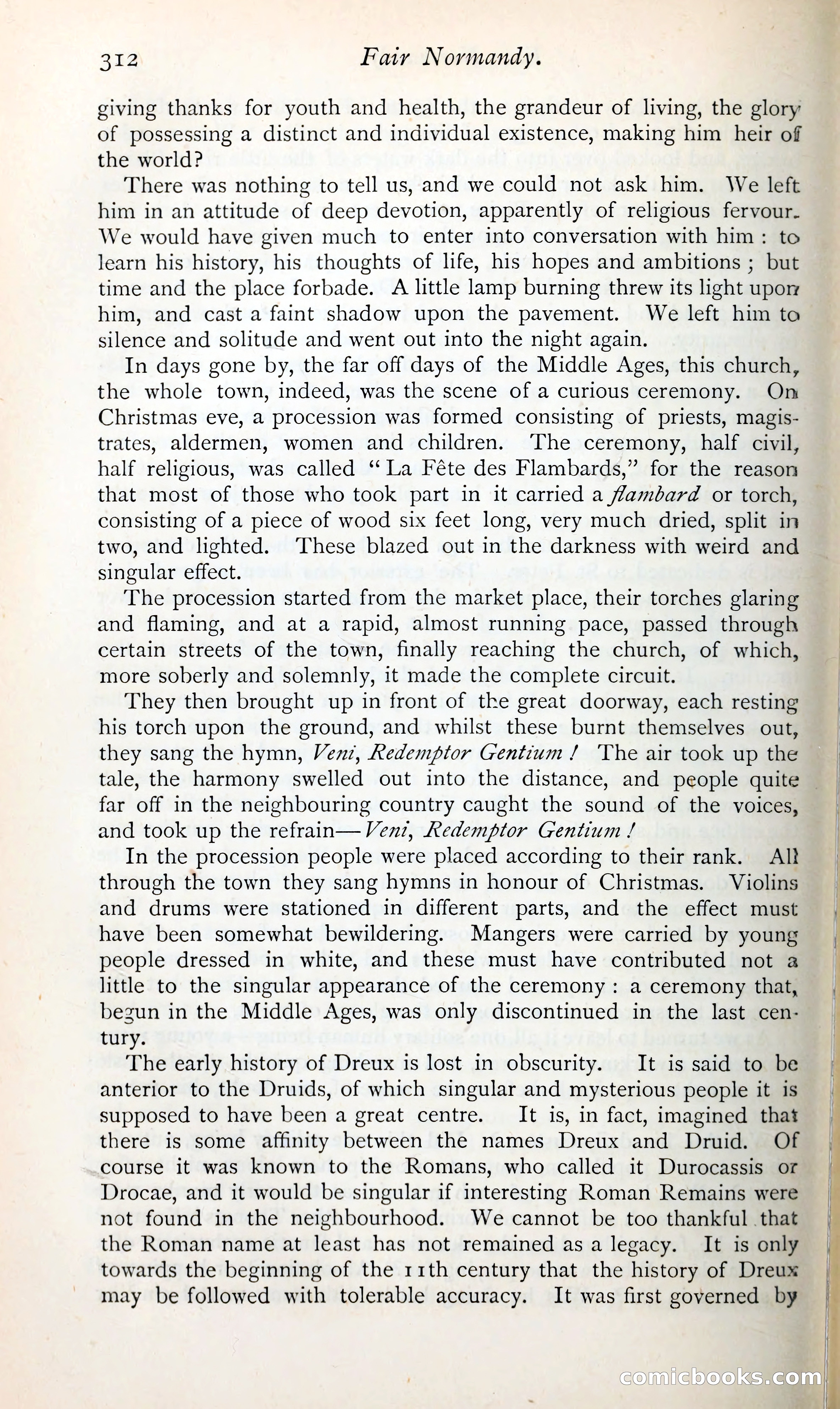
A restored page from Pulp Fiction, 1865. Page through the whole issue in the reader above.
📄 Transcribed text from this page (OCR, searchable)
Machine-transcribed from the original scan — historical spelling and the odd misread are preserved.
312 Far Normandy. giving thanks for youth and health, the grandeur of living, the glory of possessing a distinct and individual existence, making him heir of the world? There was nothing to tell us, and we could not ask him. We left him in an attitude of deep devotion, apparently of religious fervour. We would have given much to enter into conversation with him: to learn his history, his thoughts of life, his hopes and ambitions ; but time and the place forbade. A little lamp burning threw its light upor him, and cast a faint shadow upon the pavement. We left him to silence and solitude and went out into the night again. In days gone by, the far off days of the Middle Ages, this church, the whole town, indeed, was the scene of a curious ceremony. On Christmas eve, a procession was formed consisting of priests, magis- trates, aldermen, women and children. The ceremony, half civil, half religious, was called ‘‘ La Féte des Flambards,” for the reason that most of those who took part in it carried a fambard or torch, consisting of a piece of wood six feet long, very much dried, split in two, and lighted. ‘These blazed out in the darkness with weird and singular effect. The procession started from the market place, their torches glaring and flaming, and at a rapid, almost running pace, passed through certain streets of the town, finally reaching the church, of which, more soberly and solemnly, it made the complete circuit. They then brought up in front of the great doorway, each resting his torch upon the ground, and whilst these burnt themselves out, they sang the hymn, Venz, Redemptor Gentium ! ‘The air took up the tale, the harmony swelled out into the distance, and people quite © far off in the neighbouring country caught the sound of the voices, and took up the refrain—Venz, Redemptor Gentium / In the procession people were placed according to their rank. Al} through the town they sang hymns in honour of Christmas. Violins and drums were stationed in different parts, and the effect must have been somewhat bewildering. Mangers were carried by young people dressed in white, and these must have contributed not a little to the singular appearance of the ceremony: a ceremony that, bezun in the Middle Ages, was only discontinued in the last cen- tury. The early history of Dreux is lost in obscurity. It is said to be anterior to the Druids, of which singular and mysterious people it is supposed to have been a great centre. It is, in fact, imagined that there is some affinity between the names Dreux and Druid. Of course it was known to the Romans, who called it Durocassis or Drocae, and it would be singular if interesting Roman Remains were not found in the neighbourhood. We cannot be too thankful that the Roman name at least has not remained as a legacy. It is only towards the beginning of the 11th century that the history of Dreux may be followed with tolerable accuracy. It was first governed by Eomichbooks.co