
Pulp Fiction, 1865 · page 332 of 399
The Argosy — page 332: what you’re looking at
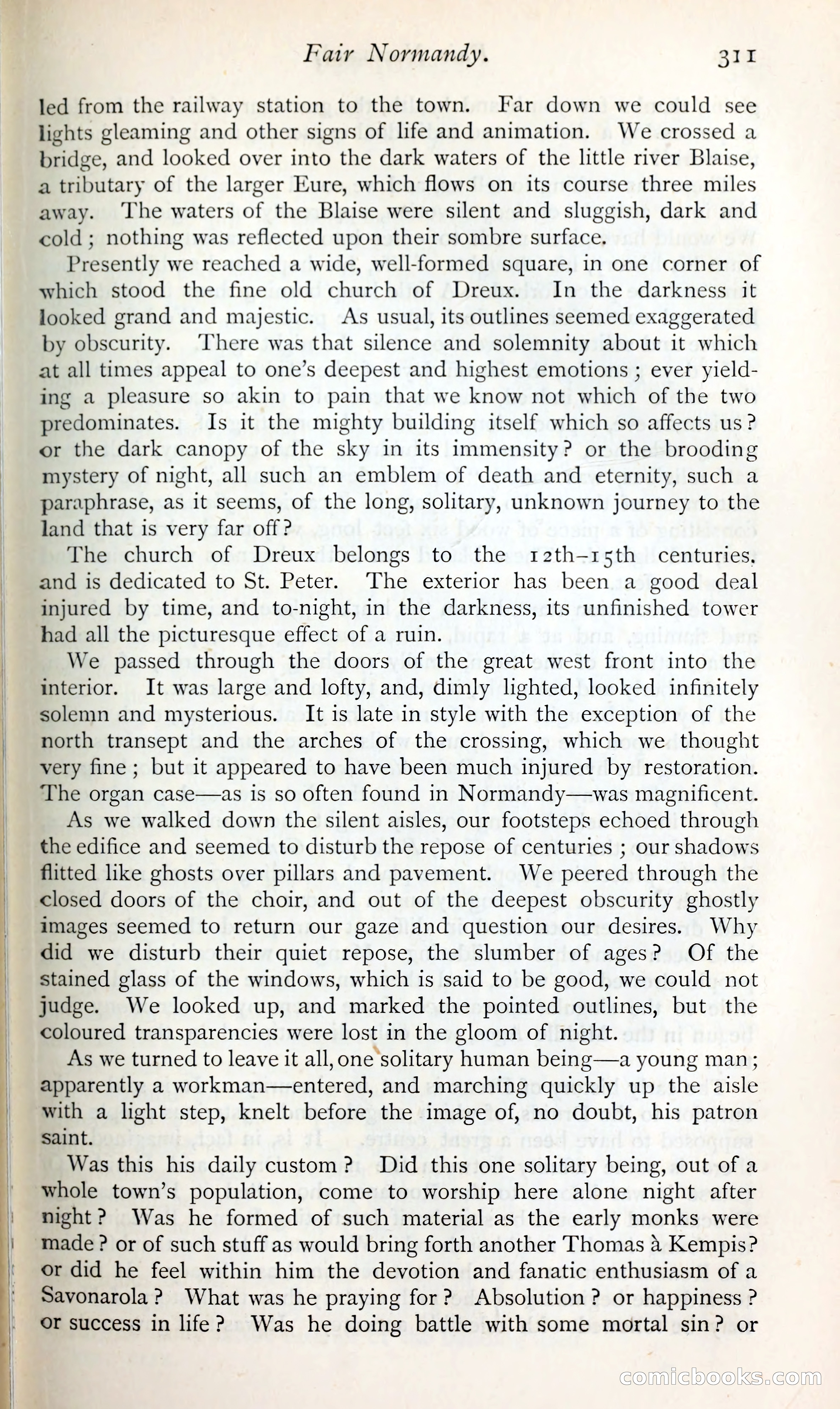
A restored page from Pulp Fiction, 1865. Page through the whole issue in the reader above.
📄 Transcribed text from this page (OCR, searchable)
Machine-transcribed from the original scan — historical spelling and the odd misread are preserved.
Fair Normandy. 311 led from the railway station to the town. Far down we could see lights gleaming and other signs of life and animation. We crossed a bridge, and looked over into the dark waters of the little river Blaise, a tributary of the larger Eure, which flows on its course three miles away. ‘The waters of the Blaise were silent and sluggish, dark and cold; nothing was reflected upon their sombre surface. Presently we reached a wide, well-formed square, in one corner of which stood the fine old church of Dreux. In the darkness it looked grand and majestic. As usual, its outlines seemed exaggerated by obscurity. ‘There was that silence and solemnity about it which at all times appeal to one’s deepest and highest emotions ; ever yield- ing a pleasure so akin to pain that we know not which of the two predominates. Is it the mighty building itself which so affects us? or the dark canopy of the sky in its immensity? or the brooding mystery of night, all such an emblem of death and eternity, such a paraphrase, as it seems, of the long, solitary, unknown journey to the land that is very far off? The church of Dreux belongs to the tr2th—-r15th centuries. and is dedicated to St. Peter. ‘The exterior has been a good deal injured by time, and to-night, in the darkness, its unfinished tower had all the picturesque effect of a ruin. We passed through the doors of the great west front into the interior. It was large and lofty, and, dimly lighted, looked infinitely solemn and mysterious. It 1s late in style with the exception of the north transept and the arches of the crossing, which we thought very fine; but it appeared to have been much injured by restoration. ‘The organ case—as is so often found in Normandy—was magnificent. As we walked down the silent aisles, our footsteps echoed through the edifice and seemed to disturb the repose of centuries ; our shadows flitted like ghosts over pillars and pavement. We peered through the closed doors of the choir, and out of the deepest obscurity ghostly images seemed to return our gaze and question our desires. Why did we disturb their quiet repose, the slumber of ages? Of the stained glass of the windows, which is said to be good, we could not judge. We looked up, and marked the pointed outlines, but the coloured transparencies were lost in the gloom of night. As we turned to leave it all, one solitary human being—a young man; apparently a workman—entered, and marching quickly up the aisle with a light step, knelt before the image of, no doubt, his patron Saint. Was this his daily custom? Did this one solitary being, out of a whole town’s population, come to worship here alone night after night? Was he formed of such material as the early monks were ‘made ? or of such stuff as would bring forth another Thomas 4 Kempis? or did he feel within him the devotion and fanatic enthusiasm of a Savonarola? What was he praying for? Absolution ? or happiness ? or success in life? Was he doing battle with some mortal sin? or GomiilGaooks (S©) im