
Pulp Fiction, 1865 · page 315 of 399
The Argosy — page 315: what you’re looking at
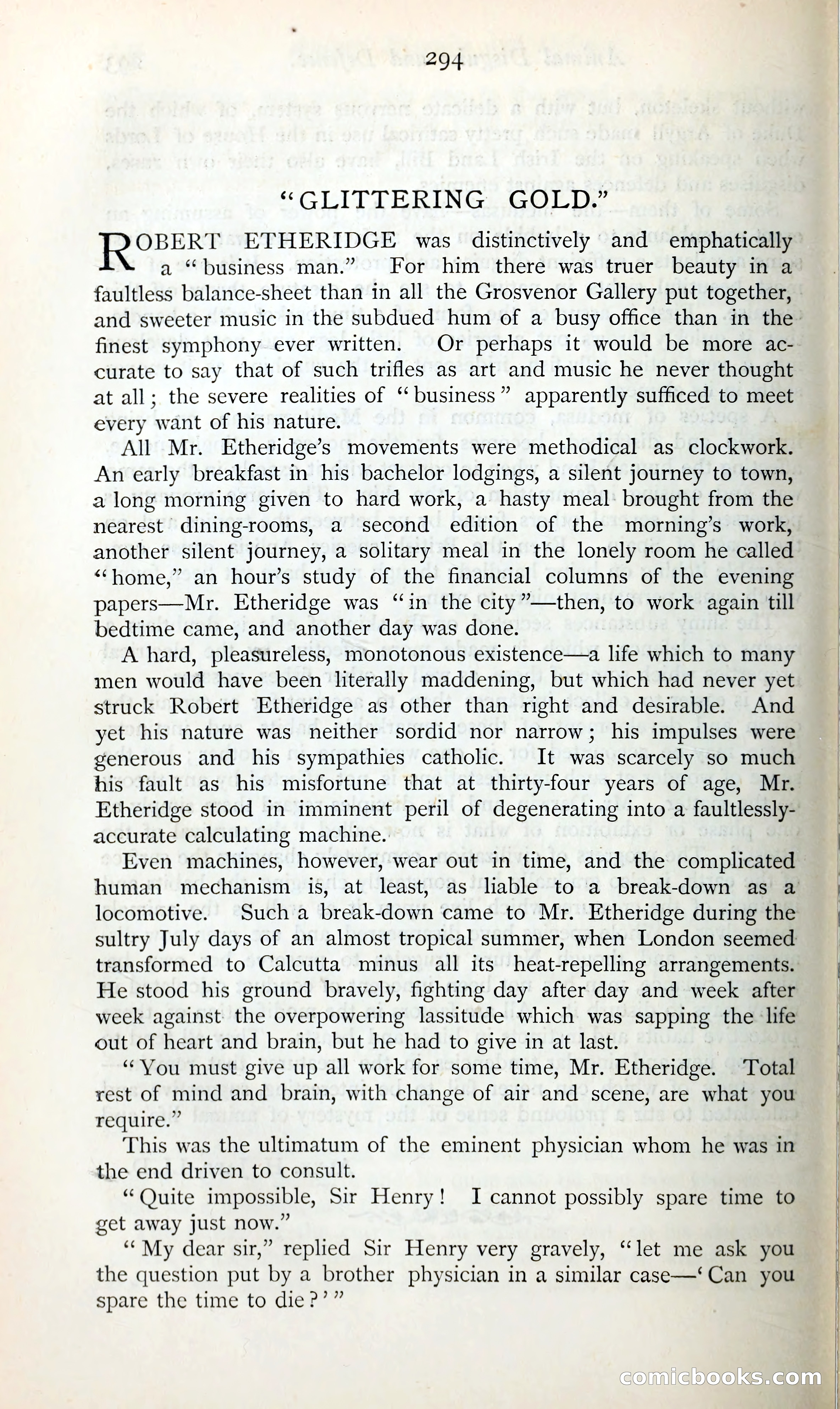
A restored page from Pulp Fiction, 1865. Page through the whole issue in the reader above.
📄 Transcribed text from this page (OCR, searchable)
Machine-transcribed from the original scan — historical spelling and the odd misread are preserved.
294 “GLITTERING GOLD.” oe oe ETHERIDGE was distinctively and emphatically a “business man.” For him there was truer beauty in a faultless balance-sheet than in all the Grosvenor Gallery put together, and sweeter music in the subdued hum of a busy office than in the finest symphony ever written. Or perhaps it would be more ac- curate to say that of such trifles as art and music he never thought at all; the severe realities of “‘ business” apparently sufficed to meet every want of his nature. All Mr. Etheridge’s movements were methodical as clockwork. An early breakfast in his bachelor lodgings, a silent journey to town, a long morning given to hard work, a hasty meal brought from the nearest dining-rooms, a second edition of the morning’s work, another silent journey, a solitary meal in the lonely room he called “home,” an hour’s study of the financial columns of the evening papers—Mr. Etheridge was “in the city”—then, to work again till bedtime came, and another day was done. A hard, pleasureless, monotonous existence—a life which to many men would have been literally maddening, but which had never yet struck Robert Etheridge as other than right and desirable. And yet his nature was neither sordid nor narrow; his impulses were generous and his sympathies catholic. It was scarcely so much his fault as his misfortune that at thirty-four years of age, Mr. Etheridge stood in imminent peril of degenerating into a faultlessly- accurate calculating machine.: | Even machines, however, wear out in time, and the complicated human mechanism is, at least, as lable to a break-down as a locomotive. Such a break-down came to Mr. Etheridge during the sultry July days of an almost tropical summer, when London seemed transformed to Calcutta minus all its heat-repelling arrangements. He stood his ground bravely, fighting day after day and week after week against the overpowering lassitude which was sapping the life out of heart and brain, but he had to give in at last. ‘You must give up all work for some time, Mr. Etheridge. Total rest of mind and brain, with change of air and scene, are what you require.” This was the ultimatum of the eminent physician whom he was in the end driven to consult. “Quite impossible, Sir Henry! I cannot possibly spare time to get away just now.” ‘¢ My dear sir,” replied Sir Henry very gravely, “let me ask you the question put by a brother physician in a similar case—‘ Can you spare the time to die?’” Eomicbooks.co