
Pulp Fiction, 1865 · page 192 of 399
The Argosy — page 192: what you’re looking at
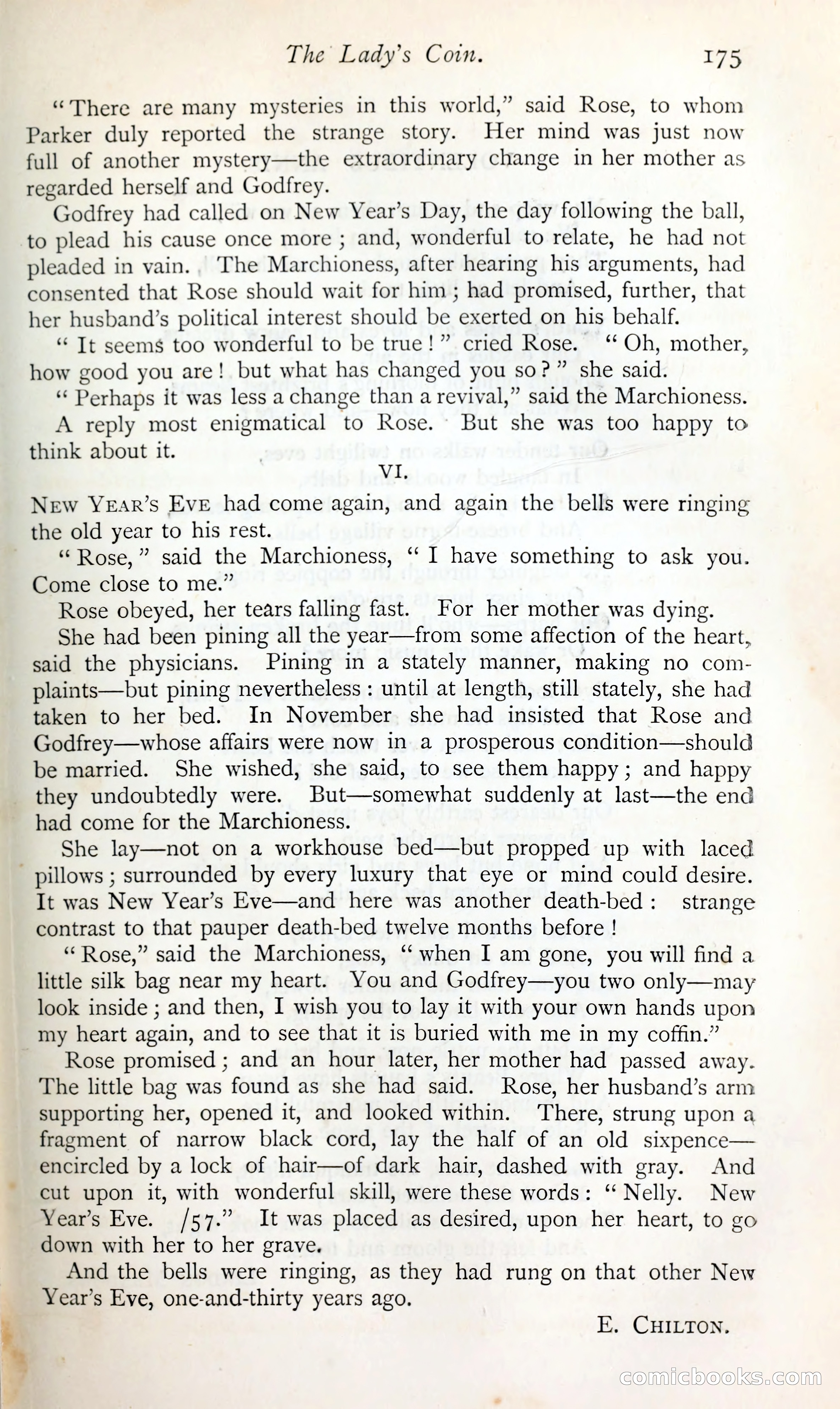
A restored page from Pulp Fiction, 1865. Page through the whole issue in the reader above.
📄 Transcribed text from this page (OCR, searchable)
Machine-transcribed from the original scan — historical spelling and the odd misread are preserved.
iy The Lady’s Cow. r75 “There are many mysteries in this world,” said Rose, to whom Parker duly reported the strange story. Her mind was just now full of another mystery—the extraordinary change in her mother as regarded herself and Godfrey. Godfrey had called on New Year’s Day, the day following the ball, to plead his cause once more ; and, wonderful to relate, he had not pleaded in vain., The Marchioness, after hearing his arguments, had consented that Rose should wait for him ; had promised, further, that her husband’s political interest should be exerted on his behalf. “It seems too wonderful to be true!” cried Rose. © @Oh,»mother, how good you are! but what has changed you so: ?” she said. ‘Perhaps it was less a change than a revival,” said the Marchioness. A reply most enigmatical to Rose. But she was too happy to think about it. VI, New YeEAr’s Eve had come again, and again the bells were ringing the old year to his rest. “Rose, ” said the Marchioness, ‘‘ I have something to ask you. Come close to me.” Rose obeyed, her tears falling fast. For her mother was dying. She had been pining all the year—from some affection of the heart, said the physicians. ining in a stately manner, making no com- plaints—but pining nevertheless : until at length, still stately, she had taken to her bed. In November she had insisted that Rose and Godfrey—whose affairs were now in a prosperous condition—should be married. She wished, she said, to see them happy; and happy they undoubtedly were. But—somewhat suddenly at last—the end had come for the Marchioness. She lay—not on a workhouse bed—but propped up with laced _ pillows ; surrounded by every luxury that eye or mind could desire. It was New Year’s Eve—and here was another death-bed: strange contrast to that pauper death-bed twelve months before ! “Rose,” said the Marchioness, ‘‘ when I am gone, you will find a little silk bag near my heart. You and Godfrey—you two only—may look inside ; and then, I wish you to lay it with your own hands upon my heart again, and to see that it is buried with me in my coffin.” Rose promised ; and an hour later, her mother had passed away. The little bag was found as she had said. Rose, her husband’s arm supporting her, opened it, and looked within. ‘There, strung upon a fragment of narrow black cord, lay the half of an old sixpence encircled by a lock of hair—of dark hair, dashed with gray. And cut upon it, with wonderful skill, were these words: “Nelly. New Year’s Eve. /57.” It was placed as desired, upon her heart, to go down with her to her grave. And the bells were ringing, as they had rung on that other New Year’s Eve, one-and-thirty years ago. E. CHILTON. GomiilGcaooks am