
Pulp Fiction, 1865 · page 125 of 399
The Argosy — page 125: what you’re looking at
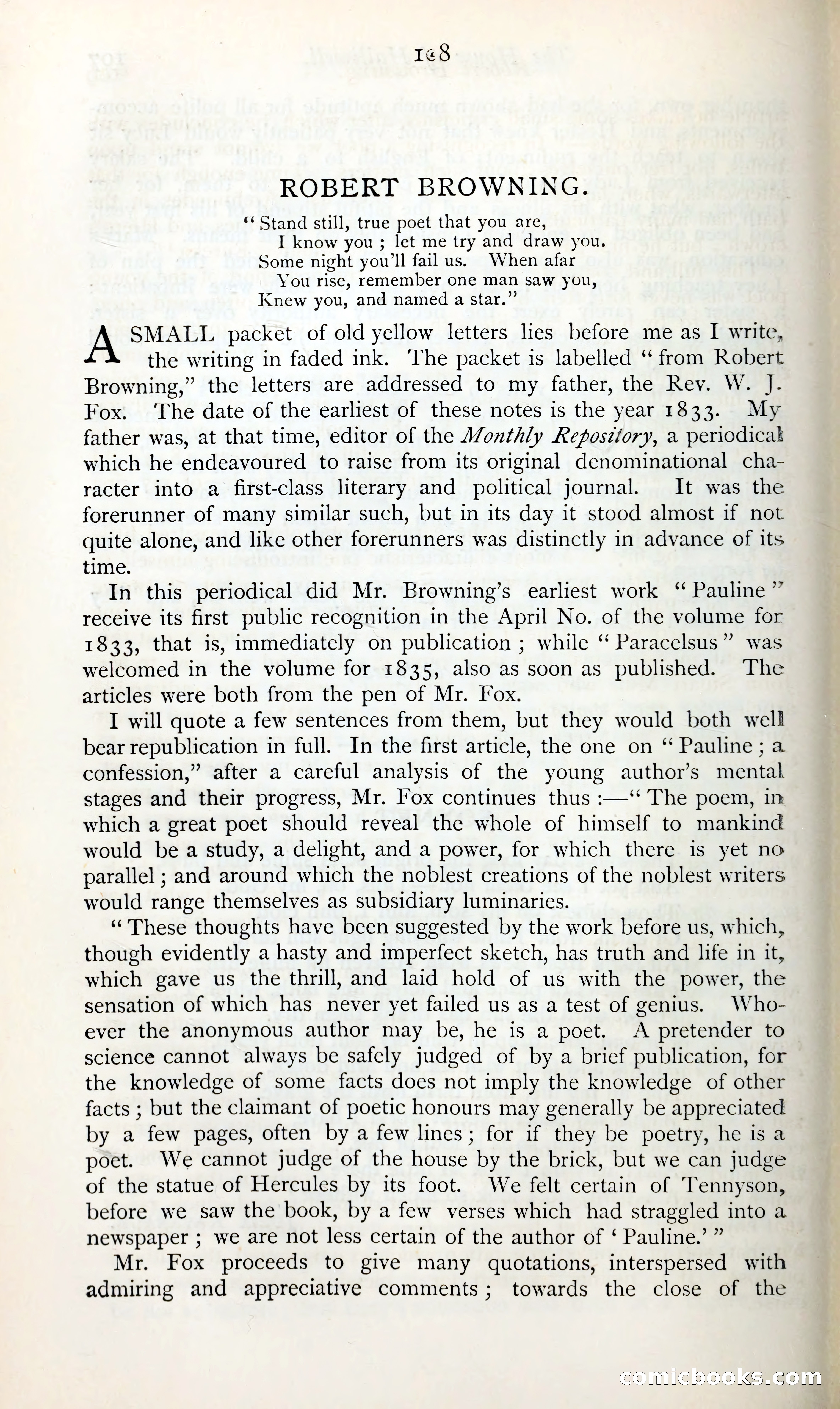
A restored page from Pulp Fiction, 1865. Page through the whole issue in the reader above.
📄 Transcribed text from this page (OCR, searchable)
Machine-transcribed from the original scan — historical spelling and the odd misread are preserved.
ROBERT BROWNING. “ Stand still, true poet that you are, | I know you ; let me try and draw you. Some night you'll fail us. When afar You rise, remember one man saw you, Knew you, and named a star.” A SMALL packet of old yellow letters lies before me as I write, the writing in faded ink. The packet is labelled ‘‘ from Robert Browning,” the letters are addressed to my father, the Rev. W. J. Fox. The date of the earliest of these notes is the year 1833. My father was, at that time, editor of the A/onthly Repository, a periodicak which he endeavoured to raise from its original denominational cha- racter into a first-class literary and political journal. It was the forerunner of many similar such, but in its day it stood almost if not quite alone, and like other forerunners was distinctly in advance of its time. In this periodical did Mr. Browning’s earliest work ‘ Pauline ” receive its first public recognition in the April No. of the volume for 1833, that is, immediately on publication ; while ‘“ Paracelsus” was welcomed in the volume for 1835, also as soon as published. ‘The articles were both from the pen of Mr. Fox. I will quote a few sentences from them, but they would both well bear republication in full. In the first article, the one on “ Pauline; a confession,” after a careful analysis of the young author’s mental stages and their progress, Mr. Fox continues thus :—‘‘ The poem, in which a great poet should reveal the whole of himself to mankind would be a study, a delight, and a power, for which there is yet no parallel ; and around which the noblest creations of the noblest writers would range themselves as subsidiary luminaries. “These thoughts have been suggested by the work before us, which, though evidently a hasty and imperfect sketch, has truth and life in it, which gave us the thrill, and laid hold of us with the power, the sensation of which has never yet failed us as a test of genius. Who- ever the anonymous author may be, he is a poet. A pretender to science cannot always be safely judged of by a brief publication, for the knowledge of some facts does not imply the knowledge of other facts ; but the claimant of poetic honours may generally be appreciated: by a few pages, often by a few lines; for if they be poetry, he is a poet. We cannot judge of the house by the brick, but we can judge of the statue of Hercules by its foot. We felt certain of Tennyson, before we saw the book, by a few verses which had straggled into a newspaper ; we are not less certain of the author of ‘ Pauline.’ ” Mr. Fox proceeds to give many quotations, interspersed with admiring and appreciative comments; towards the close of the e€om (~) 2 0)(0)(0)| KS,(E(6) m