
Pulp Fiction, 1865 · page 96 of 399
The Argosy — page 96: what you’re looking at
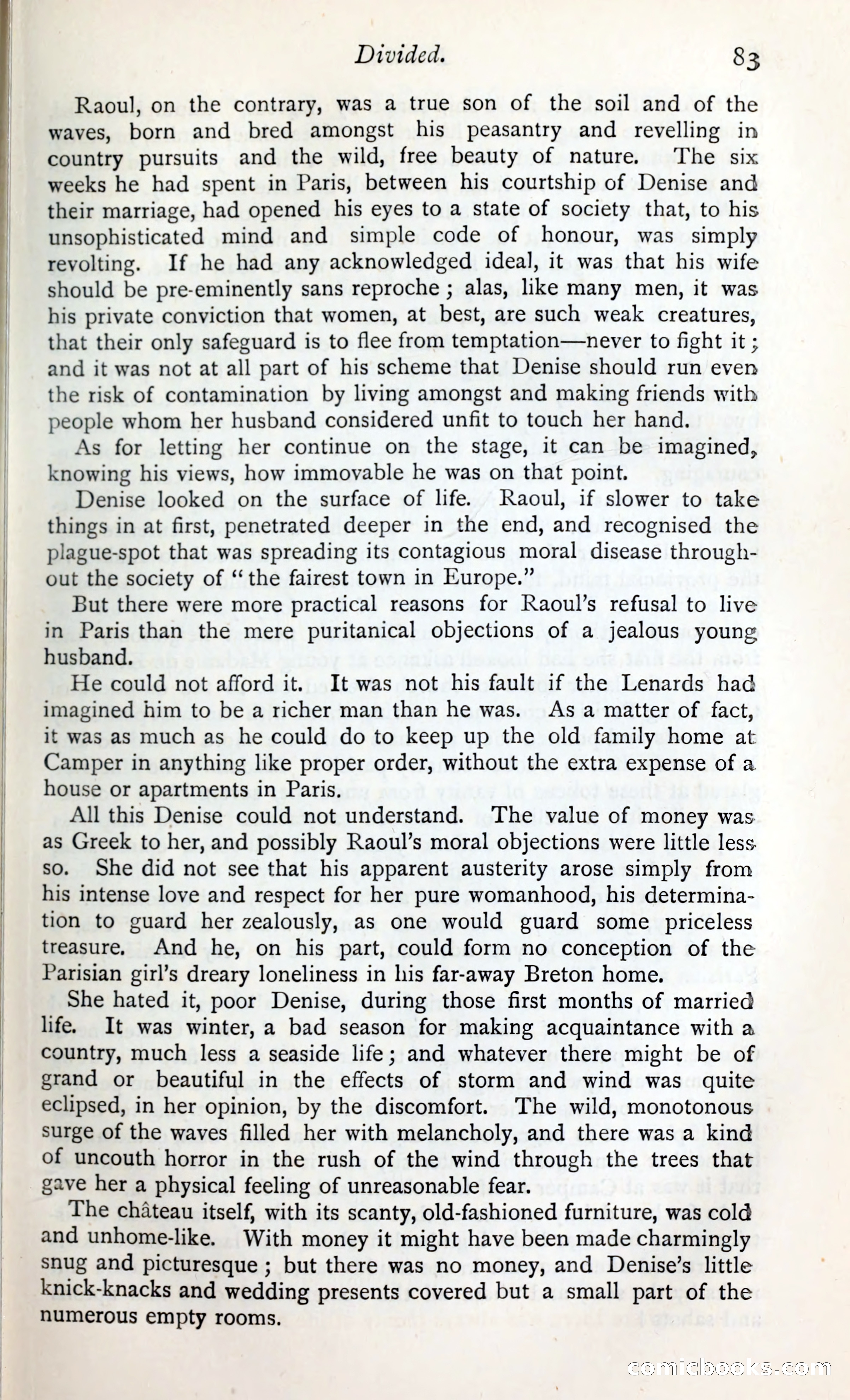
A restored page from Pulp Fiction, 1865. Page through the whole issue in the reader above.
📄 Transcribed text from this page (OCR, searchable)
Machine-transcribed from the original scan — historical spelling and the odd misread are preserved.
Divided. 83 Raoul, on the contrary, was a true son of the soil and of the waves, born and bred amongst his peasantry and revelling in country pursuits and the wild, free beauty of nature. The six weeks he had spent in Paris, between his courtship of Denise and their marriage, had opened his eyes to a state of society that, to his unsophisticated mind and simple code of honour, was simply revolting. If he had any acknowledged ideal, it was that his wife should be pre-eminently sans reproche ; alas, like many men, it was his private conviction that women, at best, are such weak creatures, that their only safeguard is to flee from temptation—never to fight it ; and it was not at all part of his scheme that Denise should run even the risk of contamination by living amongst and making friends with people whom her husband considered unfit to touch her hand. As for letting her continue on the stage, it can be imagined, knowing his views, how immovable he was on that point. Denise looked on the surface of life. Raoul, if slower to take things in at first, penetrated deeper in the end, and recognised the plague-spot that was spreading its contagious moral disease through- out the society of “the fairest town in Europe.” But there were more practical reasons for Raoul’s refusal to live in Paris than the mere puritanical objections of a jealous young husband. He could not afford it. It was not his fault if the Lenards had imagined him to be a richer man than he was. As a matter of fact, it was as much as he could do to keep up the old family home at Camper in anything like proper order, without the extra expense of a house or apartments in Paris. All this Denise could not understand. The value of money was as Greek to her, and possibly Raoul’s moral objections were little less so. She did not see that his apparent austerity arose simply from his intense love and respect for her pure womanhood, his determina- tion to guard her zealously, as one would guard some priceless treasure, And he, on his part, could form no conception of the Parisian girl’s dreary loneliness in his far-away Breton home. She hated it, poor Denise, during those first months of married life. It was winter, a bad season for making acquaintance with a country, much less a seaside life; and whatever there might be of grand or beautiful in the effects of storm and wind was quite eclipsed, in her opinion, by the discomfort. The wild, monotonous surge of the waves filled her with melancholy, and there was a kind of uncouth horror in the rush of the wind through the trees that gave her a physical feeling of unreasonable fear. The chateau itself, with its scanty, old-fashioned furniture, was cold and unhome-like. With money it might have been made charmingly snug and picturesque ; but there was no money, and Denise’s little knick-knacks and wedding presents covered but a small part of the numerous empty rooms. CoOnniclooOolKSs (SO) am