
Pulp Fiction, 1865 · page 95 of 399
The Argosy — page 95: what you’re looking at
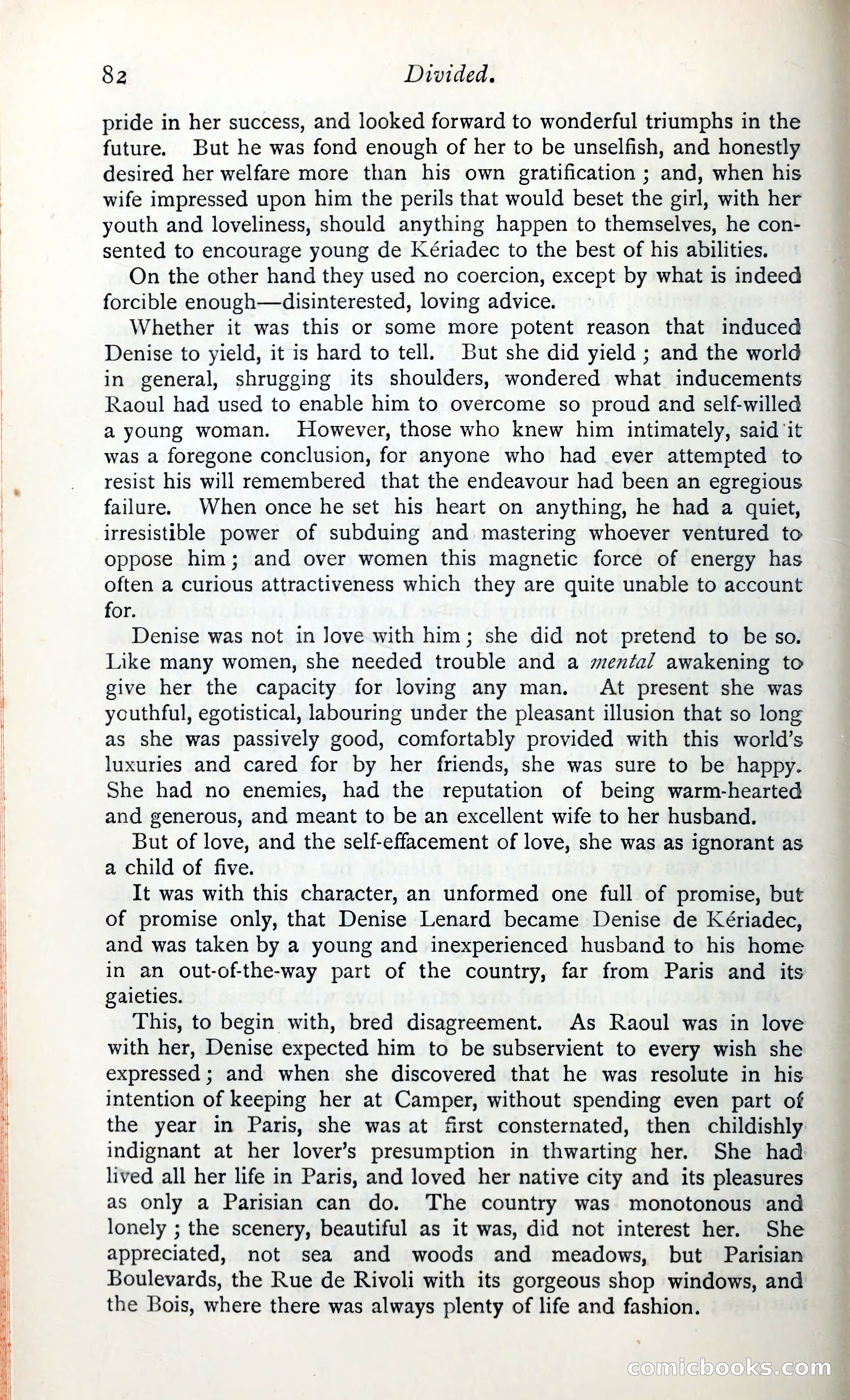
A restored page from Pulp Fiction, 1865. Page through the whole issue in the reader above.
📄 Transcribed text from this page (OCR, searchable)
Machine-transcribed from the original scan — historical spelling and the odd misread are preserved.
82 Divided. pride in her success, and looked forward to wonderful triumphs in the future. But he was fond enough of her to be unselfish, and honestly desired her welfare more than his own gratification ; and, when his wife impressed upon him the perils that would beset the girl, with her youth and loveliness, should anything happen to themselves, he con- sented to encourage young de Kériadec to the best of his abilities. On the other hand they used no coercion, except by what is indeed forcible enough—disinterested, loving advice. Whether it was this or some more potent reason that induced Denise to yield, it is hard to tell. But she did yield ; and the world in general, shrugging its shoulders, wondered what inducements Raoul had used to enable him to overcome so proud and self-willed a young woman. However, those who knew him intimately, said ‘it was a foregone conclusion, for anyone who had ever attempted to resist his will remembered that the endeavour had been an egregious failure. When once he set his heart on anything, he had a quiet, irresistible power of subduing and mastering whoever ventured to oppose him; and over women this magnetic force of energy has often a curious attractiveness which they are quite unable to account for. Denise was not in Jove with him; she did not pretend to be so. Like many women, she needed trouble and a mental awakening to give her the capacity for loving any man. At present she was youthful, egotistical, labouring under the pleasant illusion that so long as she was passively good, comfortably provided with this world’s luxuries and cared for by her friends, she was sure to be happy. She had no enemies, had the reputation of being warm-hearted and generous, and meant to be an excellent wife to her husband. But of love, and the self-effacement of love, she was as ignorant as a child of five. It was with this character, an unformed one full of promise, but of promise only, that Denise Lenard became Denise de Kériadec, and was taken by a young and inexperienced husband to his home in an out-of-the-way part of the country, far from Paris and its gaieties. This, to begin with, bred disagreement. As Raoul was in love with her, Denise expected him to be subservient to every wish she expressed ; and when she discovered that he was resolute in his intention of keeping her at Camper, without spending even part of the year in Paris, she was at first consternated, then childishly indignant at her lover’s presumption in thwarting her. She had lived all her life in Paris, and loved her native city and its pleasures as only a Parisian can do. The country was monotonous and lonely ; the scenery, beautiful as it was, did not interest her. She appreciated, not sea and woods and meadows, but Parisian Boulevards, the Rue de Rivoli with its gorgeous shop windows, and the Bois, where there was always plenty of life and fashion. Eomicbooks.co