
Pulp Fiction, 1865 · page 73 of 399
The Argosy — page 73: what you’re looking at
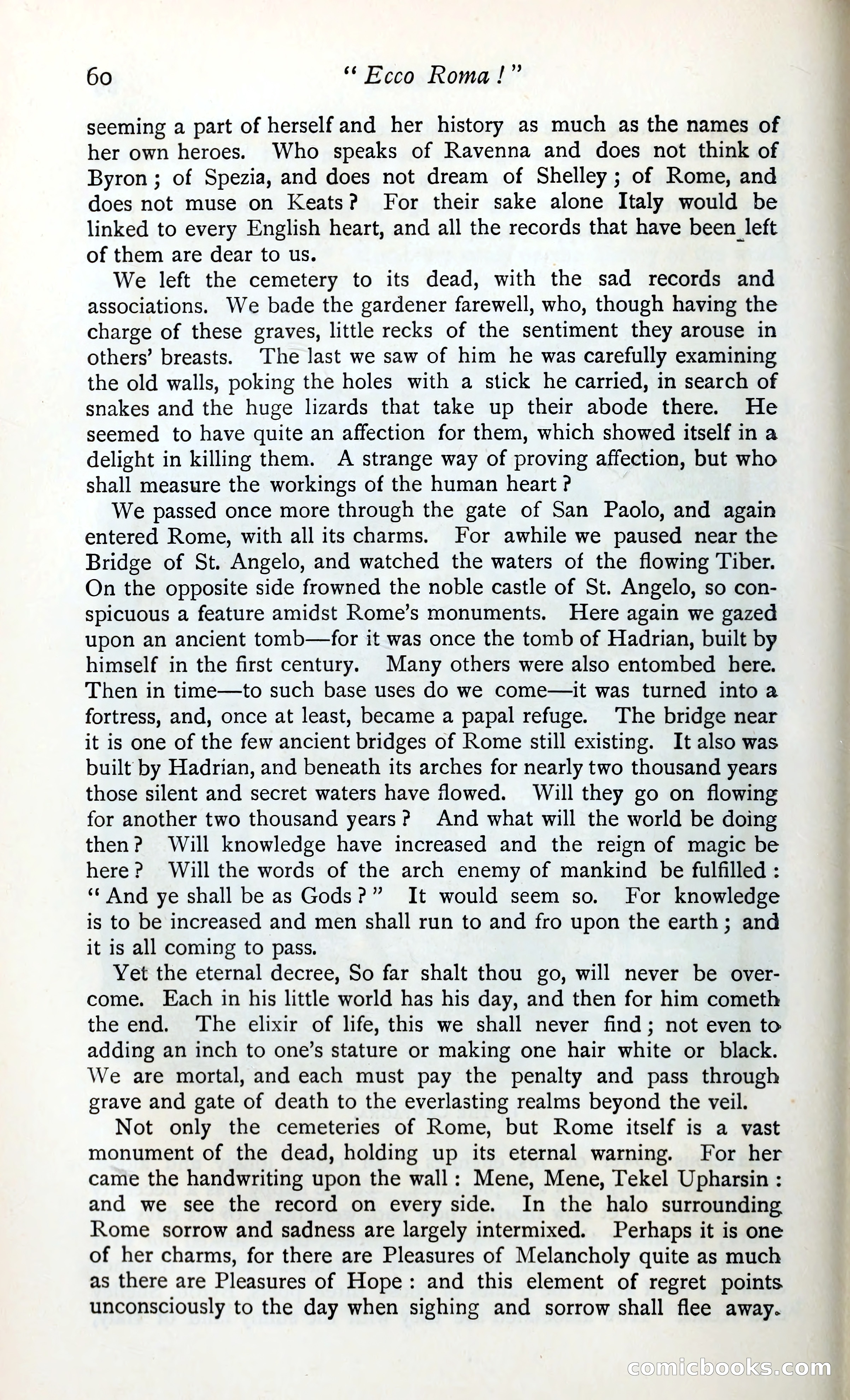
A restored page from Pulp Fiction, 1865. Page through the whole issue in the reader above.
📄 Transcribed text from this page (OCR, searchable)
Machine-transcribed from the original scan — historical spelling and the odd misread are preserved.
60 ‘ Ecco Roma!” seeming a part of herself and her history as much as the names of her own heroes. Who speaks of Ravenna and does not think of Byron ; of Spezia, and does not dream of Shelley ; of Rome, and does not muse on Keats? For their sake alone Italy would be linked to every English heart, and all the records that have been left of them are dear to us. We left the cemetery to its dead, with the sad records and associations. We bade the gardener farewell, who, though having the charge of these graves, little recks of the sentiment they arouse in others’ breasts. The last we saw of him he was carefully examining the old walls, poking the holes with a stick he carried, in search of snakes and the huge lizards that take up their abode there. He seemed to have quite an affection for them, which showed itself in a delight in killing them. A strange way of proving affection, but who shall measure the workings of the human heart P We passed once more through the gate of San Paolo, and again entered Rome, with all its charms. For awhile we paused near the Bridge of St. Angelo, and watched the waters of the flowing Tiber. On the opposite side frowned the noble castle of St. Angelo, so con- spicuous a feature amidst Rome’s monuments. Here again we gazed upon an ancient tomb—for it was once the tomb of Hadrian, built by himself in the first century. Many others were also entombed here. Then in time—to such base uses do we come—it was turned into a fortress, and, once at least, became a papal refuge. The bridge near it is one of the few ancient bridges of Rome still existing. It also was built by Hadrian, and beneath its arches for nearly two thousand years those silent and secret waters have flowed. Will they go on flowing for another two thousand years? And what will the world be doing then? Will knowledge have increased and the reign of magic be here? Will the words of the arch enemy of mankind be fulfilled : ‘‘ And ye shall be as Gods?” It would seem so. For knowledge is to be increased and men shall run to and fro upon the earth; and it is all coming to pass. Yet the eternal decree, So far shalt thou go, will never be over- come. Each in his little world has his day, and then for him cometh the end. The elixir of life, this we shall never find; not even to adding an inch to one’s stature or making one hair white or black. We are mortal, and each must pay the penalty and pass through grave and gate of death to the everlasting realms beyond the veil. Not only the cemeteries of Rome, but Rome itself is a vast monument of the dead, holding up its eternal warning. For her came the handwriting upon the wall: Mene, Mene, Tekel Upharsin : and we see the record on every side. In the halo surrounding Rome sorrow and sadness are largely intermixed. Perhaps it is one of her charms, for there are Pleasures of Melancholy quite as much as there are Pleasures of Hope: and this element of regret points. unconsciously to the day when sighing and sorrow shall flee away. CORNICE OOOMKS.(€)