
Pulp Fiction, 1865 · page 59 of 399
The Argosy — page 59: what you’re looking at
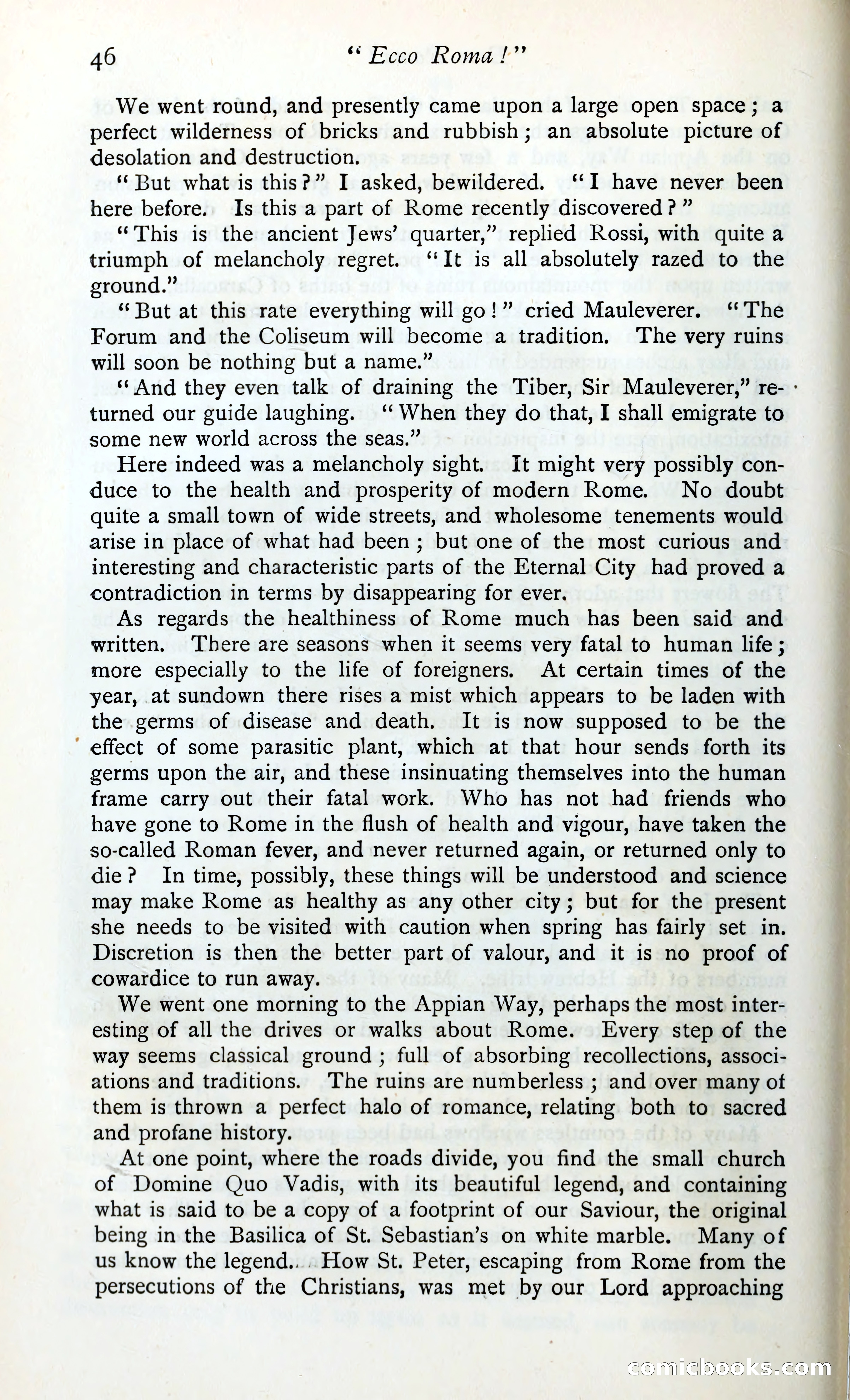
A restored page from Pulp Fiction, 1865. Page through the whole issue in the reader above.
📄 Transcribed text from this page (OCR, searchable)
Machine-transcribed from the original scan — historical spelling and the odd misread are preserved.
A6 *“ Ecco Roma !’”’ We went round, and presently came upon a large open space; a perfect wilderness of bricks and rubbish; an absolute picture of desolation and destruction. ‘But what is this?” I asked, bewildered. ‘‘I have never been here before. Is this a part of Rome recently discovered P ” “This is the ancient Jews’ quarter,” replied Rossi, with quite a triumph of melancholy regret. ‘‘It is all absolutely razed to the ground.” ‘But at this rate everything will go!” cried Mauleverer. ‘The Forum and the Coliseum will become a tradition. The very ruins will soon be nothing but a name.” ‘¢ And they even talk of draining the Tiber, Sir Mauleverer,” re- - turned our guide laughing. ‘‘ When they do that, I shall emigrate to some new world across the seas.” Here indeed was a melancholy sight. It might very possibly con- duce to the health and prosperity of modern Rome. No doubt quite a small town of wide streets, and wholesome tenements would arise in place of what had been; but one of the most curious and interesting and characteristic parts of the Eternal City had proved a contradiction in terms by disappearing for ever. As regards the healthiness of Rome much has been said and written. ‘There are seasons when it seems very fatal to human life ; more especially to the life of foreigners, At certain times of the year, at sundown there rises a mist which appears to be laden with the germs of disease and death. It is now supposed to be the effect of some parasitic plant, which at that hour sends forth its germs upon the air, and these insinuating themselves into the human frame carry out their fatal work. Who has not had friends who have gone to Rome in the flush of health and vigour, have taken the so-called Roman fever, and never returned again, or returned only to die? In time, possibly, these things will be understood and science may make Rome as healthy as any other city; but for the present she needs to be visited with caution when spring has fairly set in. Discretion is then the better part of valour, and it is no proof of cowardice to run away. We went one morning to the Appian Way, perhaps the most inter- esting of all the drives or walks about Rome. Every step of the way seems classical ground; full of absorbing recollections, associ- ations and traditions. The ruins are numberless ; and over many of them is thrown a perfect halo of romance, relating both to sacred and profane history. At one point, where the roads divide, you find the small church of Domine Quo Vadis, with its beautiful legend, and containing what is said to be a copy of a footprint of our Saviour, the original being in the Basilica of St. Sebastian’s on white marble. Many of us know the legend... How St. Peter, escaping from Rome from the persecutions of the Christians, was met by our Lord approaching COMIC OOOKS eC) a1 SS Oe, eee oe