
Pulp Fiction, 1865 · page 58 of 399
The Argosy — page 58: what you’re looking at
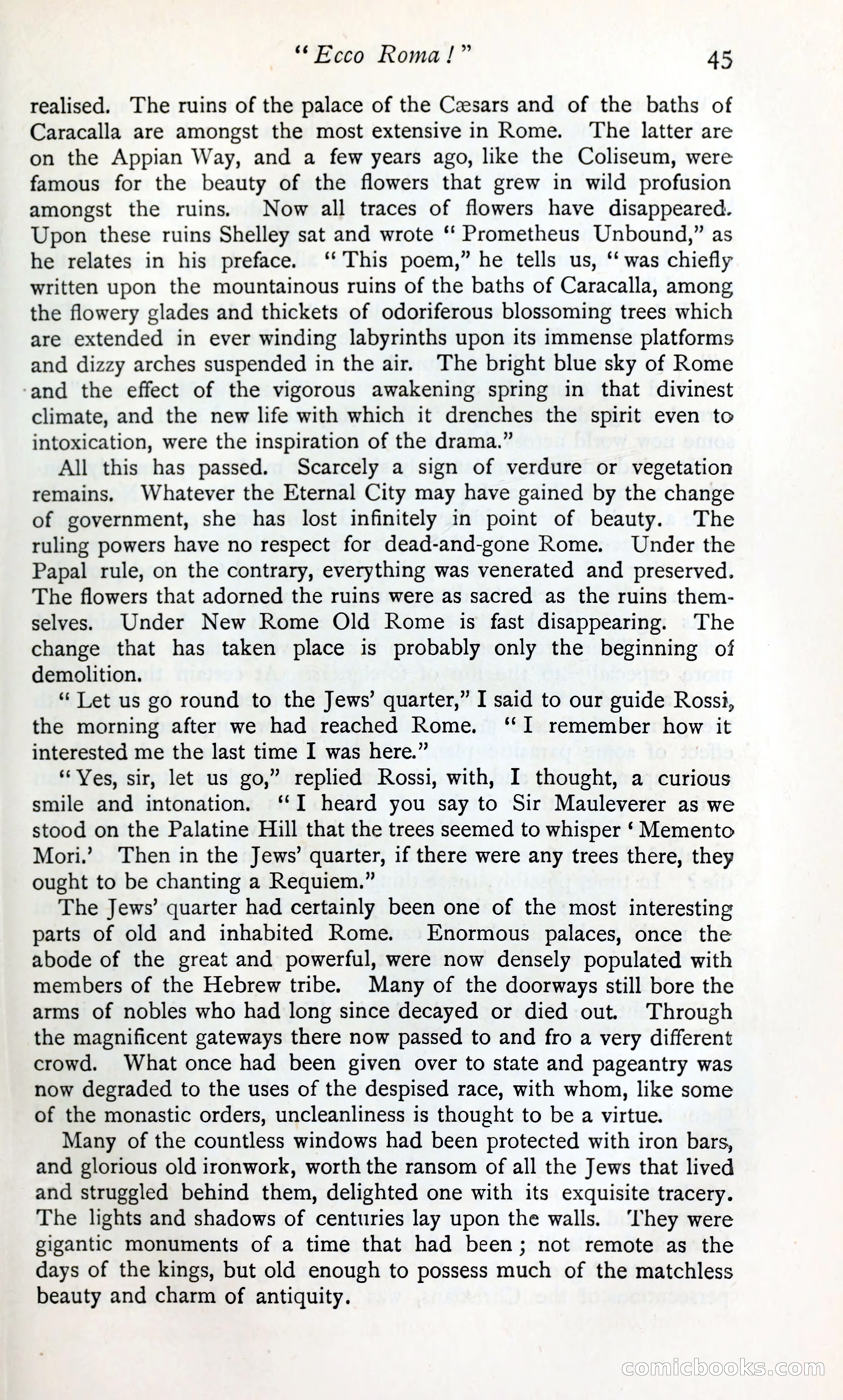
A restored page from Pulp Fiction, 1865. Page through the whole issue in the reader above.
📄 Transcribed text from this page (OCR, searchable)
Machine-transcribed from the original scan — historical spelling and the odd misread are preserved.
“Ecco Roma!” 45 realised. The ruins of the palace of the Cesars and of the baths of Caracalla are amongst the most extensive in Rome. The latter are on the Appian Way, and a few years ago, like the Coliseum, were famous for the beauty of the flowers that grew in wild profusion amongst the ruins. Now all traces of flowers have disappeared. Upon these ruins Shelley sat and wrote ‘‘ Prometheus Unbound,” as he relates in his preface. ‘‘ This poem,” he tells us, ‘‘ was chiefly written upon the mountainous ruins of the baths of Caracalla, among the flowery glades and thickets of odoriferous blossoming trees which are extended in ever winding labyrinths upon its immense platforms and dizzy arches suspended in the air. The bright blue sky of Rome ‘and the effect of the vigorous awakening spring in that divinest climate, and the new life with which it drenches the spirit even to intoxication, were the inspiration of the drama.” All this has passed. Scarcely a sign of verdure or vegetation remains. Whatever the Eternal City may have gained by the change of government, she has lost infinitely in point of beauty. The ruling powers have no respect for dead-and-gone Rome. Under the Papal rule, on the contrary, everything was venerated and preserved. The flowers that adorned the ruins were as sacred as the ruins them- selves. Under New Rome Old Rome is fast disappearing. The change that has taken place is probably only the beginning of demolition. “Let us go round to the Jews’ quarter,” I said to our guide Rossi, the morning after we had reached Rome. ‘“‘I remember how it interested me the last time I was here.” “Ves, sir, let us go,” replied Rossi, with, I thought, a curious smile and intonation. ‘‘I heard you say to Sir Mauleverer as we stood on the Palatine Hill that the trees seemed to whisper ‘ Memento Mori.’ Then in the Jews’ quarter, if there were any trees there, they ought to be chanting a Requiem.” The Jews’ quarter had certainly been one of the most interesting parts of old and inhabited Rome. Enormous palaces, once the abode of the great and powerful, were now densely populated with members of the Hebrew tribe. Many of the doorways still bore the arms of nobles who had long since decayed or died out. Through the magnificent gateways there now passed to and fro a very different crowd. What once had been given over to state and pageantry was now degraded to the uses of the despised race, with whom, like some of the monastic orders, uncleanliness is thought to be a virtue. Many of the countless windows had been protected with iron bars, and glorious old ironwork, worth the ransom of all the Jews that lived and struggled behind them, delighted one with its exquisite tracery. The lights and shadows of centuries lay upon the walls. ‘They were gigantic monuments of a time that had been; not remote as the days of the kings, but old enough to possess much of the matchless beauty and charm of antiquity. COMiCcooo® .S (S©) mm