
Pulp Fiction, 1865 · page 400 of 399
The Argosy — page 400: what you’re looking at
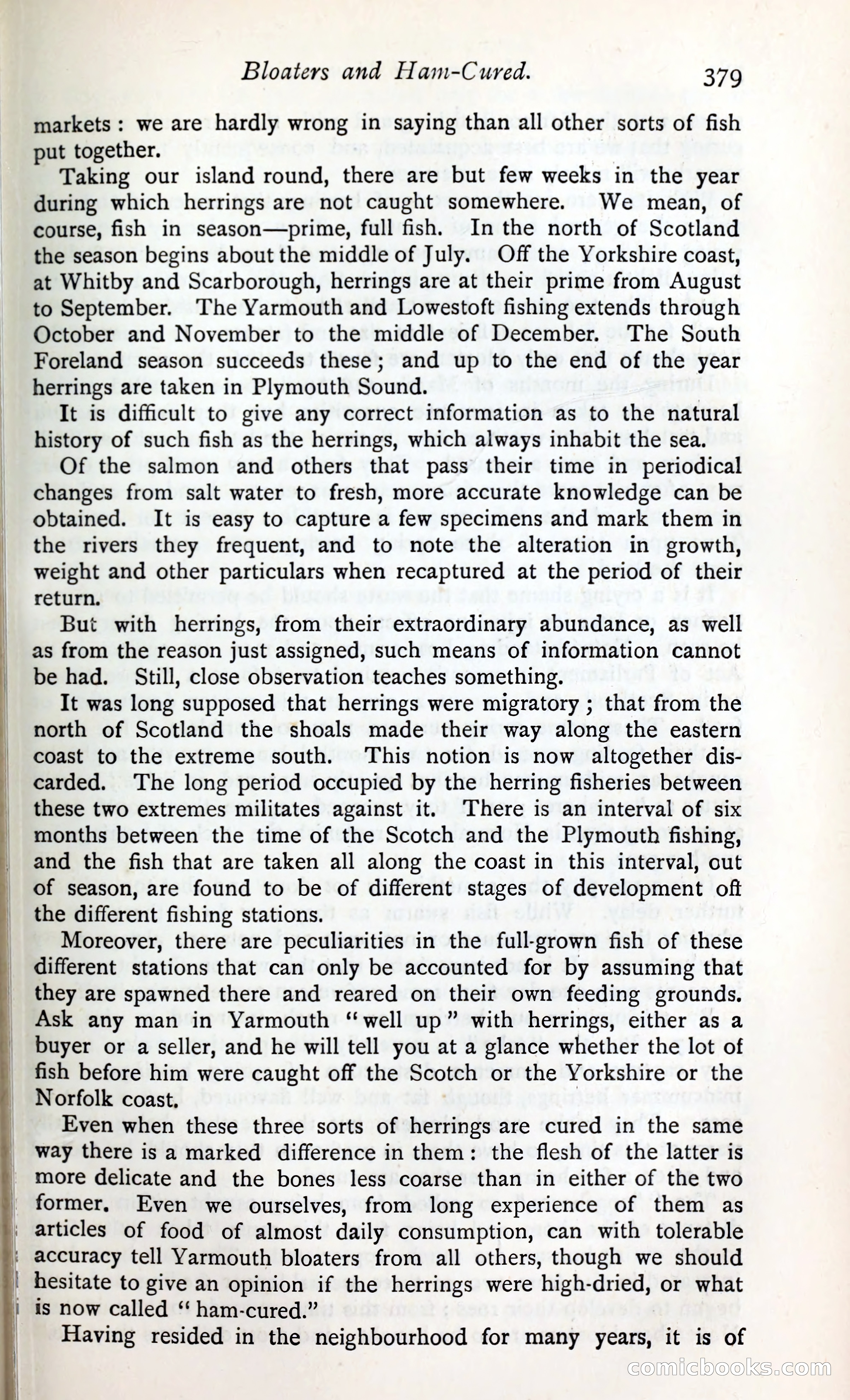
A restored page from Pulp Fiction, 1865. Page through the whole issue in the reader above.
📄 Transcribed text from this page (OCR, searchable)
Machine-transcribed from the original scan — historical spelling and the odd misread are preserved.
Bloaters and Ham-Cured. 379 markets : we are hardly wrong in saying than all other sorts of fish put together. Taking our island round, there are but few weeks in the year during which herrings are not caught somewhere. We mean, of course, fish in season—prime, full fish. Inthe north of Scotland the season begins about the middle of July. Off the Yorkshire coast, at Whitby and Scarborough, herrings are at their prime from August to September. The Yarmouth and Lowestoft fishing extends through October and November to the middle of December. The South Foreland season succeeds these; and up to the end of the year herrings are taken in Plymouth Sound. It is difficult to give any correct information as to the natural history of such fish as the herrings, which always inhabit the sea. Of the salmon and others that pass their time in periodical changes from salt water to fresh, more accurate knowledge can be obtained. It is easy to capture a few specimens and mark them in the rivers they frequent, and to note the alteration in growth, weight and other particulars when recaptured at the period of their return. But with herrings, from their extraordinary abundance, as well as from the reason just assigned, such means of information cannot be had. Still, close observation teaches something. It was long supposed that herrings were migratory ; that from the north of Scotland the shoals made their way along the eastern coast to the extreme south. This notion is now altogether dis- carded. ‘The long period occupied by the herring fisheries between these two extremes militates against it. ‘There is an interval of six months between the time of the Scotch and the Plymouth fishing, and the fish that are taken all along the coast in this interval, out of season, are found to be of different stages of development oft the different fishing stations. Moreover, there are peculiarities in the full-grown fish of these different stations that can only be accounted for by assuming that they are spawned there and reared on their own feeding grounds. Ask any man in Yarmouth “well up” with herrings, either as a buyer or a seller, and he will tell you at a glance whether the lot of fish before him were caught off the Scotch or the Yorkshire or the Norfolk coast, | Even when these three sorts of herrings are cured in the same way there is a marked difference in them: the flesh of the latter is more delicate and the bones less coarse than in either of the two former, Even we ourselves, from long experience of them as articles of food of almost daily consumption, can with tolerable accuracy tell Yarmouth bloaters from all others, though we should hesitate to give an opinion if the herrings were high-dried, or what is now called “ ham-cured.” Having resided in the neighbourhood for many years, it is of CORNICLOO cS (SO) An