
Pulp Fiction, 1865 · page 399 of 399
The Argosy — page 399: what you’re looking at
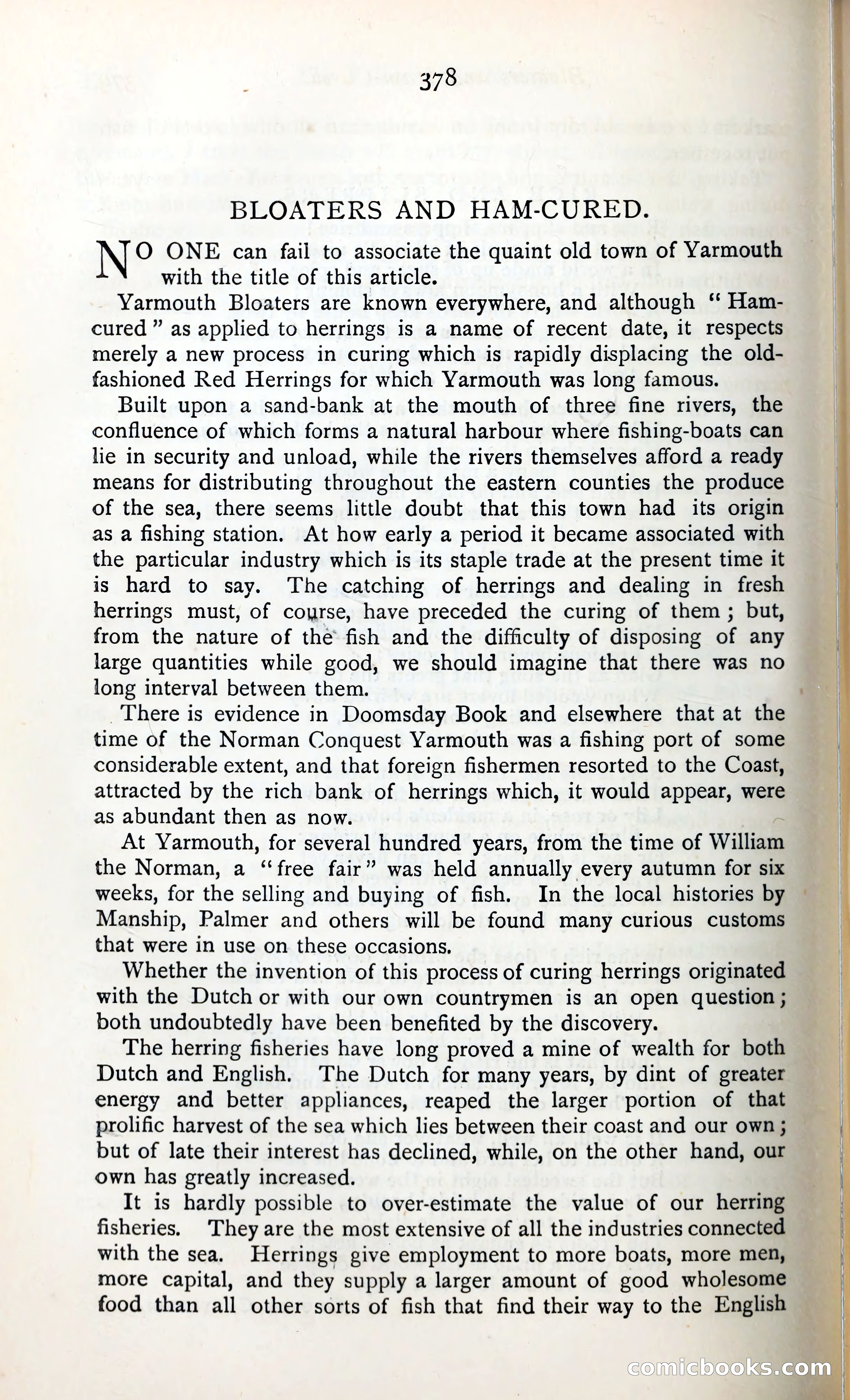
A restored page from Pulp Fiction, 1865. Page through the whole issue in the reader above.
📄 Transcribed text from this page (OCR, searchable)
Machine-transcribed from the original scan — historical spelling and the odd misread are preserved.
378 BLOATERS AND HAM-CURED. N° ONE can fail to associate the quaint old town of Yarmouth with the title of this article. Yarmouth Bloaters are known everywhere, and although ‘“ Ham- cured ” as applied to herrings is a name of recent date, it respects merely a new process in curing which is rapidly displacing the old- fashioned Red Herrings for which Yarmouth was long famous. Built upon a sand-bank at the mouth of three fine rivers, the confluence of which forms a natural harbour where fishing-boats can lie in security and unload, while the rivers themselves afford a ready means for distributing throughout the eastern counties the produce of the sea, there seems little doubt that this town had its origin as a fishing station. At how early a period it became associated with the particular industry which is its staple trade at the present time it is hard to say. The catching of herrings and dealing in fresh herrings must, of course, have preceded the curing of them ; but, from the nature of the fish and the difficulty of disposing of any large quantities while good, we should imagine that there was no long interval between them. There is evidence in Doomsday Book and elsewhere that at the time of the Norman Conquest Yarmouth was a fishing port of some considerable extent, and that foreign fishermen resorted to the Coast, attracted by the rich bank of herrings which, it would appear, were as abundant then as now. At Yarmouth, for several hundred years, from the time of William the Norman, a ‘free fair” was held annually every autumn for six weeks, for the selling and buying of fish. In the local histories by ~ Manship, Palmer and others will be found many curious customs that were in use on these occasions, Whether the invention of this process of curing herrings originated with the Dutch or with our own countrymen is an open question; both undoubtedly have been benefited by the discovery. The herring fisheries have long proved a mine of wealth for both Dutch and English. The Dutch for many years, by dint of greater energy and better appliances, reaped the larger portion of that prolific harvest of the sea which lies between their coast and our own; but of late their interest has declined, while, on the other hand, our own has greatly increased. It is hardly possible to over-estimate the value of our herring fisheries. They are the most extensive of all the industries connected with the sea. MHerrings give employment to more boats, more men, more capital, and they supply a larger amount of good wholesome food than all other sorts of fish that find their way to the English Gomicbooks.com |