
Pulp Fiction, 1865 · page 213 of 399
The Argosy — page 213: what you’re looking at
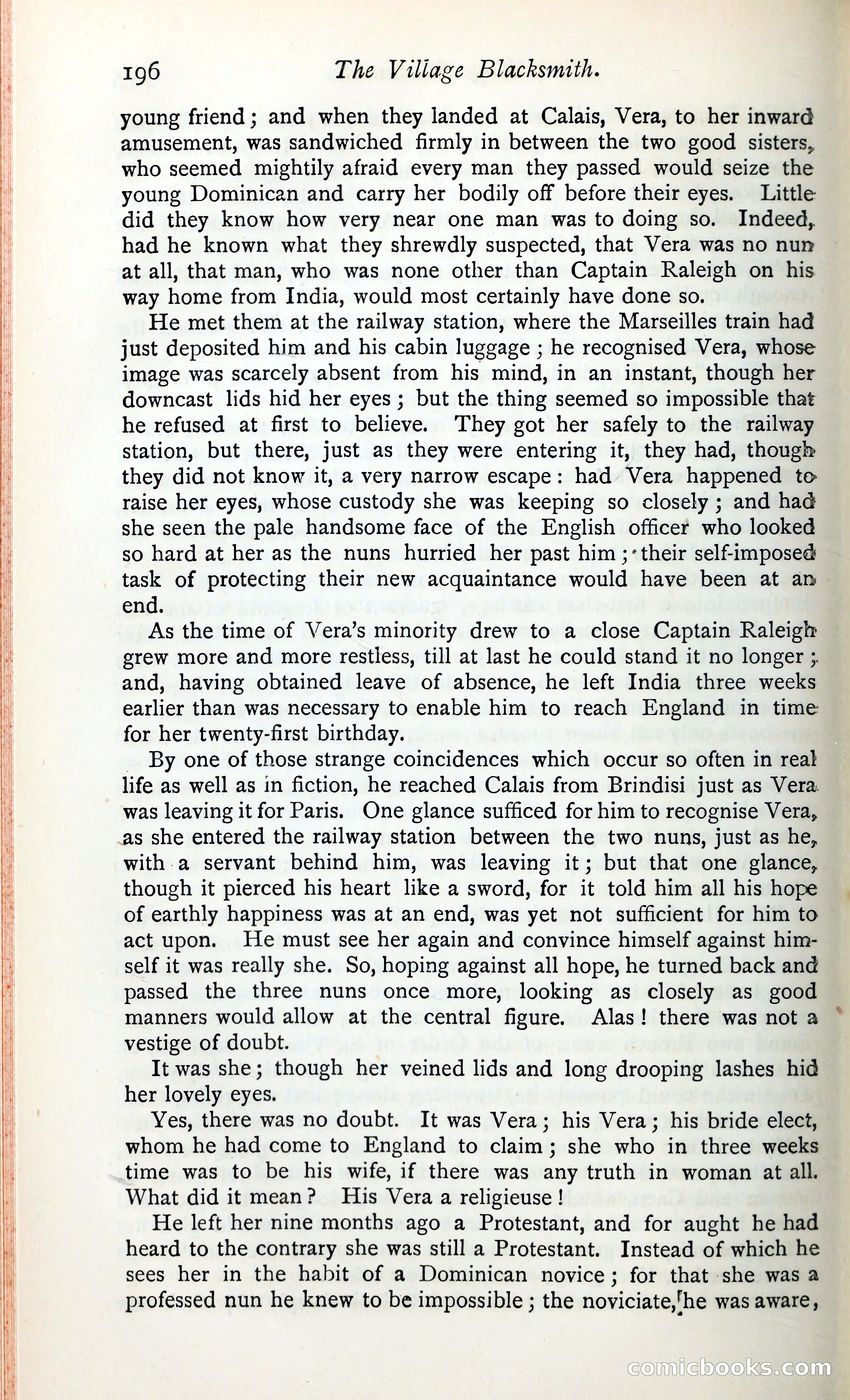
A restored page from Pulp Fiction, 1865. Page through the whole issue in the reader above.
📄 Transcribed text from this page (OCR, searchable)
Machine-transcribed from the original scan — historical spelling and the odd misread are preserved.
196 The Villiage Blacksmith. young friend ; and when they landed at Calais, Vera, to her inward amusement, was sandwiched firmly in between the two good sisters, who seemed mightily afraid every man they passed would seize the young Dominican and carry her bodily off before their eyes. Little did they know how very near one man was to doing so. Indeed, had he known what they shrewdly suspected, that Vera was no nun i at all, that man, who was none other than Captain Raleigh on his iq way home from India, would most certainly have done so. | He met them at the railway station, where the Marseilles train had i just deposited him and his cabin luggage ; he recognised Vera, whose i image was scarcely absent from his mind, in an instant, though her i downcast lids hid her eyes; but the thing seemed so impossible that i he refused at first to believe. They got her safely to the railway | station, but there, just as they were entering it, they had, though \ they did not know it, a very narrow escape: had Vera happened to raise her eyes, whose custody she was keeping so closely ; and had ‘| she seen the pale handsome face of the English officer who looked so hard at her as the nuns hurried her past him ;°their self-imposed | task of protecting their new acquaintance would have been at an il end. | As the time of Vera’s minority drew to a close Captain Raleigh i grew more and more restless, till at last he could stand it no longer ;. | and, having obtained leave of absence, he left India three weeks i earlier than was necessary to enable him to reach England in time : for her twenty-first birthday. | By one of those strange coincidences which occur so often in real life as well as in fiction, he reached Calais from Brindisi just as Vera i was leaving it for Paris. One glance sufficed for him to recognise Vera, | as she entered the railway station between the two nuns, just as he, | with.a servant behind him, was leaving it; but that one glance, ‘ though it pierced his heart like a sword, for it told him all his hope : of earthly happiness was at an end, was yet not sufficient for him to i act upon. He must see her again and convince himself against him- | self it was really she. So, hoping against all hope, he turned back and : passed the three nuns once more, looking as closely as good ! manners would allow at the central figure. Alas! there was not a me = See = —— vestige of doubt. It was she; though her veined lids and long drooping lashes hid ; her lovely eyes. i; Yes, there was no doubt. It was Vera; his Vera; his bride elect, whom he had come to England to claim; she who in three weeks time was to be his wife, if there was any truth in woman at all. What did it mean? His Vera a religieuse! He left her nine months ago a Protestant, and for aught he had heard to the contrary she was still a Protestant. Instead of which he sees her in the habit of a Dominican novice; for that she was a professed nun he knew to be impossible ; the noviciate,'he was aware, Gomicbooks.cGom