
Pulp Fiction, 1865 · page 139 of 399
The Argosy — page 139: what you’re looking at
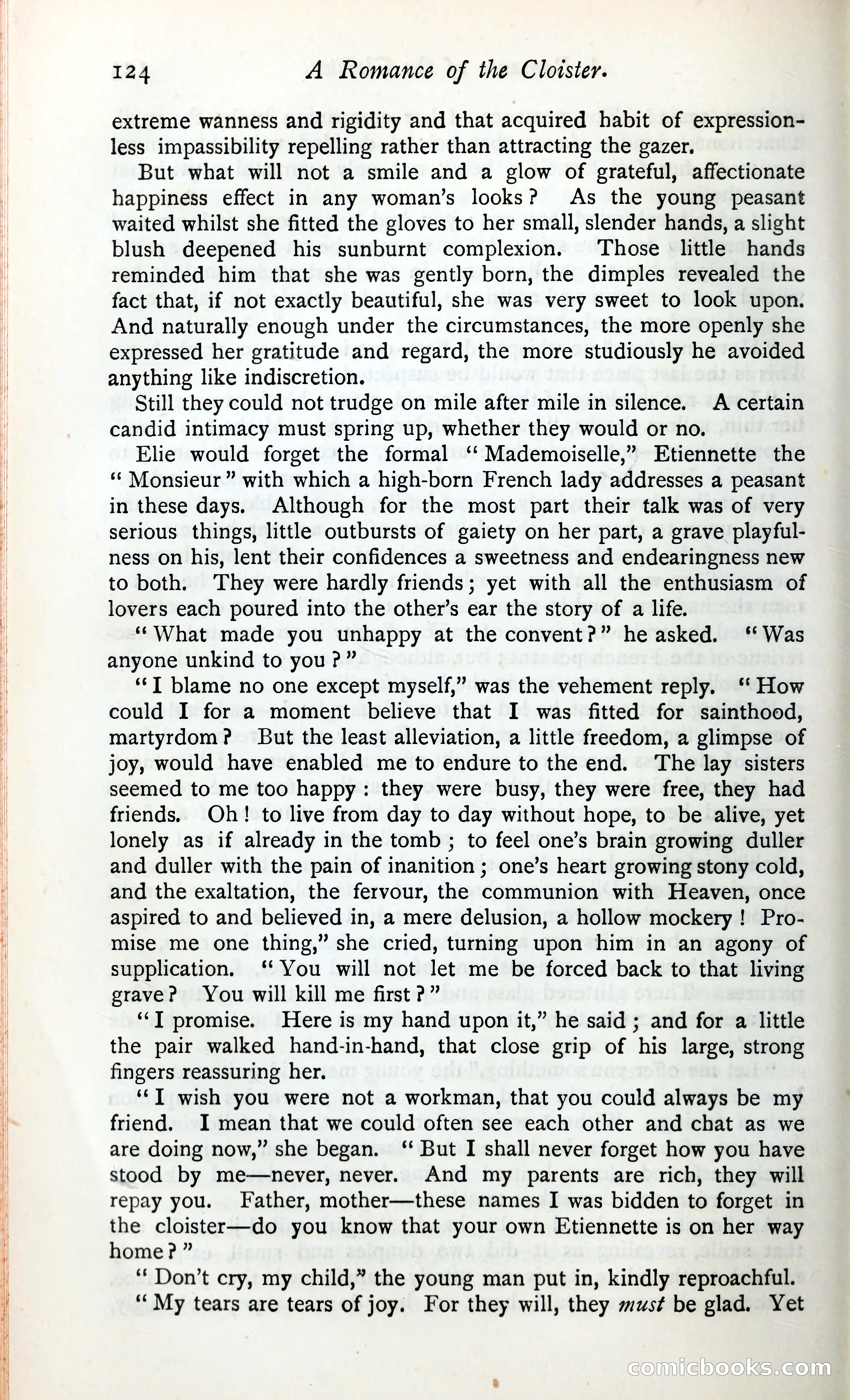
A restored page from Pulp Fiction, 1865. Page through the whole issue in the reader above.
📄 Transcribed text from this page (OCR, searchable)
Machine-transcribed from the original scan — historical spelling and the odd misread are preserved.
124 A Romance of the Cloister. extreme wanness and rigidity and that acquired habit of expression- less impassibility repelling rather than attracting the gazer. But what will not a smile and a glow of grateful, affectionate happiness effect in any woman’s looks? As the young peasant waited whilst she fitted the gloves to her small, slender hands, a slight blush deepened his sunburnt complexion. Those little hands reminded him that she was gently born, the dimples revealed the fact that, if not exactly beautiful, she was very sweet to look upon. And naturally enough under the circumstances, the more openly she expressed her gratitude and regard, the more studiously he avoided anything like indiscretion. Still they could not trudge on mile after mile in silence. A certain candid intimacy must spring up, whether they would or no. Elie would forget the formal ‘‘ Mademoiselle,” Etiennette the ‘“ Monsieur” with which a high-born French lady addresses a peasant in these days. Although for the most part their talk was of very serious things, little outbursts of gaiety on her part, a grave playful- ness on his, lent their confidences a sweetness and endearingness new to both. They were hardly friends; yet with all the enthusiasm of lovers each poured into the other’s ear the story of a life. ‘What made you unhappy at the convent?” he asked. ‘‘ Was anyone unkind to you ?” ‘‘T blame no one except myself,” was the vehement reply. ‘‘ How could I for a moment believe that I was fitted for sainthood, martyrdom? But the least alleviation, a little freedom, a glimpse of joy, would have enabled me to endure to the end. ‘The lay sisters seemed to me too happy: they were busy, they were free, they had friends. Oh! to live from day to day without hope, to be alive, yet lonely as if already in the tomb ; to feel one’s brain growing duller and duller with the pain of inanition ; one’s heart growing stony cold, and the exaltation, the fervour, the communion with Heaven, once aspired to and believed in, a mere delusion, a hollow mockery! Pro- mise me one thing,” she cried, turning upon him in an agony of supplication. ‘You will not let me be forced back to that living grave? You will kill me first ?” ‘‘T promise. Here is my hand upon it,” he said ; and for a little the pair walked hand-in-hand, that close grip of his large, strong fingers reassuring her. ‘‘T wish you were not a workman, that you could always be my friend. I mean that we could often see each other and chat as we are doing now,” she began. ‘‘ But I shall never forget how you have stood by me—never, never. And my parents are rich, they will repay you. Father, mother—these names I was bidden to forget in the cloister—do you know that your own Etiennette is on her way home P ” ‘* Don’t cry, my child,” the young man put in, kindly reproachful. ‘“ My tears are tears of joy. For they will, they mus¢ be glad. Yet CORNIELOOOKS ne)