
Pulp Fiction, 1865 · page 138 of 399
The Argosy — page 138: what you’re looking at
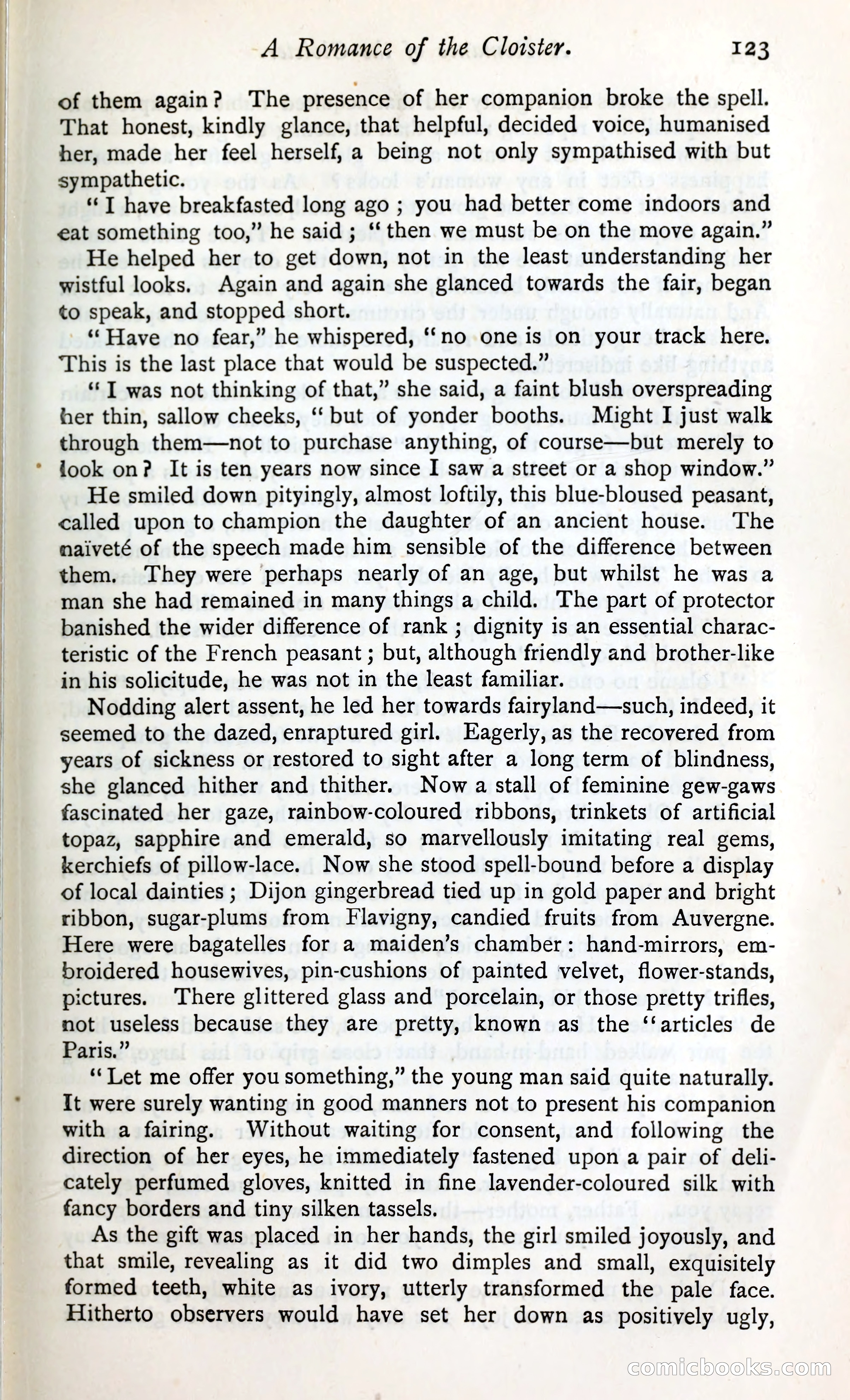
A restored page from Pulp Fiction, 1865. Page through the whole issue in the reader above.
📄 Transcribed text from this page (OCR, searchable)
Machine-transcribed from the original scan — historical spelling and the odd misread are preserved.
A Romance of the Cloister. 123 of them again? The presence of her companion broke the spell. That honest, kindly glance, that helpful, decided voice, humanised her, made her feel herself, a being not only sympathised with but sympathetic. ‘‘T have breakfasted long ago ; you had better come indoors and eat something too,” he said; ‘‘ then we must be on the move again.” He helped her to get down, not in the least understanding her wistful looks. Again and again she glanced towards the fair, began to speak, and stopped short. ‘Have no fear,” he whispered, ‘no one is on your track here. This is the last place that would be suspected.” ‘‘T was not thinking of that,” she said, a faint blush overspreading her thin, sallow cheeks, ‘but of yonder booths. Might I just walk through them—not to purchase anything, of course—but merely to * look on? It is ten years now since I saw a street or a shop window.” He smiled down pityingly, almost loftily, this blue-bloused peasant, called upon to champion the daughter of an ancient house. The maiveté of the speech made him sensible of the difference between them. They were perhaps nearly of an age, but whilst he was a man she had remained in many things a child. The part of protector banished the wider difference of rank ; dignity is an essential charac- teristic of the French peasant ; but, although friendly and brother-like in his solicitude, he was not in the least familiar. Nodding alert assent, he led her towards fairyland—such, indeed, it seemed to the dazed, enraptured girl. Eagerly, as the recovered from years of sickness or restored to sight after a long term of blindness, she glanced hither and thither. Nowa stall of feminine gew-gaws fascinated her gaze, rainbow-coloured ribbons, trinkets of artificial topaz, sapphire and emerald, so marvellously imitating real gems, kerchiefs of pillow-lace. Now she stood spell-bound before a display of local dainties ; Dijon gingerbread tied up in gold paper and bright ribbon, sugar-plums from Flavigny, candied fruits from Auvergne. Here were bagatelles for a maiden’s chamber: hand-mirrors, em- broidered housewives, pin-cushions of painted velvet, flower-stands, pictures. ‘There glittered glass and porcelain, or those pretty trifles, mot useless because they are pretty, known as the ‘‘articles de Paris.” “Let me offer you something,” the young man said quite naturally. It were surely wanting in good manners not to present his companion with a fairing. Without waiting for consent, and following the direction of her eyes, he immediately fastened upon a pair of deli- cately perfumed gloves, knitted in fine lavender-coloured silk with fancy borders and tiny silken tassels. As the gift was placed in her hands, the girl smiled joyously, and that smile, revealing as it did two dimples and small, exquisitely formed teeth, white as ivory, utterly transformed the pale face. Hitherto observers would have set her down as positively ugly, COnnicloooks (SO