
Pulp Fiction, 1865 · page 248 of 400
The Argosy — page 248: what you’re looking at
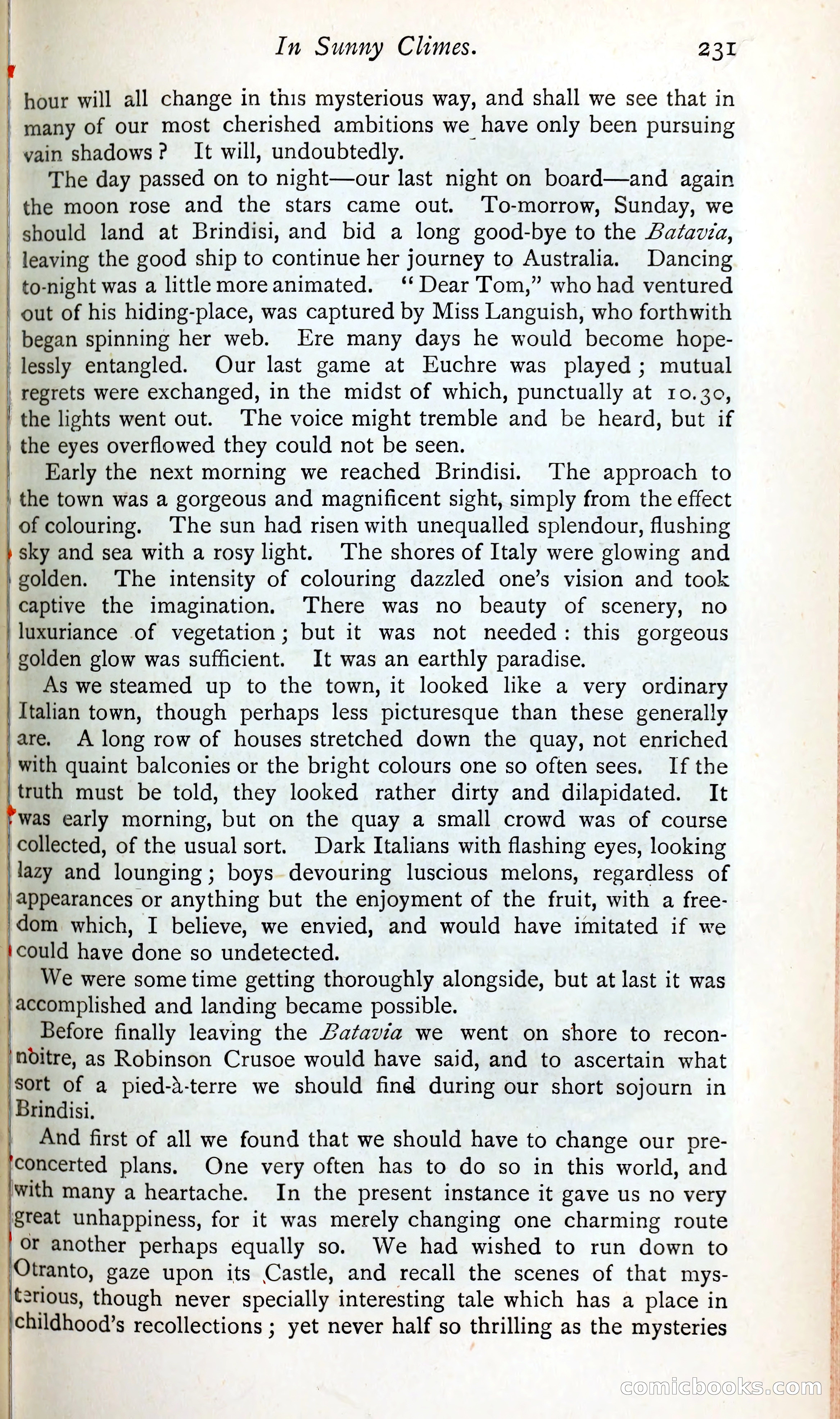
A restored page from Pulp Fiction, 1865. Page through the whole issue in the reader above.
📄 Transcribed text from this page (OCR, searchable)
Machine-transcribed from the original scan — historical spelling and the odd misread are preserved.
| In Sunny Climes. 231 hour will all change in this mysterious way, and shall we see that in many of our most cherished ambitions we have only been pursuing vain shadows? It will, undoubtedly. The day passed on to night—our last night on board—and again the moon rose and the stars came out. ‘To-morrow, Sunday, we should land at Brindisi, and bid a long good-bye to the Batavia, leaving the good ship to continue her journey to Australia. Dancing to-night was a little moreanimated. ‘‘ Dear Tom,” who had ventured out of his hiding-place, was captured by Miss Languish, who forthwith | began spinning her web. Ere many days he would become hope- 'lessly entangled. Our last game at Euchre was played; mutual | regrets were exchanged, in the midst of which, punctually at 10.30, | the lights went out. The voice might tremble and be heard, but if , the eyes overflowed they could not be seen. | Early the next morning we reached Brindisi. ‘The approach to | the town was a gorgeous and magnificent sight, simply from the effect | of colouring. The sun had risen with unequalled splendour, flushing sky and sea with a rosy light. The shores of Italy were glowing and \ golden. The intensity of colouring dazzled one’s vision and took | captive the imagination, There was no beauty of scenery, no | luxuriance of vegetation; but it was not needed: this gorgeous golden glow was sufficient. It was an earthly paradise. | As we steamed up to the town, it looked like a very ordinary Italian town, though perhaps less picturesque than these generally are. <A long row of houses stretched down the quay, not enriched ) with quaint balconies or the bright colours one so often sees. If the : truth must be told, they looked rather dirty and dilapidated. It Was early morning, but on the quay a small crowd was of course | collected, of the usual sort. Dark Italians with flashing eyes, looking jlazy and lounging; boys devouring luscious melons, regardless of | appearances or anything but the enjoyment of the fruit, with a free- | dom which, I believe, we envied, and would have imitated if we }could have done so undetected. | We were some time getting thoroughly alongside, but at last it was jaccomplished and landing became possible. | Before finally leaving the Latavia we went on shore to recon- | noitre, as Robinson Crusoe would have said, and to ascertain what sort of a pied-a-terre we should find during our short sojourn in | Brindisi. | | And first of all we found that we should have to change our pre- concerted plans. One very often has to do so in this world, and with many a heartache. In the present instance it gave us no very great unhappiness, for it was merely changing one charming route | Or another perhaps equally so. We had wished to run down to Otranto, gaze upon its Castle, and recall the scenes of that mys- (Srious, though never specially interesting tale which has a place in jchildhood’s recollections ; yet never half so thrilling as the mysteries ———_ -- = > - ~ “2S COMIC OOO SS me = , a ne