
Pulp Fiction, 1865 · page 247 of 400
The Argosy — page 247: what you’re looking at
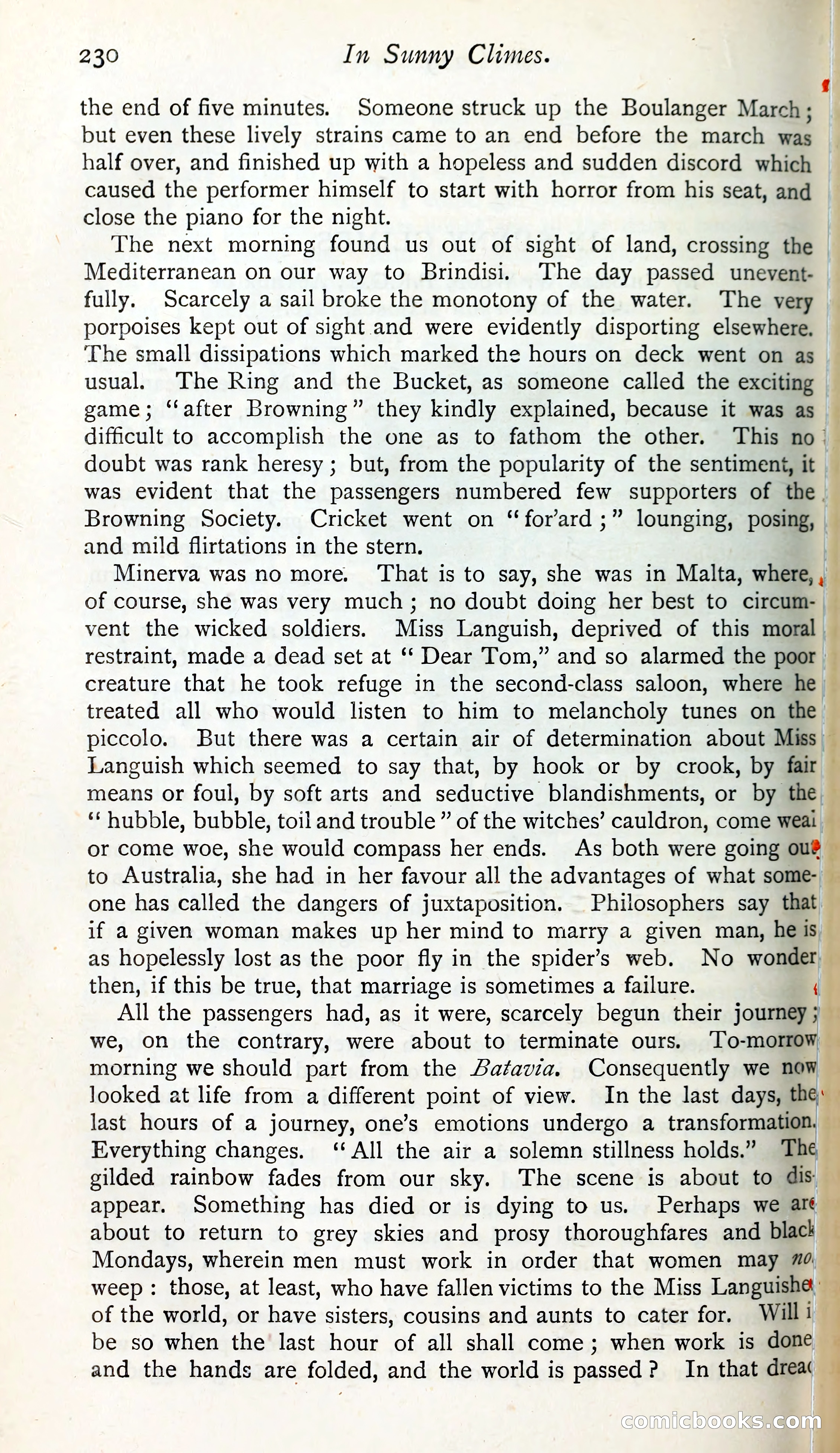
A restored page from Pulp Fiction, 1865. Page through the whole issue in the reader above.
📄 Transcribed text from this page (OCR, searchable)
Machine-transcribed from the original scan — historical spelling and the odd misread are preserved.
230 In Sunny Climes. q the end of five minutes. Someone struck up the Boulanger March; but even these lively strains came to an end before the march was half over, and finished up with a hopeless and sudden discord which caused the performer himself to start with horror from his seat, and close the piano for the night. The next morning found us out of sight of land, crossing the Mediterranean on our way to Brindisi. The day passed uneyvent- fully. Scarcely a sail broke the monotony of the water. The very porpoises kept out of sight and were evidently disporting elsewhere, The small dissipations which marked the hours on deck went on as usual. The Ring and the Bucket, as someone called the exciting game; ‘after Browning” they kindly explained, because it was as difficult to accomplish the one as to fathom the other. This no’ doubt was rank heresy ; but, from the popularity of the sentiment, it — was evident that the passengers numbered few supporters of the. Browning Society. Cricket went on “for’ard ;” lounging, posing, | and mild flirtations in the stern. | Minerva was no more. ‘That is to say, she was in Malta, where, , of course, she was very much; no doubt doing her best to circum- — vent the wicked soldiers. Miss Languish, deprived of this moral | restraint, made a dead set at ‘‘ Dear Tom,” and so alarmed the poor — creature that he took refuge in the second-class saloon, where he treated all who would listen to him to melancholy tunes on the piccolo. But there was a certain air of determination about Miss’ Languish which seemed to say that, by hook or by crook, by fair — means or foul, by soft arts and seductive blandishments, or by the — ‘‘ hubble, bubble, toil and trouble” of the witches’ cauldron, come weal — or come woe, she would compass her ends. As both were going ou® — to Australia, she had in her favour all the advantages of what some- one has called the dangers of juxtaposition. Philosophers say that if a given woman makes up her mind to marry a given man, heis as hopelessly lost as the poor fly in the spider’s web. No wonder, then, if this be true, that marriage is sometimes a failure. qo All the passengers had, as it were, scarcely begun their journey; we, on the contrary, were about to terminate ours. To-morrow morning we should part from the Batavia. Consequently we now looked at life from a different point of view. In the last days, the: last hours of a journey, one’s emotions undergo a transformation. — Everything changes. ‘All the air a solemn stillness holds.” The gilded rainbow fades from our sky. The scene is about to dis appear. Something has died or is dying to us. Perhaps we ar¢ about to return to grey skies and prosy thoroughfares and black Mondays, wherein men must work in order that women may 70 weep: those, at least, who have fallen victims to the Miss Languish@: of the world, or have sisters, cousins and aunts to cater for. Willi — be so when the last hour of all shall come; when work is done — and the hands are folded, and the world is passed? In that dreac COMICHOOOKS efor i ‘7