
Pulp Fiction, 1865 · page 176 of 400
The Argosy — page 176: what you’re looking at
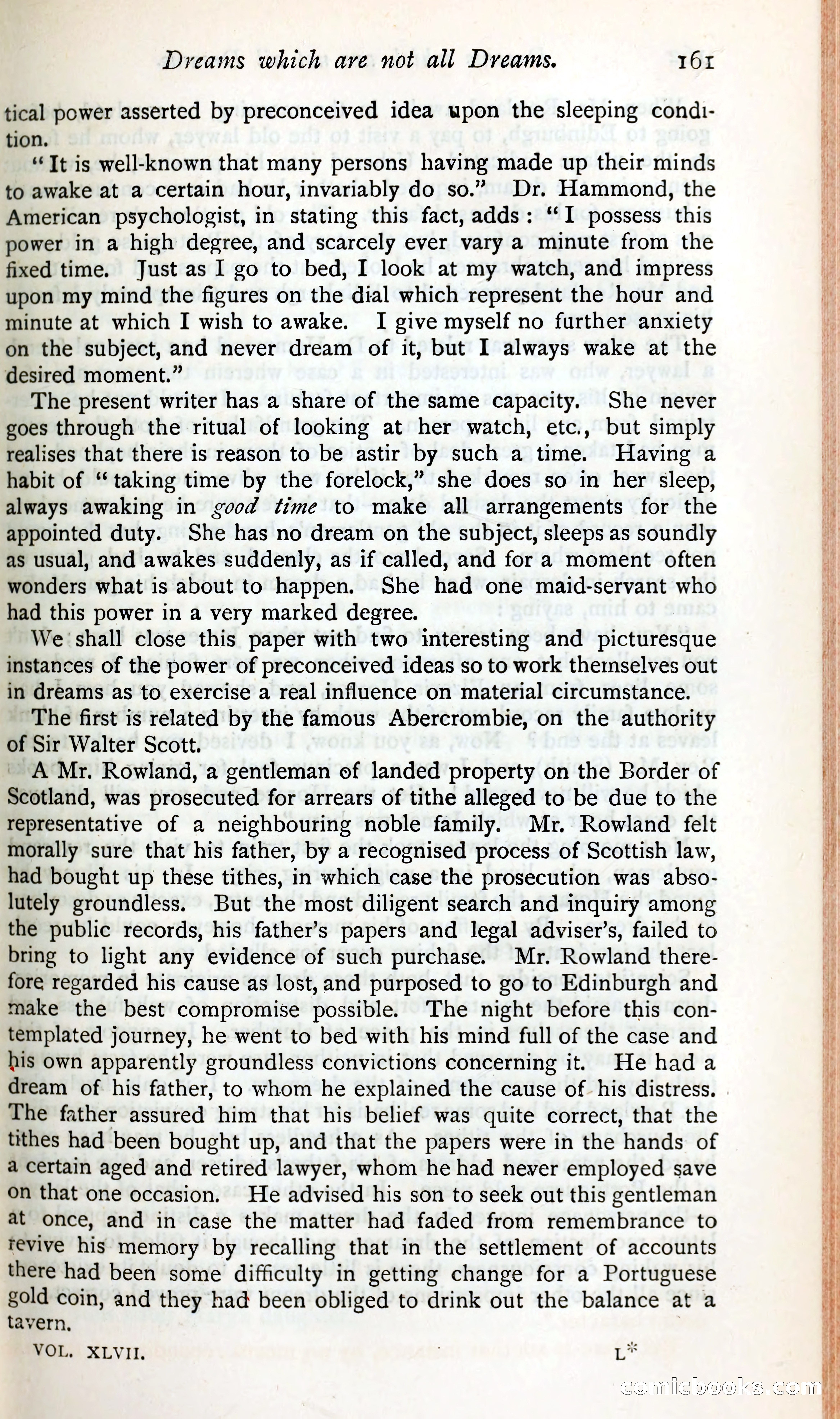
A restored page from Pulp Fiction, 1865. Page through the whole issue in the reader above.
📄 Transcribed text from this page (OCR, searchable)
Machine-transcribed from the original scan — historical spelling and the odd misread are preserved.
Dreams which are not all Dreams. I6r tical power asserted by preconceived idea upon the sleeping condi- tion. “Tt is well-known that many persons having made up their minds to awake at a certain hour, invariably do so.” Dr. Hammond, the American psychologist, in stating this fact, adds: “1 possess this power in a high degree, and scarcely ever vary a minute from the fixed time. Just as I go to bed, I look at my watch, and impress upon my mind the figures on the dial which represent the hour and minute at which I wish to awake. I give myself no further anxiety on the subject, and never dream of it, but I always wake at the desired moment.” The present writer has a share of the same capacity. She never goes through the ritual of looking at her watch, etc., but simply realises that there is reason to be astir by such a time. Having a habit of ‘‘ taking time by the forelock,” she does so in her sleep, always awaking in good time to make all arrangements for the appointed duty. She has no dream on the subject, sleeps as soundly as usual, and awakes suddenly, as if called, and fora moment often wonders what is about to happen. She had one maid-servant who had this power in a very marked degree. We shall close this paper with two interesting and picturesque instances of the power of preconceived ideas so to work thernselves out in dreams as to exercise a real influence on material circumstance. The first is related by the famous Abercrombie, on the authority of Sir Walter Scott. A Mr. Rowland, a gentleman of landed property on the Border of Scotland, was prosecuted for arrears of tithe alleged to be due to the representative of a neighbouring noble family. Mr. Rowland felt morally sure that his father, by a recognised process of Scottish law, had bought up these tithes, in which case the prosecution was abso- lutely groundless. But the most diligent search and inquiry among the public records, his father’s papers and legal adviser’s, failed to bring to light any evidence of such purchase. Mr. Rowland there- fore regarded his cause as lost, and purposed to go to Edinburgh and make the best compromise possible. The night before this con- templated journey, he went to bed with his mind full of the case and his own apparently groundless convictions concerning it. He hada dream of his father, to whom he explained the cause of his distress. . The father assured him that his belief was quite correct, that the tithes had been bought up, and that the papers were in the hands of a certain aged and retired lawyer, whom he had never employed save on that one occasion. He advised his son to seek out this gentleman at once, and in case the matter had faded from remembrance to revive his memory by recalling that in the settlement of accounts there had been some difficulty in getting change for a Portuguese gold coin, and they had been obliged to drink out the balance at a tavern, | VOL, XLVI. : C COMIC OOO ‘S (CO)