
Pulp Fiction, 1865 · page 175 of 400
The Argosy — page 175: what you’re looking at
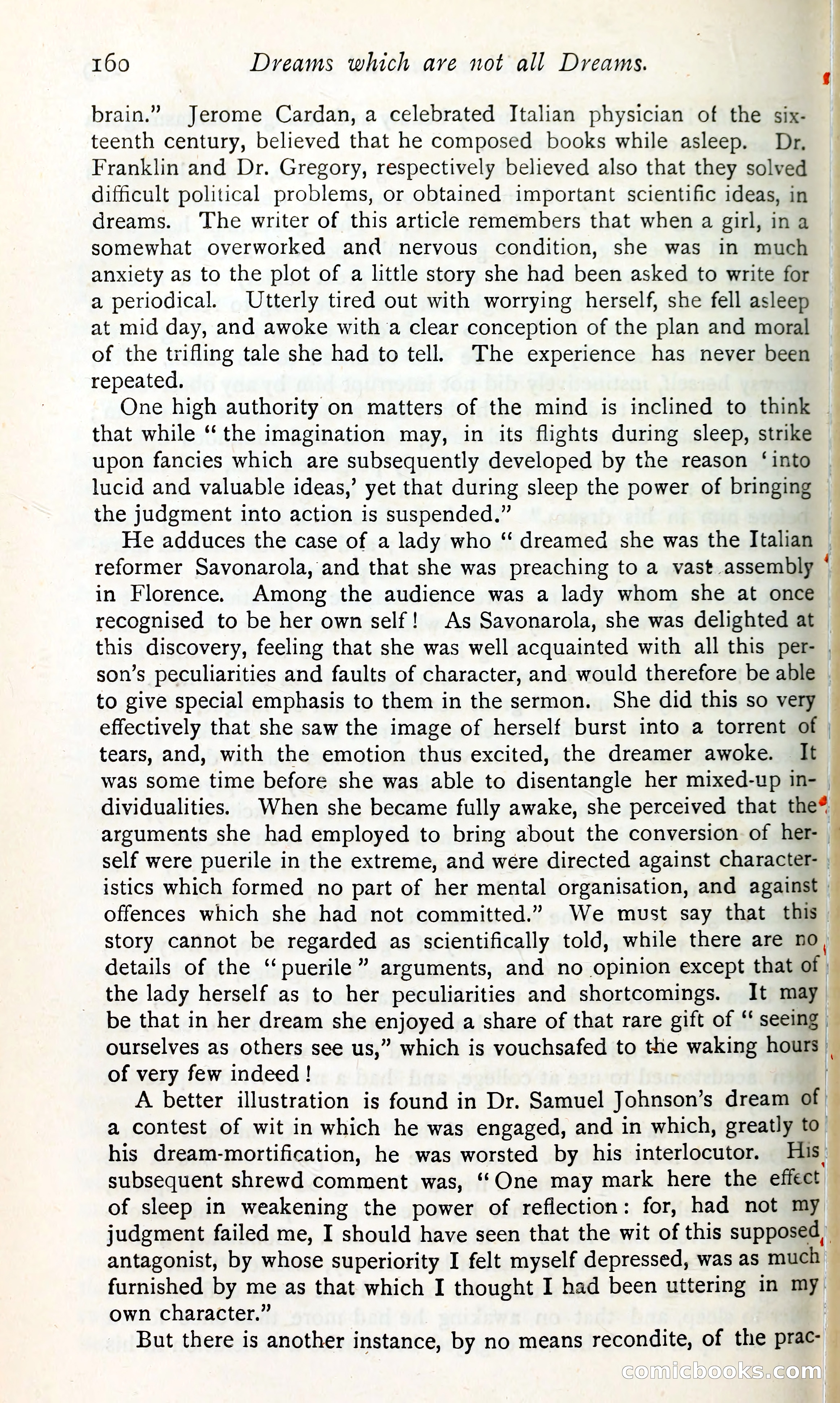
A restored page from Pulp Fiction, 1865. Page through the whole issue in the reader above.
📄 Transcribed text from this page (OCR, searchable)
Machine-transcribed from the original scan — historical spelling and the odd misread are preserved.
160 Dreams which are not all Dreams. brain.” Jerome Cardan, a celebrated Italian physician of the six- teenth century, believed that he composed books while asleep. Dr, Franklin and Dr. Gregory, respectively believed also that they solved difficult political problems, or obtained important scientific ideas, in dreams. ‘The writer of this article remembers that when a girl, ina somewhat overworked and nervous condition, she was in much anxiety as to the plot of a little story she had been asked to write for — a periodical. Utterly tired out with worrying herself, she fell asleep at mid day, and awoke with a clear conception of the plan and moral _ of the trifling tale she had to tell) The experience has never been ~ repeated. | One high authority on matters of the mind is inclined to think © that while “‘ the imagination may, in its flights during sleep, strike © upon fancies which are subsequently developed by the reason ‘into — lucid and valuable ideas,’ yet that during sleep the power of bringing © the judgment into action is suspended.” He adduces the case of a lady who “ dreamed she was the Italian _ reformer Savonarola, and that she was preaching to a vast assembly ° in Florence. Among the audience was a lady whom she at once recognised to be her own self! As Savonarola, she was delighted at — this discovery, feeling that she was well acquainted with all this per- _ son’s peculiarities and faults of character, and would therefore be able | to give special emphasis to them in the sermon. She did this so very effectively that she saw the image of herself burst into a torrent of © tears, and, with the emotion thus excited, the dreamer awoke. It was some time before she was able to disentangle her mixed-up in- | dividualities. When she became fully awake, she perceived that the® arguments she had employed to bring about the conversion of her- _ self were puerile in the extreme, and were directed against character- - istics which formed no part of her mental organisation, and against» offences which she had not committed.” We must say that this story cannot be regarded as scientifically told, while there are no — details of the ‘“puerile” arguments, and no opinion except that of the lady herself as to her peculiarities and shortcomings. It may | be that in her dream she enjoyed a share of that rare gift of ‘ seeing” ourselves as others see us,” which is vouchsafed to the waking hours | of very few indeed! L A better illustration is found in Dr. Samuel Johnson’ s dream of | a contest of wit in which he was engaged, and in which, great to his dream-mortification, he was worsted by his interlocutor. His. subsequent shrewd comment was, ‘‘One may mark here the effect of sleep in weakening the power of reflection: for, had not my judgment failed me, I should have seen that the wit of this supposed, antagonist, by whose superiority I felt myself depressed, was as much | furnished by me as that which I thought I had been uttering in my own character.” But there is another instance, by no means recondite, of the prac- — GOmMmiGcdookstecom| 4 4