
Pulp Fiction, 1865 · page 80 of 400
The Argosy — page 80: what you’re looking at
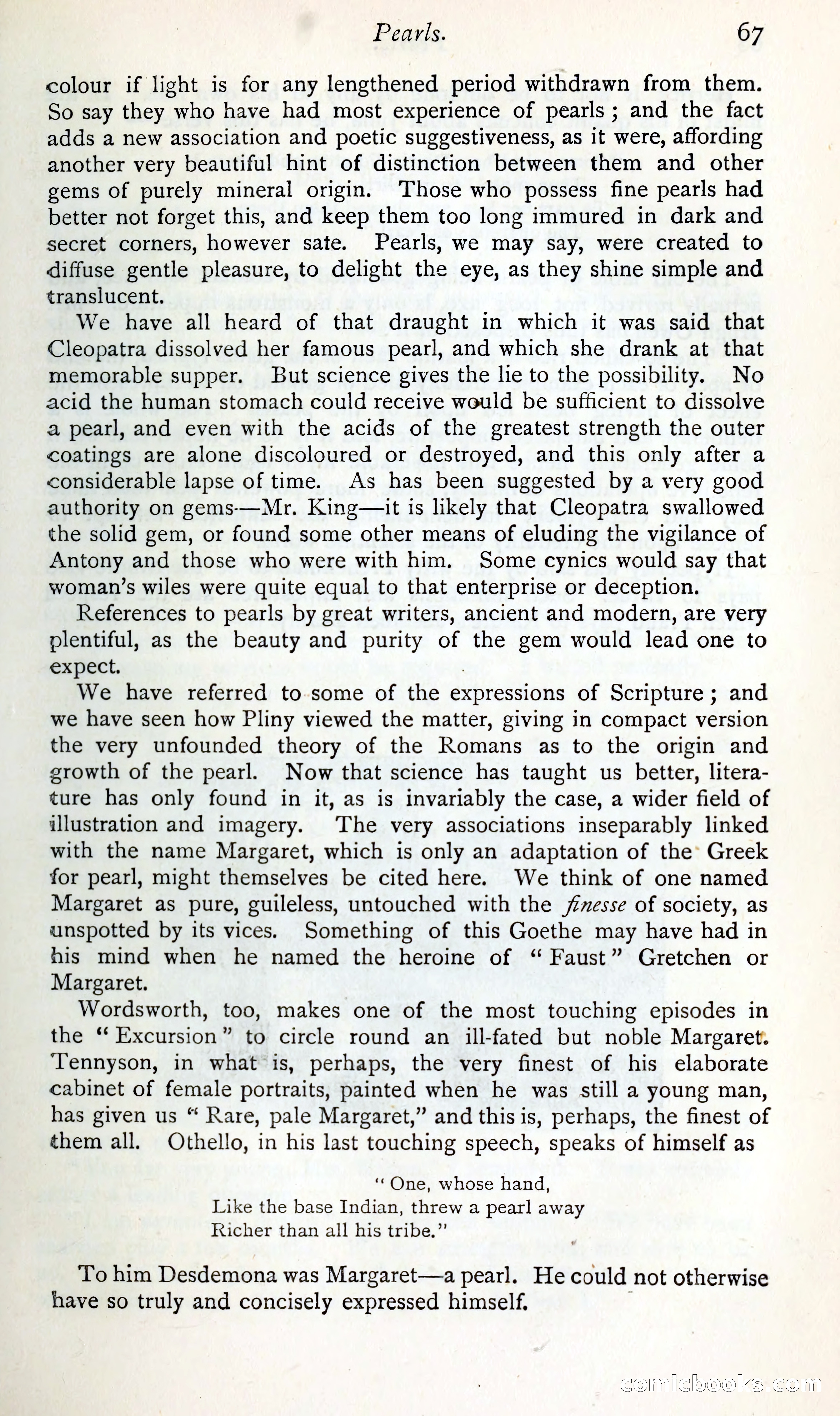
A restored page from Pulp Fiction, 1865. Page through the whole issue in the reader above.
📄 Transcribed text from this page (OCR, searchable)
Machine-transcribed from the original scan — historical spelling and the odd misread are preserved.
Pearls. 67 colour if light is for any lengthened period withdrawn from them. So say they who have had most experience of pearls; and the fact adds a new association and poetic suggestiveness, as it were, affording another very beautiful hint of distinction between them and other gems of purely mineral origin. ‘Those who possess fine pearls had better not forget this, and keep them too long immured in dark and secret corners, however sate. Pearls, we may say, were created to diffuse gentle pleasure, to delight the eye, as they shine simple and translucent. We have all heard of that draught in which it was said that Cleopatra dissolved her famous pearl, and which she drank at that memorable supper. But science gives the lie to the possibility. No acid the human stomach could receive would be sufficient to dissolve a pearl, and even with the acids of the greatest strength the outer coatings are alone discoloured or destroyed, and this only after a considerable lapse of time. As has been suggested by a very good authority on gems-—Mr. King—it is likely that Cleopatra swallowed the solid gem, or found some other means of eluding the vigilance of Antony and those who were with him. Some cynics would say that woman’s wiles were quite equal to that enterprise or deception. References to pearls by great writers, ancient and modern, are very plentiful, as the beauty and purity of the gem would lead one to expect. We have referred to some of the expressions of Scripture ; and we have seen how Pliny viewed the matter, giving in compact version the very unfounded theory of the Romans as to the origin and growth of the pearl. Now that science has taught us better, litera- ture has only found in it, as is invariably the case, a wider field of illustration and imagery. The very associations inseparably linked with the name Margaret, which is only an adaptation of the Greek for pearl, might themselves be cited here. We think of one named Margaret as pure, guileless, untouched with the finesse of society, as unspotted by its vices. Something of this Goethe may have had in his mind when he named the heroine of “ Faust” Gretchen or Margaret. Wordsworth, too, makes one of the most touching episodes in the “Excursion” to circle round an ill-fated but noble Margaret. ‘Tennyson, in what is, perhaps, the very finest of his elaborate cabinet of female portraits, painted when he was still a young man, has given us “ Rare, pale Margaret,” and this is, perhaps, the finest of them all. Othello, in his last touching speech, speaks of himself as ‘“One, whose hand, Like the base Indian, threw a pearl away Richer than all his tribe.”’ To him Desdemona was Margaret—a pearl. He could not otherwise have so truly and concisely expressed himself. cConniclooolkks (C(O)